
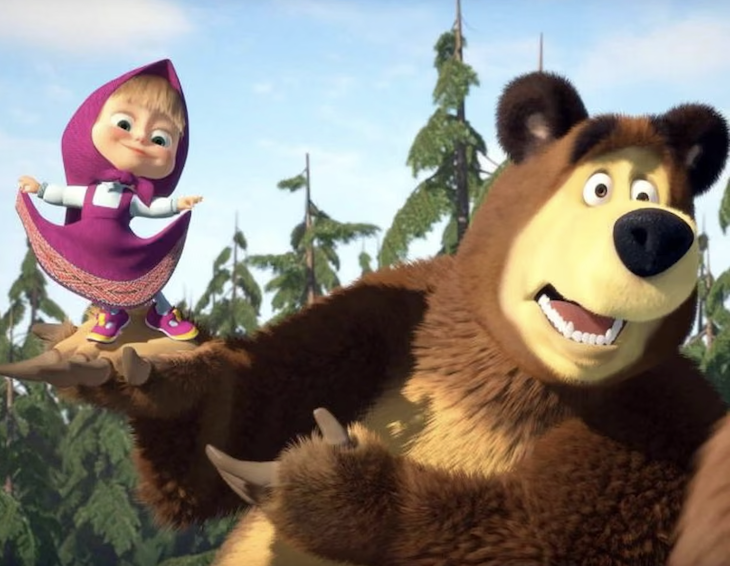
Thank heavens that everything in the UK is going so well, that more than 50 MPs have so little to do that they can spend their time lobbying against a children’s cartoon about an unruly four-year-old and a put-upon bear because it is allegedly supporting Vladimir Putin’s war effort in Ukraine.
Masha and the Bear, one of the most popular children’s cartoon series around, recounts the misadventures of the mischievous Masha, and former circus bear Misha. Most of the seven-minute episodes revolve around her playing pranks or trying to do a good deed, only for it to go uproariously wrong.
Are we really to believe that a cartoon character’s wardrobe choices will brainwash a generation of British toddlers?
It may not be the most elevated of television, and the tantrum-throwing Masha is hardly a good role model, but it is cute and it has a big heart. As it originates in Russia, though – even though the production company is no longer based there – it finds itself in the front lines of the new culture wars.
Often there are props and outfits to match, and in one of the more than 170 episodes she wears what looks like a Soviet army uniform, and in another a border guard’s cap. The horror. That was enough for the Ukrainian government’s Centre for Countering Disinformation to describe the cartoon as “an instrument of Russian soft power.”
The Centre has been controversial in the past for accusing any critics of Kyiv’s policies of reinforcing or amplifying Russian propaganda, as if there were no such thing as honest disagreement. But that hasn’t stopped a cross-party array of MPs signing a letter to the Culture Secretary, Lisa Nandy, asking her to intervene. Their demand is that she investigates how to prevent this cartoon from being shown in the UK.
It was one thing to ban the Russian government’s RT TV channel, although one might wonder quite why we are so insecure about the rightness of our position that we would rather ban than debate alternative voices. Yet to start to censor children’s TV shows on this basis seems to be taking this to bizarre extremes.
Yes, the production company does still pay taxes on certain intellectual property rights and the like in Russia, but Lib Dem MP Tom Gordon, who oversaw the letter, claims it “has openly militarised children.”
Are we really to believe that a rambunctious cartoon character’s wardrobe choices will brainwash a generation of British toddlers into become Putin’s preschool fifth column? Or is the problem simply that it humanises Russians?
A particular depressing irony is that Masha and the Bear also faced criticism from equally po-faced would-be inquisitors in Russia. The series (which is loosely based on a Russian folk tale) was criticised on the grounds that portraying Masha as living alone with three animal friends but no evident parents was undermining traditional family values. Even more ludicrously, even more criticism was levelled at Masha’s teasing and tormenting of Misha the bear – both a father figure and symbolic of Russia.
We have come to expect this kind of near-cartoonish priggishness from the kind of Russians who, seeing a chance to make their names and fortunes by leaping onto the traditional values bandwagon, attack everything from western pop videos to My Little Pony for “promoting paedophilia, bestiality, and sexual deviance.” After all, even the nationalist philosopher Alexander Dugin has assailed another icon of Russian childhood, the big-eared, orange-loving, bear-like Cheburashka as a “lunar demon,” a “rootless cosmopolitan”, and quite possibly a cause of the collapse of the Soviet Union.
Some might have suspected that ideological and financial bankruptcy might have been rather more significant, but who am I to contradict the self-aggrandising figure some clueless western journalists still wrongly called “Putin’s brain”?
So far, so silly. Yet just as the new iron curtain dividing Russia from the west has been erected not like last time by Moscow, to keep its people in, but by us, to keep them out, so too we are witnessing the emergence of our own fun-hating commissars.
And so long as it is Russia-bashing, then no matter how asinine the cause, it seems to have its adherents. Radio 4 asked me to come speak on air about Masha and the Bear story. When I made it clear how ridiculous I thought it was, they plaintively asked if I could offer a few bullet points in support of the MPs’ concerns. Otherwise, they warned, they might not cover the story. I didn’t, and they didn’t.
Putin and his henchmen are waging a scorched earth war in Ukraine, oppressing their own people, and burning Russia’s future in the process. That needs to be recognised, and punished. But we do not need to demonise every Russian, everything about Russia, everything from Russia, in the process. That kind of xenophobia is, surely, one of the things we are meant to be fighting.


Comments