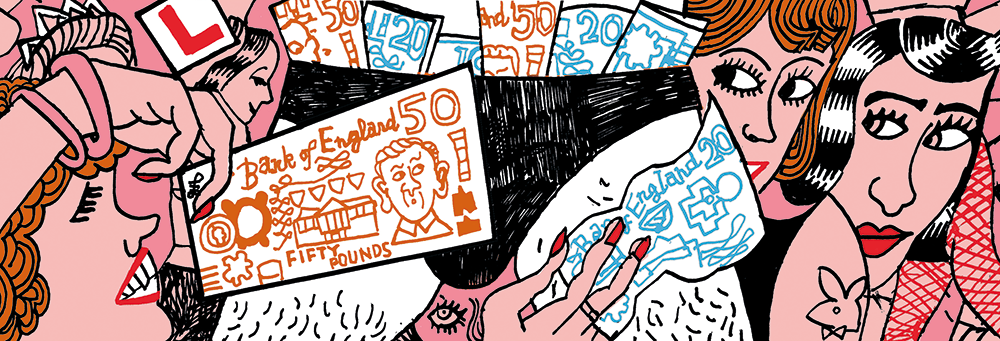


‘Hello girls!’ A few weeks ago, a WhatsApp chat named ‘Millie’s hen’ whirred into life on my phone. ‘We’re so excited to reveal the details of what will hopefully be an amazing long weekend!’ Three nights in the south of France next June, 15 women and a £500 ‘contribution’ for some, but by no means all, food, drink and activities. On flights, airport transfers, the rest of the food, drink and activities, we were expected to fend for ourselves.
All in, Millie’s hen do would cost me close to £1,000. I scrolled down to the bottom of the eight-page PDF document that had been distributed by the organisers: ‘Once everything is booked, there might be a tiny variation in price. Thanks for understanding!’ I felt my blood pressure rise.
For any woman getting married, a hen do is a rite of passage. It is often the only time in the run-up to her wedding that the bride relinquishes full planning control: a time for her to let loose, enjoy being celebrated by her closest friends and say a ritualistic goodbye to her single days. Typically, most of the details are kept secret from her until the do gets under way.
For the maids of honour organising it, however, a hen do is an exercise in delicate financial diplomacy: setting a budget that will satisfy a group of relative strangers, organising a series of activities that will both delight the bride and leave the hen party feeling like they’ve got their money’s worth and – most importantly – making sure that everyone attending has coughed up the correct sum on time.
I’m certain that I’m far from alone in gawping at the cost of a hen do these days. According to the insurer Aviva, a hen do in the UK costs its attendees an average of £779 per person, with this shooting up to £1,208 for those held abroad. This is mostly down to a few key factors. The first is what most people consider to be the golden rule of hen parties: the bride doesn’t pay a penny, with her invitees – ‘the hens’ – covering all her expenses. Maids of honour forget this rule at their peril: one friend, organising a hen do for the first time, asked the bride to contribute, earning herself an angry text message tirade from the groom and a sense of resentment towards her friend from which their relationship, several years on, has never quite recovered.
The second factor is that often a hen do is no longer a single night out but a multi-day out-of-town affair. Travel (usually train or plane) and accommodation alone typically set the starting point for costs at over £150.
Then the hen do organisers must, of course, compile a whole programme of events to fill the oodles of time now allotted to celebrating the bride. An hour of life drawing (more classy than hiring a stripper but still a little risqué)? That will be £40 per person, thank you. A private chef to cook everyone dinner at the hen house? That’s another £70. Compulsory fancy dress? It’s £20 per head, courtesy of Amazon.
According to the insurer Aviva, a hen do in the UK costs its attendees an average of £779 per person
Then come the party game props, decorations and other paraphernalia. Incidentally, for anyone missing the ability to use plastic straws since they were banned in Britain six years ago by the editor of this magazine, I’ve discovered a curious loophole: plastic novelty penis-shaped straws. They’re still available to purchase online, perhaps because they’re marketed as being ‘reusable’ despite being nothing of the sort. If you can get past the off-putting shape, a pack of 20 at £7.99 should last a few weeks. Enough booze to keep the hen party merry and enough snacks to keep them satiated can easily mean that the minimum cost per head is still in the region of £300 for a staycation hen party.
That said, organising a hen do is not for the faint of heart. No one jumps for joy at the prospect of playing tax collector to chase down late payments. Luckily, a few online tools exist that make life easier: free-to-use apps such as Ami and Collctiv, for example, help you collect money with minimal fuss. Collctiv, in particular, seems well designed for planning, allowing the organiser to send out payment links and QR codes through which the hens can pay quickly using their bank account. Crucially, the total sum of money gathered through Collctiv is visible only to the organiser, keeping the figure away from opinionated hen party eyes.
There are some obvious pitfalls to avoid. As one friend found out, it’s probably not a good idea to spend £500 of the budget on an Austin Powers impersonator when the accommodation is mixed dorm rooms in a hostel. Similarly, even if the bride is a die-hard Shrek fan, organising a themed hen do – complete with a trip to a swampy assault course – won’t be everyone’s idea of fun.
Perhaps, then, the true cost of a hen do isn’t factoring in the extra hour of karaoke at the end of the night or the ‘optional’ brunch on the final day before everyone heads home. It’s whether the bride, her bridesmaids and everyone else invited along survives the hen do with their friendships intact. On which note, it’s time I braced myself and booked my flights to France. Millie’s hen, here I come.






Comments