

On the afternoon of Easter Sunday last year, Pope Francis was driven through St. Peter’s Square in an open-topped Popemobile. A few weeks earlier he had nearly died from pneumonia, so pilgrims were thrilled to watch him blessing babies. They told journalists that it was a miracle to see the 88-year-old Argentinian in such good shape.
At 9:45 the next morning, the Vatican announced that Francis had just died from a stroke. And so began the preparations for a conclave that elected the second pope from the Americas. Cardinal Robert Prevost – “Bob” to his friends – was a Chicago-born dual citizen of the United States and Peru. Until 2023 he’d been bishop of the Peruvian diocese of Chiclayo. He wasn’t exactly an obscure figure, having previously been head of the Augustinian order. But it was a surprise when Francis catapulted him into the Vatican as Prefect of the Dicastery for Bishops.
When Leo was elected, conservatives broke into a cold sweat. Many thought he was a Francis II
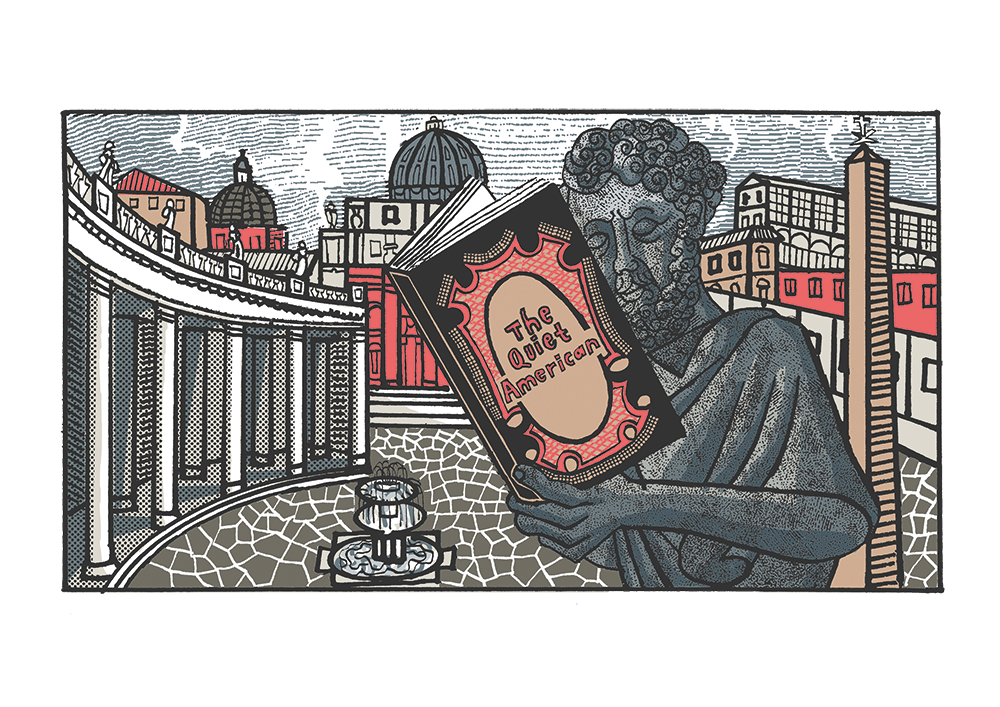
Prevost had been a cardinal for only 19 months when he became Pope Leo XIV. Easter is early this year, so we’re still some weeks away from the anniversary of his election on May 8. But that is long enough, surely, to anticipate the direction of his pontificate? Not necessarily. The press likes to call Leo “the Quiet American,” intending it as a compliment. They presumably haven’t read Graham Greene’s novel, in which Vietnamese civilians are blown to pieces by the criminally naive CIA operative of the title.
Leo is certainly quiet: at 70 years old, he has the gauche smile of a student at a junior prom. But he isn’t naive. He knows – though he’d never say so – that in some respects the 12-year pontificate of his predecessor was cynically divisive. It is his job to repair the damage. But how?
Pope Francis went out of his way to provoke his critics by promoting campaigners for LGBT rights and women’s ordination. He didn’t personally support either of these causes but he relished their disruptive power. He threw a withered bouquet to gays in the form of “nonliturgical” blessings for same-sex couples – but took it back when the African cardinals went nuclear. He encouraged a debate over female deacons and then abruptly declared in a television interview that change wasn’t possible. By contrast, Francis genuinely disliked the traditional Latin Mass and especially the priests who are its proponents, a group he claimed was riddled with frociaggine (roughly translated as “faggotry”). In 2021, he issued Traditionis Custodes, which imposed restrictions on the celebration of the Old Mass so sadistic that they stiffened the resolve of traditionalists. He also favored allowing divorced and remarried Catholics to receive communion. Here, however, his nerve failed him. His 2016 document Amoris Laetitia waffled about “the joy of love” with the profundity of a Hallmark card. The paragraph apparently changing the rules on communion was relegated to a footnote. Asked about it later, Francis conveniently couldn’t recall its details.
In short, Pope Leo inherited a mess. Since he is naturally meticulous and by training a canon lawyer, there was never any doubt that he would attempt to clean it up. But would he do so by streamlining Francis’s botched “reforms” or by discreetly shelving them?
When Leo was elected, conservatives broke into a cold sweat. Many orthodox Catholics were convinced that he was really a Francis II who would push the Church in a liberal Protestant direction, but cunningly, eschewing the histrionics of his predecessor.
Meanwhile, the old guard known as “Francis’s widows” – a cabal of far-left Vatican officials and journalists whom the late pontiff indulged in order to goad traditionalists – were pushing the Francis II line for different reasons. Prevost was the Argentinian pontiff’s chosen successor, they insisted. That wasn’t true. Like Woody Allen, Francis didn’t want to achieve immortality through his work; he wanted to achieve it by not dying. There was no dauphin.
Nor had Prevost been the candidate of the leftists. They preferred the ostensibly moderate Cardinal Pietro Parolin, who despised the Old Mass and would give them their ultimate prize, a total ban on its celebration. Even so, the widows have claimed Leo as their man. In consequence, he risks being caught in a pincer movement between opposing lobbies both trying to squeeze him into a progressive mold.
His response has been one of Zen-like calm. As a diocesan bishop and cardinal, he kept an eye on Twitter; he’s learned to ignore social media loudmouths. Also, he remembers how popes behaved before Francis turned everyday disputes into a Latin American soap opera.
For example, they often took a long time before replacing senior officials. Unfortunately, Leo found himself in the middle of a sinister clown show. His chief lieutenants were Parolin, the Secretary of State who handed over Chinese Catholics to their communist persecutors; Arthur Roche, the slippery Yorkshireman whom Francis employed as witchfinder general against traditionalists; and “Tucho” Fernandez, the sex-obsessed Argentinian whom Francis made doctrinal watchdog despite knowing that he’d once written a book about the theology of orgasms. Roche, thank God, will soon be retiring, but why are the other two still in their jobs?
Bob Prevost was always hard to read, though his colleagues never doubted his intellect or holiness. His mixture of charm and inscrutability healed wounds in the Augustinian order. “He’s seen enough people being hurt and he doesn’t like it,” says a priest who has worked with him in Rome. No pope in living memory has been so reluctant to throw bishops under the bus. Moreover, he knows that liberals, who are far more deeply embedded in the Vatican than conservatives, know how to destroy a pontificate they suspect of “turning back the clock”: he saw them do it to Benedict.
Does Leo want to turn back the clock? There’s no simple answer. On Palm Sunday he declared that Jesus “does not listen to the prayers of those who wage war, but rejects them,” a statement that appeared to ditch centuries of Catholic teaching on the concept of a just war. It’s not clear whether it was a serious attempt to move the Church in the direction of pacifism or merely carelessly phrased. Either way, there is no simple factional correspondence between the Pope’s politics and his theology.
“He’s left-wing on the environment, clearly doesn’t like Trump’s foreign policy, but instinctively conservative on sexual morality,” says the priest. “We shouldn’t expect the translucent theology of Benedict or the charismatic presence of John Paul II. But he’ll restore the rule of law” – a reference to the decision by Vatican judges to reconsider the conviction of Curial officials whose trial for corruption appears to have been rigged by Francis.
The most noticeable differences are ones that traditionalists tend to dismiss as window-dressing
Change will come surreptitiously, and there are increasing signs that it will be conservative. Leo is unlikely to tear up Traditionis Custodes, but his friendly overtures to French enthusiasts for the Latin Mass imply that it will become a dead letter. He chose the Norwegian monk-bishop Erik Varden, a scholar with a cult following among young orthodox Catholics, to preach the Lenten lectures at a retreat for the Roman Curia. He has abandoned Francis’s habit of parachuting obscure or discredited progressives into major sees. Liberal dioceses get familiar liberals while mildly conservative dioceses (there are no very conservative ones) get mild if uninspiring conservatives.
The most noticeable differences are ones that traditionalists – growing in numbers but still a tiny proportion of Catholics – tend to dismiss as window-dressing. Leo wears far more elegant vestments than Francis, whose copes looked as if they had been rescued from the wardrobe of Star Trek: The Next Generation, and often sports the red satin mozzetta, or shoulder-cape, that was ostentatiously ditched by his predecessor. This might seem surprising, given that the former “Father Bob,” even as a cardinal, was happy to be photographed in a checked sports shirt. “But you have to understand that this is about restoring respect for the papal office,” says a Vatican insider.
“Leo has moved back into the Apostolic Palace, bringing an end to the expensive ‘humility’ of Francis living in a hostel, with all its extra security costs. We’re back to traditional protocol at papal audiences and ceremonies, which is a relief for everyone. And priests can walk through the streets wearing cassocks without worrying that someone will dob them in to the liberal Stasi. None of this is superficial. The restored sense of decorum is good for the city of Rome and for the morale of Catholics. Pope Leo knows that nothing good can happen until pulses return to normal. That’s his first gift to the whole Church and, irrespective of our differences, we should just be grateful.”


Comments