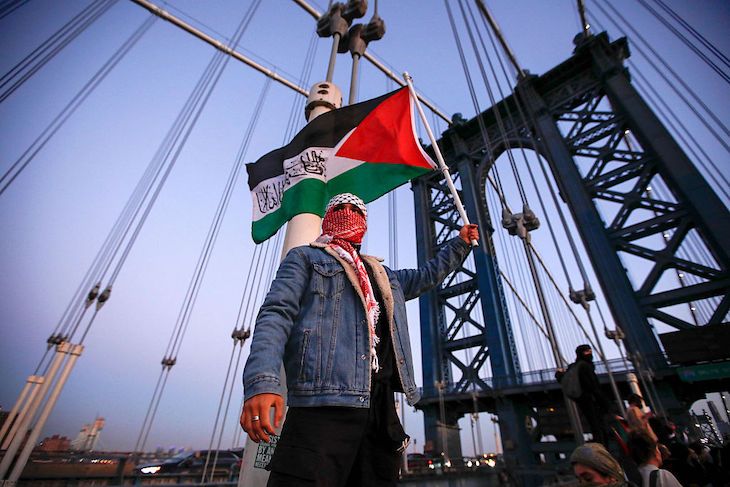
Few places make for a less likely fashion hub than the agricultural community of Masafer Yatta in the West Bank. Located roughly 40 miles south of Jerusalem, the cluster of hamlets and villages rose to prominence a few years back as the flashpoint of Jewish-Palestinian conflict depicted in the Academy Award-winning film No Other Land, whose directors include the Israeli duo behind the even more polarising follow-up, NAZA.
The greatest failure of Palestine’s evolution into an emblem of the elite is the lack of any sense of self-reflection or critique
Along with olive groves and herds of sheep, Masafer Yatta is also a centre for the production of tatreez, a traditional Palestinian embroidery technique added to Unesco’s Intangible Cultural Heritage List back in 2021. Touted as an economic lifeline for struggling Palestinian families, tatreez has recently emerged on red carpets and at fancy galas thanks to Resolute RGL, a Palestinian fashion brand offering tatreez-adorned luxury shoes and accessories including its Haifa sneaker, which sells for $350 (£270) a pair.
Mixing politics with fashion rarely turns out well, but that hasn’t stopped the founders of Resolute from giving it a try. In late-September, smack in the middle of the United Nations General Assembly and flush with $1.3 million (£1 million) in seed funding, Resolute made its big-city debut at a swanky shindig on Manhattan’s Lower East Side. Prominent pro-Palestinian actor Cynthia Nixon was there, rallying supporters to purchase a collaborative t-shirt designed by celebrated muralist Shepard Fairey, best-known for the iconic Hope poster which helped propel Barack Obama’s nascent 2008 presidential campaign.
It’s a sell both canny and cool, arriving at a moment when all things Palestine-adjacent – food, films, and in Resolute’s case, fashion – are instantly anointed with the imprimatur of style and sophistication. But in place of the keffiyeh-chic spirit epitomised by former PLO head Yasser Arafat more than 50 years ago, brands like Resolute are aiming for something more elevated, expensive, elite. Taste has replaced terror, influencers rather than intifadeh.
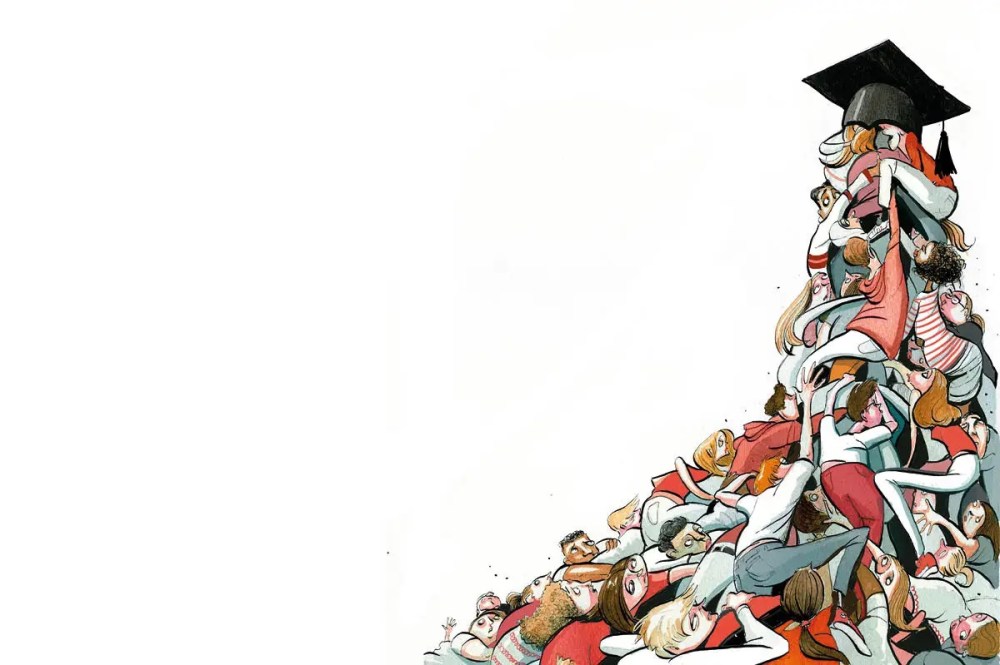
Today, a public alignment with Palestine and Gaza (or against Israel and Zionism) is a tool for cultural and commercial mobility – with the cash and prizes (book deals and magazine covers) to prove it. Just look at the Palestinian restaurant Albi in Washington, DC, which in June became the first restaurant outside of New York to earn a four-star review from the New York Times.
We’ve been down this road before. Back in 2020, a similar phenomenon accompanied #blacklivesmatter as it evolved from an ideologically-based protest movement into a global platform of racial reckoning following the death of George Floyd in Minneapolis. First came the ubiquitous black squares across the social media accounts of cultural brands and celebrities followed by a concerted (if not coercive) campaign to embed #blm’s agenda throughout the pop-culture elite.
June 2020, for instance, saw the debut of the 15 Percent Pledge, a petition-led initiative compelling fashion brands to devote 15 per cent of their shelf space to black-owned businesses. Beauty giant Sephora quickly signed on. An annual celeb-filled gala arrived shortly thereafter.
Mere months later on the cover of its vaulted September issue, Vogue featured images of black women wearing black-designed frocks painted by notable black artists. The same month, Vanity Fair delivered a cover portrait of slain African-American nurse Brianna Taylor by black artist Amy Sherald, who two years earlier painted the portrait of former First Lady Michelle Obama for the National Portrait Gallery.
Similar efforts unfolded throughout the creative industries, which relentlessly prioritised black stories and voices much as they privilege their Arab, Muslim and, most crucially, Palestinian counterparts today.
But there are vast differences between the elitification of #palestine and #blm. Yes, as Resolute confirms, there’s a hearty reliance on the virtue-signally emblems of justice and revolution among the #freegaza crowd, often with hefty price tags attached. Wear a pair of Resolute kicks on the red carpet and you’re quickly considered on the right side of history. Become an enfant terrible like Hasan Piker or cause celebre like Mahmoud Khalil and it’s party time with Zohran Mamdani complete with invites to intimate iftars at Gracie Mansion.
But the “history” of most social justice movements has typically been one of expansion rather than contraction. Vogue and Vanity Fair placed black women on their covers in addition to white women, not as a replacement for them. This has not been the case with #freegaza or #palestine. Today, as Arab and Islamic voices achieve ever more prominence throughout elite institutions, Jews are being squeezed out as a consequence. Palestinian restaurants like Albi are rising for instance while many Israeli restaurants struggle to stay alive. A recent report from the Anti-Defamation League details how Jewish creatives are being systematically shut out from the arts, while their Arab and Muslim counterparts are thriving.
The most insidious part here is that the gate-keepers are no longer even trying to hide it. New York Magazine’s Habibi City cover package in August explicitly framed itself as a response to Israel’s war in Gaza and the resulting “genocide.” The articles inside were #peakelite – chef and artist profiles, party reviews and community celebrations – entirely centred on an Arab and Muslim reaction to Israel yet notably judenrein.
The greatest failure of Palestine’s evolution into an emblem of the elite is the lack of any sense of self-reflection or critique.
Jews, of course, enjoy no such luxury, endlessly saddled with demands to consider the “other side.” Indeed what else is NAZA – which explores allegations of systematic IDF killings in Gaza – if not a massive exercise of irrational Zionist introspection. Crowned with a Special Jury Prize and 25-minute standing ovation at the Venice Film Festival last month, NAZA is the rare Israeli cultural commodity now achieving elite acclaim. But look what it took to achieve it.
Yet there is no parallel soul-searching in the reverse; no questioning of Hamas cruelty at swanky progressive sneaker soirees, no critique of Islamist violence against women or LGBTs by creatives. Why? Because ultimately, like with #blm before it, #palestine is the elite at their most shallow and craven, elitism by aggrievement rather than achievement.
And the damage – whether in Manhattan or Masafer Yatta – may never be undone.





Comments