
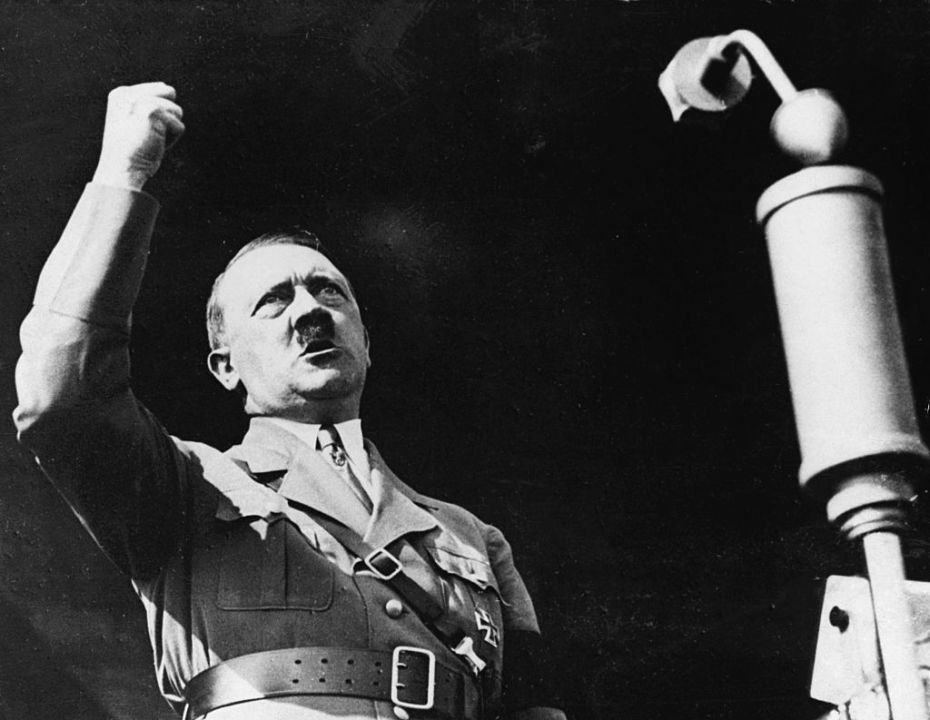
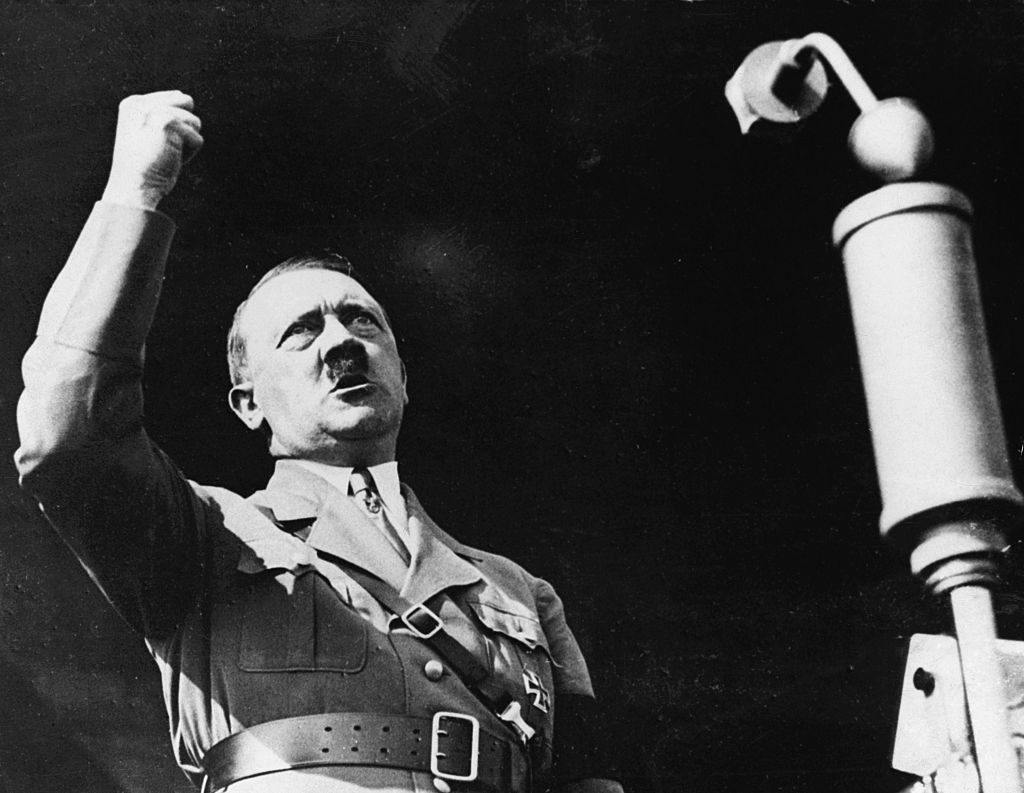
‘A century ago, the most potent moral figure in Western society was Jesus Christ. Now it is Adolf Hitler. Perhaps we still believe that Jesus is good, but not with the same fervour and conviction that we believe Nazism is evil. Crosses and crucifixes have lost most of their power in our culture. It is possible to play with them, even joke about them, and no one really minds. Not so with swastikas, which pack an emotional punch like no other visual image.’
Everyone needs a moral compass, every society needs taboos, and the Nazis came to function as that anchor
I was a bit annoyed when I first heard of Alec Ryrie’s The Age of Hitler, as it sounded exactly like a book I wanted to write, about how the Nazis have become the basis of our entire moral system, our civilisation’s origin story and foundation myth. The war against Hitler was, as French writer Laurent Binet called it, ‘our Trojan wars’. This is ‘The World Hitler Made’, as I had provisionally titled my book, which would presumably be the British publishing industry’s 100,000th on the Nazis. Just that month.
My thinking was in part inspired by Tom Holland’s 2021 essay arguing that Hitler had taken the place of the Devil, with Auschwitz standing in for Hell. The German dictator has become the moral lodestar of our world, as Renaud Camus pointed out in ‘Hitler’s Second Career’, and the decree ‘to do whatever He wouldn’t have done’ has warped many people’s political sense (there was even a notorious case in 1970s Germany when authorities placed children in the care of convicted paedophiles, partly motivated by the guiding sense that the Nazis would have opposed the scheme – you’ll never guess what happened next). Paul Gottfried’s Antifascism sought to define the prevailing political ideology which united both the left and mainstream right, while R.R. Reno argued in Return of the Strong Gods that the dominant belief system of our age, the ‘open society’ which denied and condemned deeper loyalties, resulted from post-Nazi trauma.
I also think that for Britain in particular, 1940 – our finest hour – has become the defining moment in our national identity, psychologically tied up with subsequent rebirth via the foundation of the NHS and the arrival of the Windrush. The Britain of before and after that ordeal are in many ways different civilisations.
‘The second world war is not only our Trojan war,’ Ryrie argues:
‘It is our Paradise Lost: the sacred story we tell and retell and reimagine so as to keep immersing ourselves and our children in what evil truly is, in how our parents and grandparents and now our great-grandparents fought to defeat it and how we must do so again. Those are our shared values, and in them we will be content to live and die. In the post-war world, the story of Jesus has been displaced as the defining narrative of our culture by the story of the second world war. Our culture’s “greatest story” became the anti-Nazi rather than the Christian narrative.’
This is obviously reflected in popular culture which casually makes use of the Nazis as archetypes of evil, a theme found in Indiana Jones and Star Wars movies, Harry Potter and Doctor Who. If future archaeologists knew nothing of life before 1945 from direct history, they would be able to work out via popular culture that our civilisation was scarred by some sort of memory involving people who liked to dress up in black.
This book is quite different to the one I had in mind, far more theological focusing particularly on the spiritual void which the Nazis filled (he also comes from quite a different political perspective).
Ryrie writes about how the churches failed the great moral test of 1939-45, and Dietrich Bonhoeffer was one of the first to see how Christianity would never be the same. He wrote to his friend, the theologian Eberhard Bethge, to say that ‘We are proceeding towards a time of no religion at all: men as they are now simply cannot be religious any more.’ Bonhoeffer even hoped that ‘religion is no more than the garment of Christianity’, one that it would now be time to abandon; what was needed now was ‘a religionless Christianity.’ Maybe Christianity as such was ‘a mere preliminary stage to doing without religion altogether.’
He wasn’t far off, although Christianity’s sudden eclipse in the west was preceded by a religious revival in the 1950s, at least in the US. In 1954, ‘under God’ was added to the pledge of allegiance in 1954 and two years later E pluribus unum was replaced with ‘In God We Trust’ on bank notes. In 1947 radio network ABC had begun broadcasting The Greatest Story Ever Told, and this phenomenal success ran for ten years and was broadcast in over 50 countries; by the time the film was released in 1965, the cultural mood had changed and the film was a flop. The public were not moved by John Wayne’s centurion.
Across the western world religious attendance, belief and practice sharply fell in the 1960s, although at different speeds; in France sharply and dramatically, in the US more unevenly, while more Catholic countries like Ireland, Spain and Poland would need to wait much longer – but this civilisational upheaval affected one and all.
Everyone needs a moral compass, however; every society needs taboos, and the Nazis came to function as that anchor, suitably morally reprehensible both to the old Christian order, for their violation of life and their explicit denial of human dignity, and also to the post-Christian age, one that was increasingly hedonistic and globalised. More than anything, in the age of Hitler racism became the number one moral offence, crowding out all others; the author puts it well when he points out that apartheid South Africa ‘was not the worst regime in the world: merely the most offensive’.
The western world responded to the inhumanity of the Teutonic Devil by giving a religious meaning to a legal concept, human rights. While Ryrie writes that C.S. Lewis worried about the secular, progressive world becoming ‘engulfed by anti-humanist scientism’, as the author put it, instead it came to ‘embrace and to define itself by the concept of human rights.’
‘Far from being abolished, “humanity” was made the measure of all things. In the age of Hitler, the post-second world war age in which we live, “humanity” is our shared faith… It is explicitly in response to Nazism that we have the creation of the Universal Declaration of Human Rights in 1948 and the European Convention on Human Rights in 1950.’
Human rights go back further, and the American Declaration of Independence in 1776 famously states that ‘we hold these truths to be self-evident, that all men are created equal, and are endowed by their Creator with certain unalienable rights’. But rights aren’t self-evident: ‘We all know, if we stop to think about it, that the modern doctrine of human rights is a castle in the air. It is a defiant existential assertion of values (“we hold these truths…”) without any firm foundation. We know that we cannot prove that human rights exist in any sort of absolute sense. Even Jefferson could not do it without a backhanded invocation of God.’
Human rights are a mirage, yet: ‘now, in the post-1945 era, in the age of Hitler, we really do find the existence of human rights and human equality self-evident. The intellectual basis for this doctrine may be weak, but it is intuitively true: as we say, it has “truthiness”.’
It is, in fact, our culture’s form of what Lewis called the Tao. Lewis’s The Abolition of Man includes an appendix providing a cross-cultural list of examples of the values of the Tao, citing Christian, Jewish, Chinese, ancient Greek and Egyptian, Norse, Native American and other moral codes to show broad cross-cultural agreement on such values as benevolence, justice and protection of the weak.
‘Had he been writing five years later, he could have slotted clauses from the UN Declaration of Human Rights very comfortably into his lists. That was and remains the new faith of a secular age. Why do we believe human beings have rights? Even asking it feels uncomfortable, as if we are questioning something that ought not to be questioned. To raise the problem is almost to commit a kind of blasphemy. The most honest response is that we simply do believe, down to our core, that human beings have rights, regardless of whether you can prove it or not. That conviction feels like an answer. In fact, it is the question.’
Human rights have come to form the basis of Britain’s legal, political and social system, a fading worldview now personified by the deeply unpopular prime minister Keir Starmer, himself a human rights lawyer (a term not always used approvingly). The human rights regime has created what’s been termed ‘the needs-based society’, the idea that citizens and non-citizens alike are owed certain rights by the state, free of any obligations, or any of the ties of loyalty which have characterised all societies. It’s why the country cannot prevent interlopers arriving in their thousands each week, even those who commit serious crimes, nor can it protect the public from violent offenders; it underpins an array of laws and regulations that direct and undermine our economy.
Human rights aren’t God-given; they depend on an impartial law and a state which enjoys legitimacy. Universal human rights are a paradox, inevitably granting legal rights which clash with the rights of others, including the right of citizens to a border.
These are my conclusions, not the author’s, and he is more concerned with the spiritual underpinnings of the new moral order. A major problem he notes is ‘with the whole business of using an exemplar of evil to set our moral compasses. It means that we now know what we hate, but we do not know what we love.’ It is one of many perceptive points he makes.
The author sees the moral worldview which replaced a defeated Christianity as shallow, and indeed it tends to emphasise soft virtues like ‘tolerance’ and ‘kindness’. He also fears for what comes next, and gives the impression of someone who wants to save the post-war worldview from itself. I’m not convinced by his solutions, and the latter half does at times read like an anguished Anglican sermon, but his thesis is undeniable and well argued.
Indeed, Ryrie suspects that the Age of Hitler is coming to the end. Partly it is just the passage of time, and the increasing distance of the Holocaust. The taboo about anti-Semitism is certainly fading among younger generations, but this is also related to the most consequential effect of Hitler’s second career – the changing demography of the west and the arrival of large numbers of outsiders to a civilisation psychologically incapable of keeping them out. Unburdened by civilisational guilt and possessing religion of their own, these newcomers do not need the crooked cross as their moral guide. The age of Hitler may indeed be over.
This article first appeared on Ed West’s Wrong Side of History Substack.





Comments