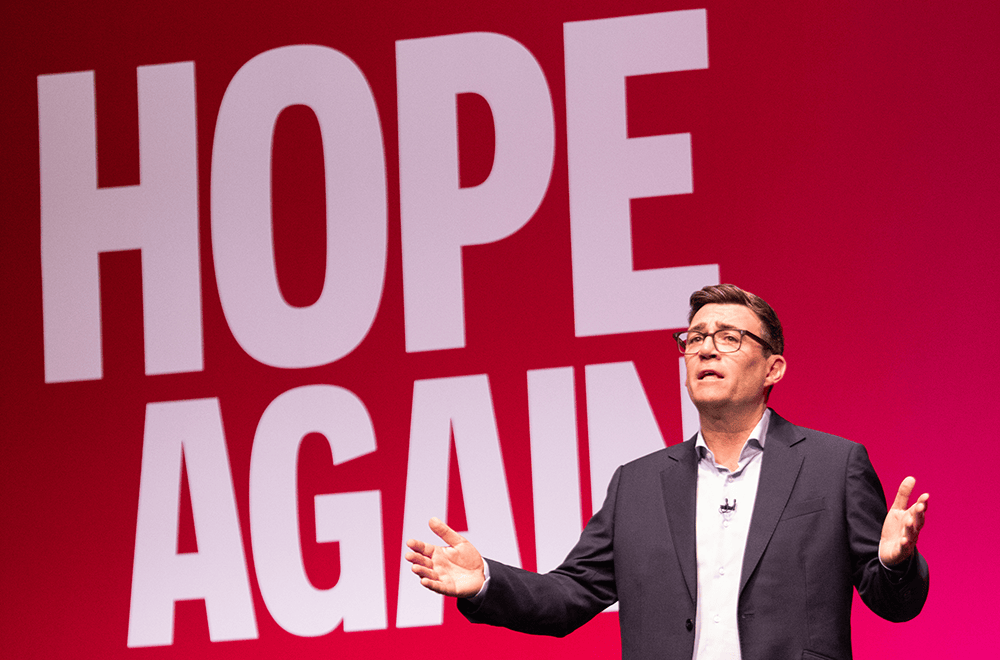


After Andy Burnham’s speech at the Labour party conference last month, one veteran factionalist declared: “We are all Burnhamites now.” Romantics love the rhetoric; cynics respect the ruthlessness. “Game recognizes game,” says one Labour figure.
The Prime Minister’s address was pitched at a wounded party seeking support. Emotive and personal, yet also intensely political, it showed a keen awareness not just of Labour’s values, but of its interests too. Right to Buy, which attracted legions to the Tory ranks, will be halted for new homes; a new National Care Service will bring thousands more members into the unions’ fold. Progressivism will be entrenched in the model Burnham chooses, with devolution imposed on his terms: mayors allowed to spend more, but restricted from cutting tax. “We have a politician as Prime Minister,” says a young MP approvingly.
Even by the standards of a party conference, this year’s Labour jamboree was peculiarly nostalgic
The new leader understands that, for all its talk of radicalism, Labour is instinctively a conservative beast. Even by the standards of a party conference, this year’s jamboree was a peculiarly nostalgic affair, full of references to HP sauce, miners’ lamps and northern soul. In his bid to roll back Margaret Thatcher’s 1980s settlement on buses, houses, water and more, Burnham was attempting to construct a 21st-century version of the postwar Labour bargain.
The dominant political operator of that pre-Thatcher age, of course, was the figure who loomed larger over this conference than any other: Harold Wilson, another northern football-lover whose views bounced between the traditions of the Tribune left and the old right. References to Wilson’s government peppered cabinet members’ speeches – “the white heat of technology” featured in no fewer than four. Party officials flocked to buy merchandise commemorating 60 years since Wilson’s 1966 victory. “We pretend the first two years didn’t happen,” jokes a backbencher, seeing parallels between 1964 and 2024.
The Wilson comparison is instructive. Labour lore recalls him as the champion of gay, ethnic and women’s rights – rather than the man who devalued the pound in 1967. Burnham, too, is full of talk about reform and plans, even as Britain’s economy is at the mercy of unfavorable world events. There was an uncomfortable irony in Chancellor John Healey’s speech: it was 50 years to the day that his namesake, Denis, had to beg the party to back a £2.3 billion IMF bailout. The day after this Healey’s speech, UK borrowing hit its highest rate this century.

Some of Burnham’s cabinet also consciously see themselves in the party’s lineage. Louise Haigh, his effective deputy, talks often of Barbara Castle: “A diminutive Yorkshire redhead with a grit and determination that occasionally found herself in trouble.” Haigh has been handed responsibility for growth by Burnham and there is an echo here of Wilson’s short-lived Department of Economic Affairs, set up to constrain the power of the Treasury. Already, officials fear that a clash with the Chancellor is looming, with predictable Labour criticisms mounting about Healey and his department’s “lack of imagination.” Burnham has said he wants “No. 10 leading on that growth mission” to “unlock the blockages” in Whitehall; Wilson said similar of the DEA, just weeks before devaluation.
Kanishka Narayan, the AI minister, cites Tony Benn as a fellow public-school technoenthusiast – even if Narayan is of a different intellectual tradition. “The Labour right’s future is Kanishka,” says a former Wes Streeting backer. Intelligent and industrious, Narayan did an estimated 70 conference events, with his role being to present an alternative political economy to the Prime Minister’s more insular worldview. “Burnham is offering 20th-century solutions to 21st-century problems,” says a former civil servant. Marrying AI to the reindustrialization agenda could be the government’s best chance of success.
Others are still adjusting to fluctuating party moods. Shabana Mahmood, the Home Secretary, has been christened “Subana” by colleagues, such is her diminished public profile after the backlash over her legal migration reforms. Health – so often the great Labour rallying cry – featured little in this conference either. Both Yvette Cooper, the current Health Secretary, and Bridget Phillipson, the equalities minister, face losing their seats to Reform as Burnham mulls reopening the European question. “The Midlands’ sparkies are the new Durham miners,” says a skeptical figure, pointing to the key battlegrounds.
For now, the Labour tribe is united, amid fears the next right-wing government will resemble some grotesque fusion of Selsdon men and Powellite bastards. Hopes are high for the Holborn and St. Pancras by-election, with most in Labour expecting a triumph over Zack Polanski, the Green leader who put himself forward. Activists on the ground report that a key moment was Ed Miliband’s sanctions on Israeli settlements. “That really went down well,” says one involved, reflecting on the Foreign Secretary’s speech to parliament last month. Tellingly, no cabinet minister attended the Labour Friends of Israel party at the conference.
After that, the Budget looms. “It’s the most important Budget this parliament,” explains a government aide. “If it falls apart, if you can’t defend it on Kuenssberg that Sunday, then that’s it.” After £75 billion in tax rises in 2024 and 2025, a similar scale is not envisaged this time, with Healey taking care to consult widely with parliamentary colleagues. “Dip their hands in the blood,” suggests one ex-Treasury staffer. Next spring’s spending review is expected to be a chastening experience for the revised cabinet. “Let’s see if it is happy families after that,” says one Tory aide.
Like Wilson, Burnham has inherited a dire economic outlook, not of his own making. But having raised the hopes of his party in Liverpool, the challenge now is to be more than just another transient political figure, condemned by history as little more than a mere tactician. His party has cause to hope again – but offering a “better yesterday” will not be enough.





Comments