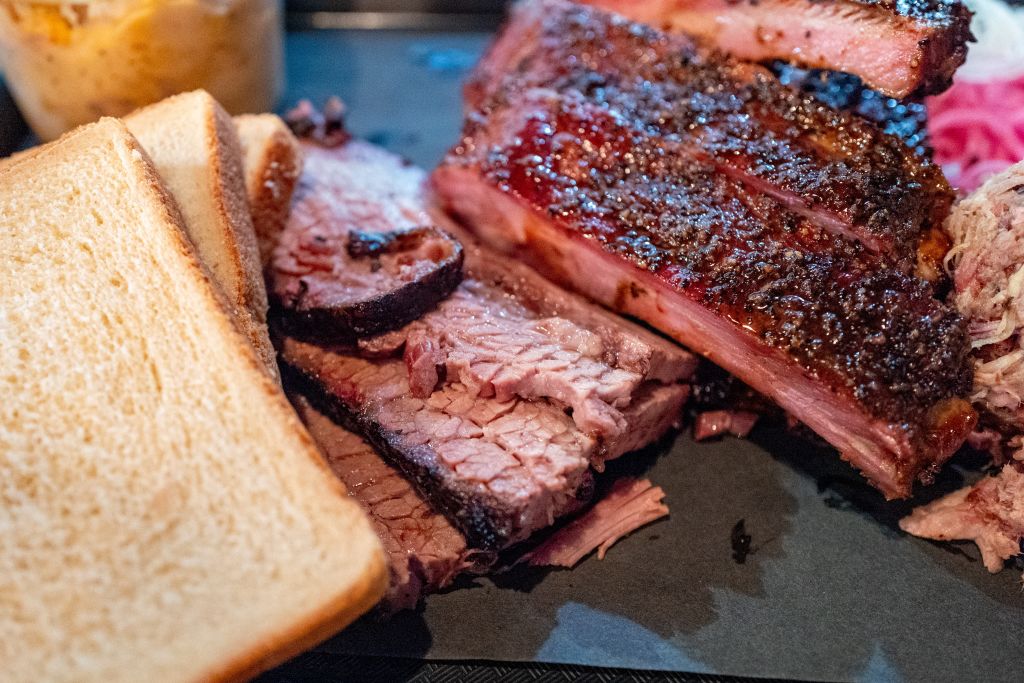
When I first became enamored with barbecue in the 1990s, I ate a lot of chopped pork at Carolina barbecue joints, and sometimes chicken and ribs. One thing I almost never encountered was beef, especially slow-smoked brisket. That barbecue cut remained mostly a Texas thing until well into the 21st century.
A few pioneers did try to introduce it to the Carolinas over the years, with limited success. Tommy Brightwell, for instance, put brisket on the menu when he opened Pappy’s BBQ in Madison, North Carolina, in 2004. A review in the Greensboro News & Record began, “So, you think barbecue has to come in pork form only?”
The public’s appetite for brisket has proven stubbornly persistent – inelastic demand, as economists would put it
Brightwell, a Texas native and former pastor at the New Life Baptist Church, brought evangelistic fervor to the enterprise. “Some like [the brisket], and some don’t,” he told the newspaper. “But most do, and I’ve converted a lot over to eating beef.” Those converts apparently went right back to their old pork-centric ways, for I can’t find a trace of Pappy’s after 2005.
Things started to change around 2010, when a new generation of cooks and diners outside Texas started discovering barbecued brisket. In a matter of years, America was in the throes of full-on brisket-mania. I chalk that up to three factors: newcomers, media and migration.
First, the newcomers. For the last half of the 20th century, barbecue had been in secular decline, eclipsed by burger and fried chicken chains. But in the opening years of the new millennium, it staged a remarkable comeback. A new generation of restaurateurs, many with no prior barbecue experience, decided to try their hand at the genre, and they found a welcome reception.
The geography of barbecue expanded, too, as chefs traded their white coats for blue jeans and opened barbecue joints in unlikely places such as Boston and New York City. In the process, a new cohort of diners was introduced to barbecue: diners who hadn’t grown up eating at local joints and had few deeply rooted convictions of what “real” barbecue was.

The national food media became obsessed with barbecue around the same time. Magazines devoted their covers to lurid overhead shots of trays lined with butcher paper, groaning under the weight of the assorted smoked meats. On cable TV, dramatic cook-offs were broadcast, setting soon-to-be-famous pitmasters against the clock – and each other. An influential 2011 Bon Appetit feature declared Austin pitmaster Aaron Franklin “a BBQ genius” and lauded his “stunning brisket – the pride of Texas-style barbecue.”
In the years that followed, brisket marched eastward across the Mississippi and muscled its way onto barbecue menus. At the same time, more Americans from barbecue backwaters such as Ohio were moving south, bringing with them media-instilled notions of what proper barbecue was. For them, barbecue was brisket – and they were determined to have it.
When Wyatt Dickson opened Picnic in Durham in 2016, he planned to serve only traditional North Carolina-style whole hog. From day one, though, aggrieved customers asked: “Where’s the brisket?” Dickson ultimately relented and added it to the menu, though in a section he decided to label “non-native barbecue.”
Carey Bringle of Nashville’s Peg Leg Porker took a different tack. Instead of compromising his original menu, he opened an entirely new restaurant called Bringle’s Smoking Oasis, which elevates beef to the headline slot. “At Peg Leg,” he explains, “I wanted to do strictly West Tennessee barbecue, pork and chicken. No brisket. Bringle’s Smoking Oasis is a very different place.”
Inspired by the Texas joints they saw on TV and social media, a new generation of pitmasters set out to meet the unfilled demand. Brisket joints sprang up like mushrooms from DC clear down to Miami, with offset smokers out back and Lone Star flags flying proudly in front. Brisket’s conquest of America was complete.
As the 2020s approached, though, Americans’ passion for brisket was becoming problematic. For starters, there are only two briskets per cow, and as more pitmasters switched to prime-grade beef, demand drove prices up. In the summer of 2019, CBS News reported that “thanks, largely, to the popularity of Texas barbecue,” brisket had reached a record high of $2.08 a pound wholesale. Once among the cheapest beef options, brisket had become the third-priciest of the prime cuts, behind only the rib and the loin.
These days, a restaurateur would kill for two-buck brisket. As with other commodities, Covid-era disruptions caused beef prices to spike, but even as the larger market settled, brisket kept rising due to smaller cattle herds and sustained demand from restaurants. By 2024, boneless brisket was regularly trading above $4 a pound wholesale. These days, pitmasters tell me they’re paying around six.
Blake Stoker of Blake’s at Southern Milling in Martin, Tennessee, broke down the math for me, explaining that a brisket can lose up to 50 percent of its weight on the smoker. To cover all their other expenses, restaurateurs typically set the menu price at 300 percent of food costs. By that metric, brisket purchased raw at six dollars a pound should be sold for $48 once it’s cooked.
But no one dares charge that much, fearing customers will grab pitchforks and torches. Many restaurateurs have taken to posting prices in half-pound increments, to blunt the sticker shock. On my most recent barbecue tour through South Texas in January, I noted brisket ranging from $15 to $18 for half a pound.
Curiously, though, the public’s appetite for brisket has proven stubbornly persistent – inelastic demand, as economists would put it. Pitmasters, on the other hand, are increasingly looking for alternatives because they can’t make a profit selling it. Stoker says he’s currently selling brisket a la carte for “$31 a pound, which is basically giving it away.” He makes it work by offering wings, burgers and combo plates, where the pricier brisket is offset by less expensive pork and turkey. “The less brisket I can sell,” he says, “the more money I’m making.”
For years, pitmasters have been turning to brisket smashburgers, house-ground sausage and chili to use up every scrap of beef. Now they’re promoting less common cuts, like pork ribeye or “bacon burnt ends” (cubed pork belly), to lure customers away from low-margin brisket.
Beef prices show no sign of returning to Earth. Will America’s love of brisket start to cool as the price crosses $40 a pound? We’ll see. I am hopeful, though, that after more than a decade of brisket-mania, market forces may finally nudge diners to explore the many other delicious smoked meats that American barbecue has to offer.


Comments