
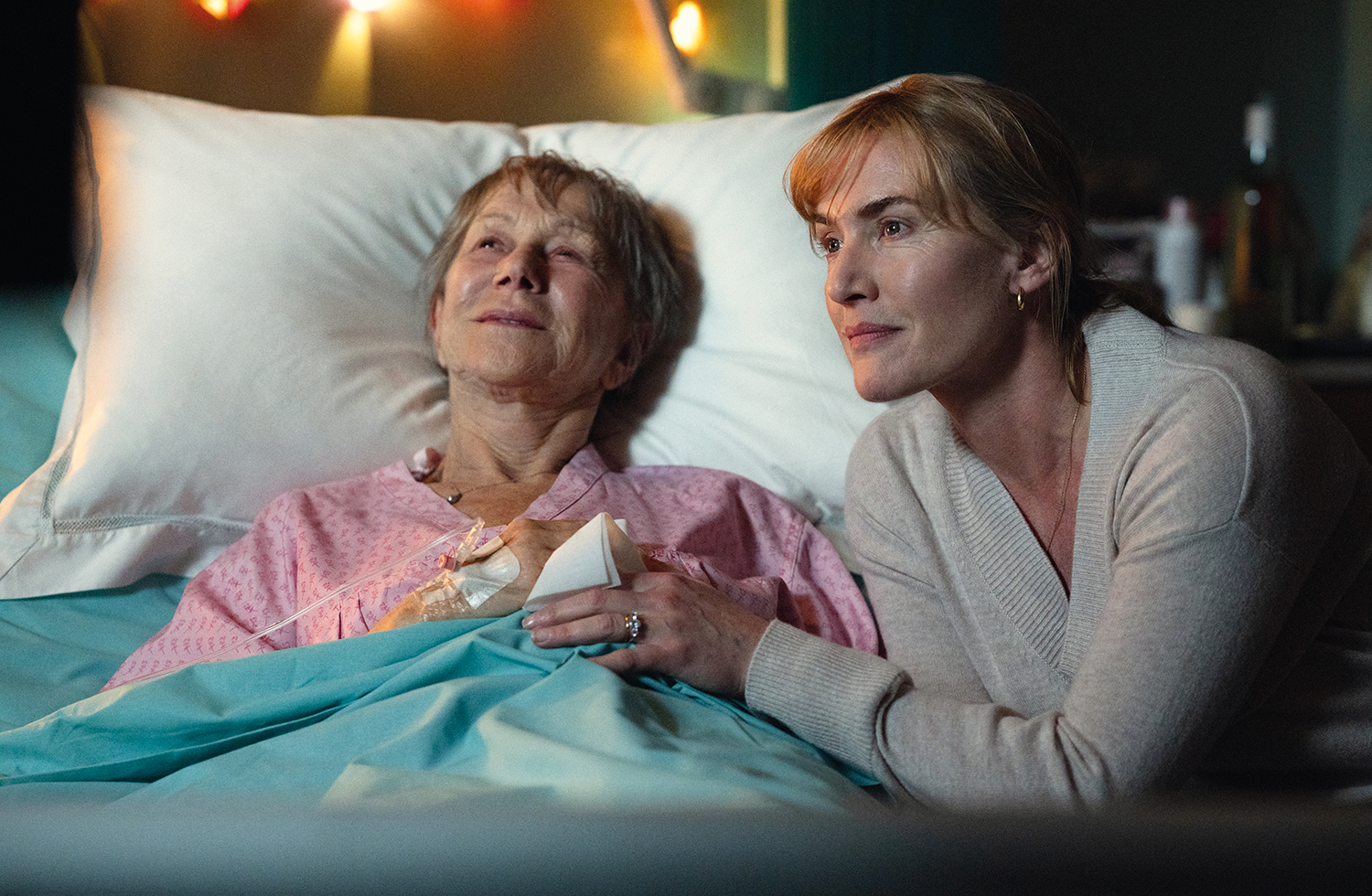
The Christmas film Goodbye June marks Kate Winslet’s directorial debut. It’s based on a screenplay by Joe Anders – the 21-year-old son she had with Sam Mendes. I would like to be gracious about it. But it would help if it were a better film.
It’s about four, fractious adult children who are forced to gather at the bedside of their dying mother. The cast is so formidable it should be a slam-dunk festive weepie. But the characters are, alas, too thinly sketched, while their various trajectories take us into the kind of banal, maudlin territory most suited to a Call The Midwife special. On a more positive note, however, if your idea of Christmassy fun is watching Helen Mirren slowly peter out while snow softly falls outside, you will be well served.

It begins with June (Mirren) putting on the kettle then swiftly collapsing. Her husband Bernard (Timothy Spall), who is upstairs in the bathroom, is initially oblivious. We see him on the toilet as the camera swoops down to take in his bloated, purplish feet. June is rushed to hospital where the doctors say her unspecified cancer has spread and there is nothing more they can do. Her children, with various grandchildren in tow, gather.
There’s Julia (Winslet), the high-flying career woman who, somewhere along the line, has fallen out with her sister, Molly (Andrea Riseborough), a frazzled mum who is permanently angry. The other sister is Helen (Toni Collette), who is the stereotype of someone into wellness woo-woo, and there’s a brother, Connor (Johnny Flynn), who is depressed and lonely and still lives at home. Why is he depressed and lonely? We never properly find out. Has he been hiding something from his parents? If so, what kind of parents are June and Bernard? We don’t find that out either.
If your idea of Christmassy fun is watching Helen Mirren slowly
peter out you will be well served
As Christmas approaches – handily a calendar counts off the days – June fades, and while there is some pain and distress, it is still cinema cancer rather than cancer cancer. There’s no vomiting or hauling her off the toilet or anything like that. June has no history and no character development to speak of. She is the Disposable Family Member who exists so the other characters might row, cry, fight, then hug by the vending machine. June is desperate for Julia and Molly to make up. ‘I love them so much and twice as much when they love each other,’ is a typical line of dialogue. Their issues are standard fare. ‘I wish I could have stayed home with my kids,’ confesses Julia to Molly, who, it turns out, has always been jealous of her career. You know the drill.
The cast elevate it but cannot save it. The direction, meanwhile, fails to introduce any dramatic tension. All we get is: will June make it to Christmas Day? Will the grandchildren have to bring their nativity to the hospital room? This is set at the Princess Mary Hospital in Cheltenham, which is fictional – and if you could choose to die in a fictional NHS hospital, I would choose this fictional one. There are barely any other patients, you get a room with an en suite, you can bring in a fridge and a Christmas tree, and also there’s a dedicated nurse who is both wonderfully caring and hot (Fisayo Akinade).
In other words, it is a weepie that is unlikely to make you weep. It didn’t make me weep. But, in fairness, I should tell you that after the screening I attended I did overhear someone remark: ‘That was so emotional… I’m floored.’ Other opinions are available is what I am graciously saying. They won’t be right, but they are out here.




Comments