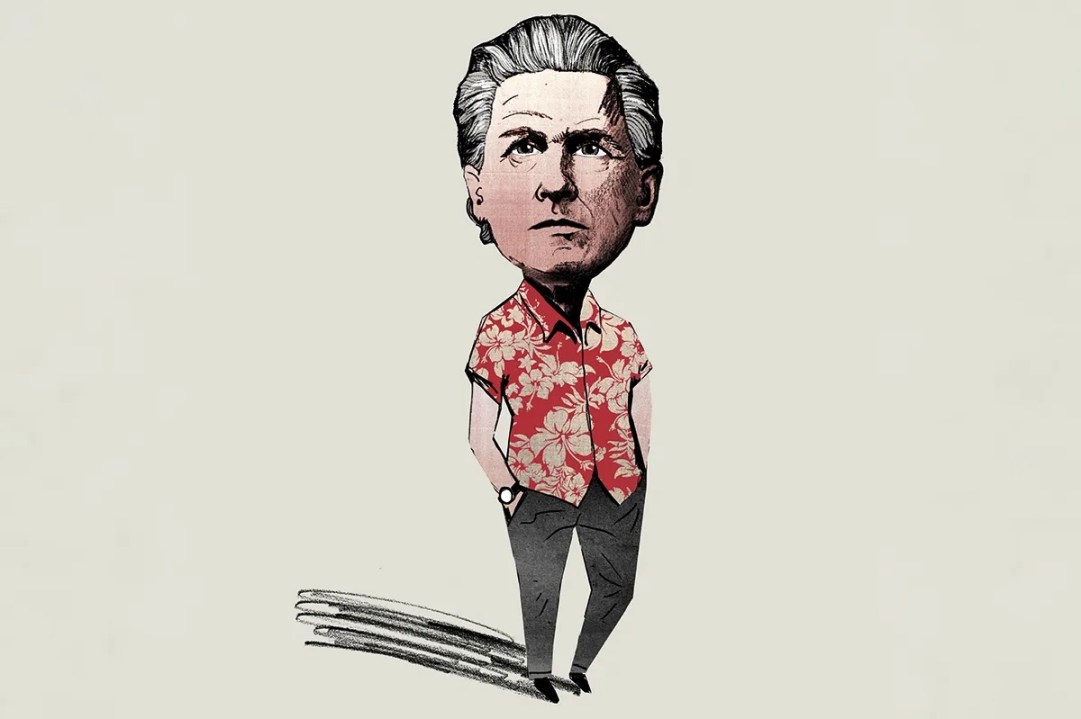
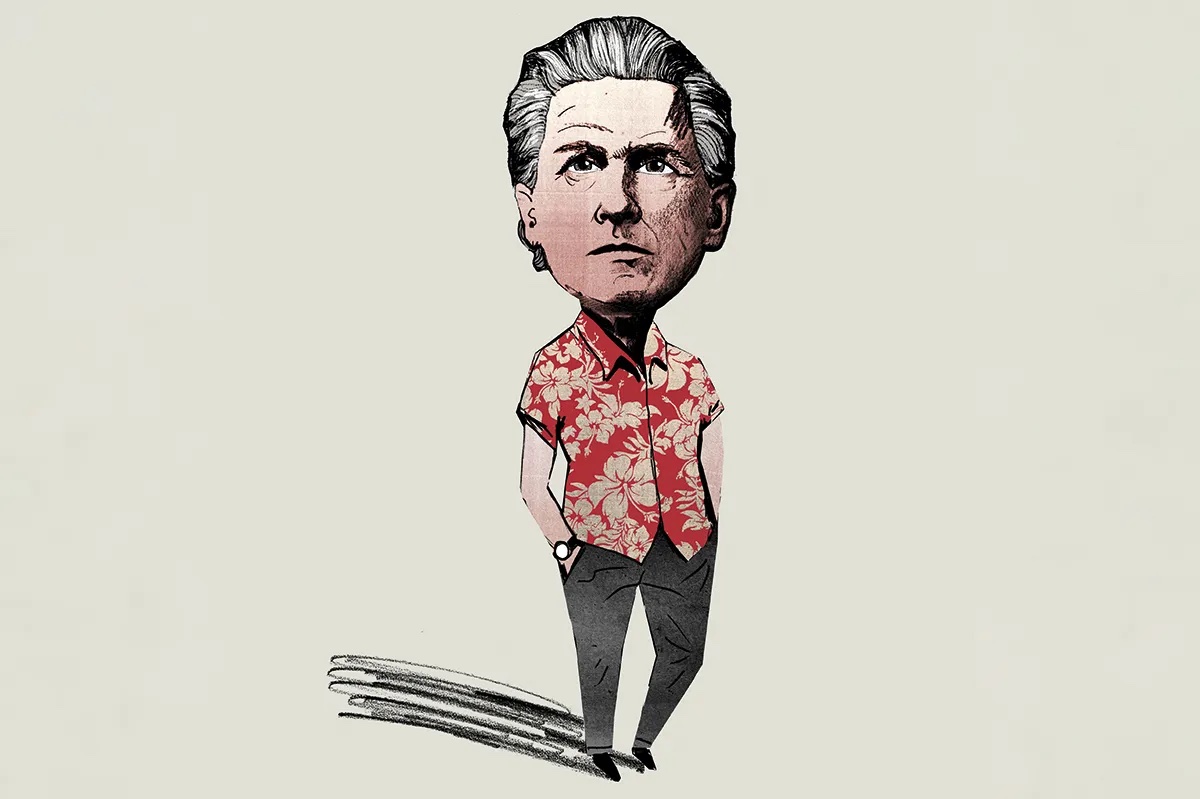
Young Man in a Hurry is California Governor Gavin Newsom’s attempt to explain himself to a divided country that may soon find him vying for its presidency. He alternates between candor and wile in answering the book’s central question: who is Gavin Newsom? In these pages he constructs a striking hero’s journey, illuminating an insular world of inherited wealth, hereditary political power and ideological contradiction that few Americans will have been exposed to. But he also casts himself as a struggling underdog, a folksy type whose patrician image belies a life of perseverance and a unique set of emotional and psychological deprivations.
Growing up, Newsom would often board the Gettys’ private 727 and gallivant for two or three weeks
In producing this memoir, Newsom (“Newscum” to Donald Trump and, we are told, somewhat implausibly, his childhood bullies in Marin County) seems to have overcome his dyslexia, which prevents him from reading his speeches and caused him to underperform at school. He claims to have bombed the SAT (“three hours of dyslexic torture”) and fallen so far behind academically that he was “resigned to a stint at the local community college,” until Santa Clara University recruited him as a first baseman. That he admits to working with a ghostwriter is an example of the transparency he can exhibit throughout this work. But despite his attempts to control the more politically inconvenient – yet irrefutable – facts of his life, Newsom has done a surprising amount of fumigation.
Newsom is a fifth-generation Californian, a descendant of Irish and Scottish immigrants who arrived in the 19th century and never left. Until the governorship brought him to Sacramento, he had always lived in and around San Francisco. Through his father, William “Bill” Newsom III, he belongs to a powerful Bay Area milieu that traces its influence back to the Democratic machine politics of the 1930s. His mother, Tessa, was the daughter of a botanist who’d endured the Bataan death march during World War Two, struggled with alcoholism and died by suicide. His grandmother was also a bohemian who spent part of her life living as an actress in Stalin’s Soviet Union.
One doesn’t get the impression that Newsom shares the ideological vigor of his communist forebears. His reflections on life are far more concerned with people and personalities than ideas. When he occasionally invokes the rhetorical wokeism – “California was born in genocide,” etc. – it all feels cynical, rather than the mark of a true believer. In recounting his early political journey, he prides himself on banning plastic bags and going all-in so early on gay marriage that Barack Obama once refused to take a photo with him. He lambasts George W. Bush, the Iraq War and the PATRIOT Act; he coyly signals his fondness for big tech.
Newsom’s childhood was marred by his parents’ divorce. They wed in 1966 when she was 19 and he was 32. Five years later, Bill divorced Tessa during a “nervous breakdown” fueled, so he claimed, by his political setbacks. After losing his bid for San Francisco County supervisor and a subsequent race for state senator, the campaigns had “left him in such deep financial debt that he could no longer face our mother.”
Bill Newsom was extremely well connected. His father William (“the Boss”) had been a key San Francisco power broker, a prominent fixer who’d made his fortune as a builder and a “thinker behind the throne” during Pat Brown’s political rise. Perhaps to say thank you for his help, governor Brown allowed the Boss to lease the Squaw Valley resort from the state for a dollar per year, which became a major scandal during Brown’s 1962 reelection campaign against Richard Nixon. The whiff of backroom deals and inside baseball is strong in this account. While attending St. Ignatius Catholic school in the 1940s, Bill befriended the sons of oil magnate J. Paul Getty, an absentee father and the world’s richest man. The Boss was a quasi-father figure to Getty’s children while Bill became like a brother to Gordon and John Paul. This relationship allowed him to become the “family consigliere,” who would later help administer their multibillion-dollar trust and come to their rescue whenever “misfortune or scandal found one Getty scion or another,” which became a normal pattern as they struggled with drugs, affairs and even extortion-related kidnappings. The Getty heirs would develop a codependency with the elder Newsom: “When they needed to be rescued from a financial jam, say a car that had broken down, they often went to ‘Uncle Bill,’ my father,” Newsom writes.
Growing up, Gavin would often board the Gettys’ private 727 (“the Jetty”) and gallivant for two or three weeks before returning to his mother’s world, “a life of trying to make ends meet.” The Gettys knew how to travel in style: polar bear spotting at a remote outpost along the Hudson Bay, partying with Jack Nicholson in Venice, celebrating Thanksgiving with Arthur Miller in Barbados and frolicking with the Spanish royal family in Madrid. These anecdotes, Newsom argues, fail to capture the unique “duality” of his youth. While he mingled with billionaires, his mother was working as a realtor and a waitress to make ends meet.
After college, a hidden hand began pulling the strings for young Newsom. First it was a sales gig for his uncle Paul, then his father arranged a job with the real-estate mogul Walter Shorenstein while Newsom lived, rent free, in the Getty mansion. The next step was starting a wine shop. Newsom named the business PlumpJack, a nod to Shakespeare’s Sir John Falstaff (and perhaps to please investor Gordon Getty, who’d written an opera by the same name). Besides the Gettys, investors included several of Bill’s friends and “a Pelosi or two.” Newsom’s first foray into politics was his appointment by Mayor Willie Brown as chair of San Francisco’s traffic commission, aged 28. “Was this Willie’s idea of a joke?” Newsom asks with practiced self-abasement. In less than a year, Brown put him on the Board of Supervisors, where he was “the only straight, white male.”
Newsom goes to great lengths to preempt allegations of egomania or vainglory. Case in point: his 2004 magazine photoshoot for Harper’s Bazaar, which labeled Gavin and his then-wife Kimberly Guilfoyle the “new Kennedys” and featured a tuxedo-clad Newsom caressing his beautiful wife atop an oriental rug. The shoot, of course, took place at the Getty mansion, and in hindsight strikes the wrong chord for a champion of Democratic politics (Newsom was, at that time, mayor of San Francisco). “The critics mocked it, but none more than me,” Newsom says. “When the magazine came out, my sister was aghast.” It turns out Newsom has a weakness, one of many which he self-diagnoses throughout the book: he lets the women in his life push him around too much. Newsom uses his sister Hilary as a repetitive literary device. Every time he recounts a vain, foolish or reckless episode, she emerges as a beacon of moral clarity. With the glumness of a repentant schoolboy, he accepts her scolding and comes to terms with his wrongdoings (such as bedding his campaign manager’s wife – “The worst betrayal of my life”).
Newsom explains his misdeeds, in part, with an extended discourse on buried family trauma
He explains these misdeeds, in part, with an extended discourse on buried family trauma. I’m one of you, Newsom seems to argue throughout the book, to various unlikely constituencies. These include janitors, social outcasts, tech bros, minorities, those with fraught love lives, oenophiles and people with low SAT scores. But he makes little attempt to explain his political record, much less his years as governor. And despite his extensive travel and lifelong exposure to elites, there’s no coherent worldview. The closest he gets to geopolitics is an account of a boozy dinner in Shanghai with California senator Dianne Feinstein and former Chinese president Jiang Zemin. Meanwhile, his meditations on China amount to a vague nostalgia for San Francisco’s Chinatown and a neutral tale of the protests surrounding the 2008 Olympics.
In the final pages of Young Man in a Hurry, Newsom comes face to face with Donald Trump during his visit to California to inspect the ruins of the 2018 Camp Fire. “Kimberly,” the President murmurs with a grin, referring to the former Fox News anchor and Don Jr.’s then-girlfriend, who happened to be Newsom’s ex-wife. In this scene, he juxtaposes himself with the President. “I grew up around wealth, though it was a different sort from Trump’s grift,” Newsom writes. This wealth is not the leveraged, cutthroat world of the New York real-estate developer but a slower, more leisurely form of inherited power. Newsom’s portrait of his life inadvertently reveals a ruling class that has run out of ideas and instead appeals to a peculiar brand of individualist, mass democracy to maintain political power.
Newsom seems sincerely passionate about wine, the outdoors, his wife and children and the rhythms of California life. What remains far less clear is what he believes in beyond himself. Young Man in a Hurry makes for a fascinating sociological study of the privileged existence of Northern California’s ruling class, but as a political manifesto, it can’t help but frustrate the reader. Will Newsom become our next president? This is a book of ellipses. Should he succeed, these omissions will become crucial.

Comments