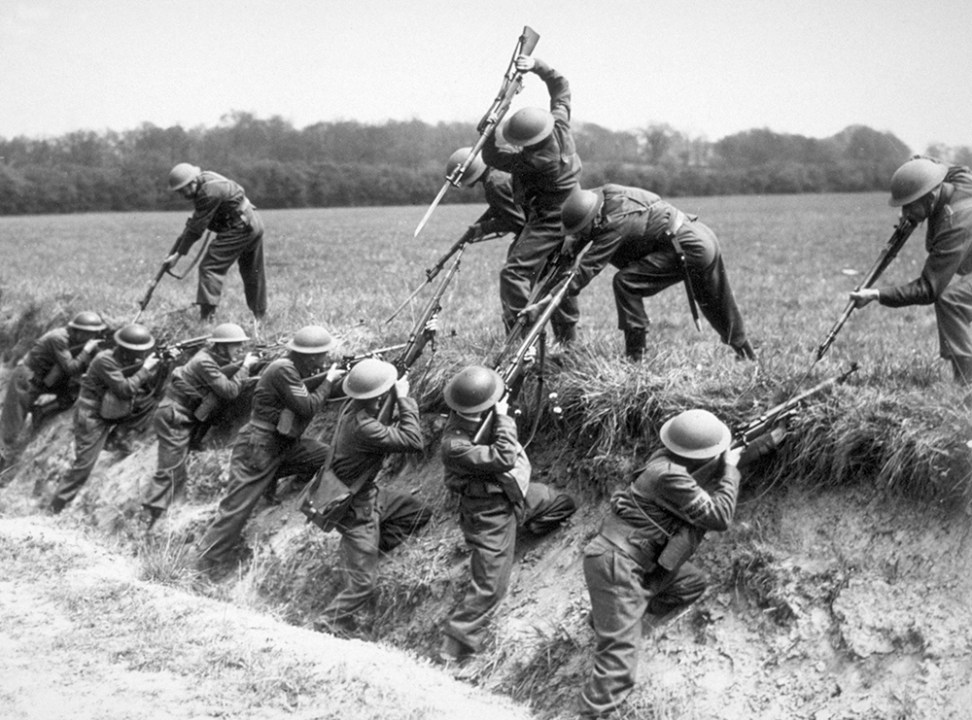
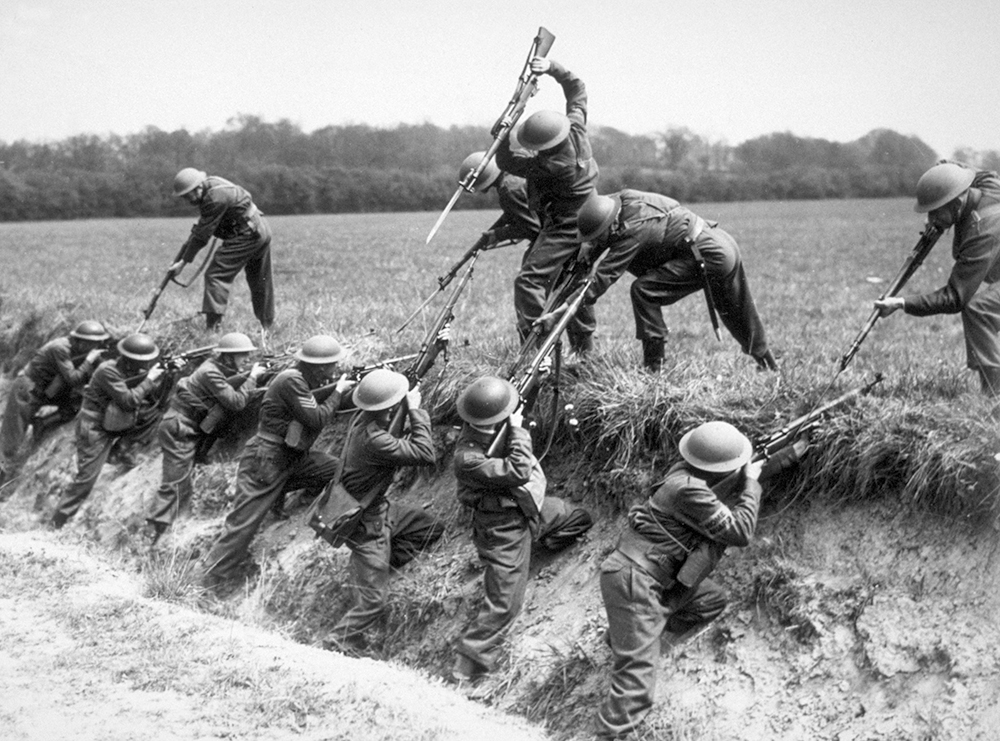
Ever since the BBC’s Dad’s Army (which ran from 1968 to 1977), it’s been hard to keep a straight face when talking about the Home Guard. Just thinking about Corporal Jones one beat out from the rest of the platoon during drill makes us go weak.
Sinclair McKay’s book on the subject, actually called Dad’s Army, does not shirk from the hilarious aspects of this domestic front line of two million volunteers at its peak, many of whom did a full day’s work before turning out to practise defending their country all evening and sometimes all night. McKay makes frequent reference to the series, reminding us that its creator Jimmy Perry had been a young Home Guard recruit and that its class-conscious characters (pompous bank manager, his socially superior deputy, panicky butcher, doomy Scottish undertaker etc), as well as many of its storylines, were drawn straight from life.

So let’s get the giggling out of our system before we buckle down to the fact that in 1940 a Nazi invasion was thought to be inevitable and that this band of men in baggy uniforms held up with safety pins, some wearing pudding basins on their heads because they couldn’t get hold of a steel helmet, was expected to thwart and delay the waves of invaders through gunfire, roadblocks, sabotage and message chains.
It’s a world of village halls, upside-down cakes, flasks of tea and British etiquette. When Hitler’s deputy Rudolf Hess bailed out of his crashed plane in Renfrewshire in 1941, the Home Guard were the first to intercept him and they politely took him for tea in a local old lady’s cottage. It’s a world of night exercises, supervised by ‘umpires’, at the end of which there were always ‘light refreshments’. It’s pipe-smoking old husbands in Home Guard uniforms cleaning their guns while wives patiently knit beside the fire. It’s hopelessly outdated weaponry (before Franklin D. Roosevelt helpfully sent some desperately needed rifles): shotguns from the previous century, golf clubs, garden forks, pikes and ‘a good, leafy stick’. It’s whiskered first world war and even Boer war veterans working alongside fresh-faced 17-year-olds – and both of those cohorts were extremely bloodthirsty, itching to throw genuine grenades.
We hear of a teenaged recruit, a carpenter by day, who was particularly in awe of two veterans in his platoon, one nicknamed ‘Snatchy’ (he’d lost an arm in the Great War) and the other ‘Nimble’ (he’d lost a leg); the so-called ‘gadgets of mass-destruction’, such as the ‘Northfield Projector’, a new-fangled weapon that looked like ‘a drainpipe on a tripod’, whose only flaw was that it couldn’t fire with quite enough force to pierce the hull of an enemy tank; and the cheating husbands saying: ‘I shan’t be home tonight, m’dear. I’m off to the Home Guard.’ Also conjured are the country pubs, instruction pamphlets and the villagers pouring terrified out of their beds in the middle of the night when the church bells start ringing, only for it to be a Home Guard exercise, not the real thing.
Good. Got all that out of the way. Because now the serious part starts. Just because Britain wasn’t invaded (apart from the Channel Islands), it’s hard to reconstruct the mindset of terror and the deeply serious intent behind the formation of this outfit. Its founding principles as a ‘People’s Army’ were set out before the war began by a dedicated socialist called Tom Wintringham, who’d been jailed in 1926 for his communist revolutionary zeal. Wounded in the Spanish Civil War, he saw at first hand the reality of total war and was under no illusion about what could happen in Britain.
Anthony Eden’s speech on 14 May 1940 asking civilians to sign up to what was then known as the Local Defence Volunteers inspired hundreds of thousands. The Dunkirk evacuation a week later caused a surge of national optimism (even though it was a defeat) and another massive spike in volunteers, who committed to training, parading and drilling in the evenings and at weekends in local platoons all over the country. By the end of the Battle of Britain that autumn, numbers were up to 1.5 million. Churchill changed the name to the Home Guard, with its ‘suggestion of valour and honour without overt belligerence’, as McKay puts it. It was typical of Churchill’s sensitivity to language that he chose the word ‘Home’, not ‘National’.
Cheating husbands would say: ‘I shan’t be home tonight, m’dear. I’m off to the Home Guard’
The instructions sent out from the War Office to platoons were ‘visions of an English apocalypse – in a pamphlet’. In each village, a ‘keep area’ must be selected, and rooms in houses should be ‘protected by barricades of chests of drawers and other furniture filled with earth and rubble’. Readers were warned that Germans might arrive in disguise, dressed as priests ‘or even as women’.
Members practised repeatedly for all these eventualities, learning ‘the dark arts of war’, such as how to decapitate an enemy motorcyclist with a wire. ‘The thirst for conflict was roaring through their veins,’ McKay writes. I admit a tiny bit of me wanted them to put this training into action and I sensed mounting anticlimax when it never quite happened. Instead, when the Blitz started, the Home Guard was called in to clear rubble and rescue families from blocked shelters and to take on anti-aircraft duties. Many enjoyed it, because at last they were involved in active duty against a palpable threat instead of the incessant mocked-up war games. Women were allowed to join from 1943, but in non-combatant roles only.
One invaluable aspect of the Home Guard was that it trained and made ready for call-up a new generation of young men. Gradually it evolved from its early ‘pike and pitchfork’ phase to being, as one army colonel called it, ‘the best trained and equipped force of its kind in the history of our country’. When it was disbanded in December 1944 in Hyde Park, there was a final muster and a march-past before the King (colonel-in-chief of the Home Guard), six abreast. One girl recalled looking for, and eventually spotting, her father: ‘On the outside left – just as he said he would be. Just look at him – all out of step.’






Comments