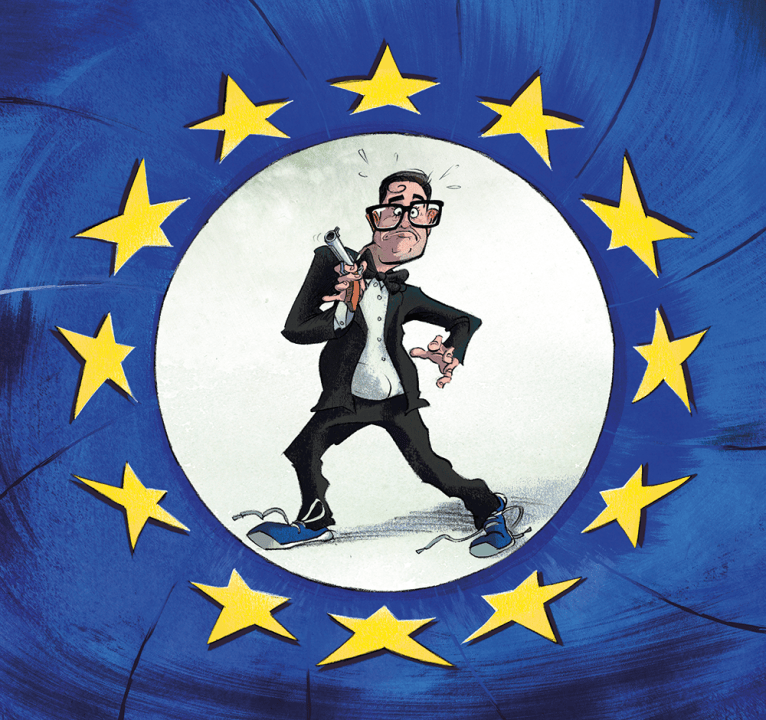


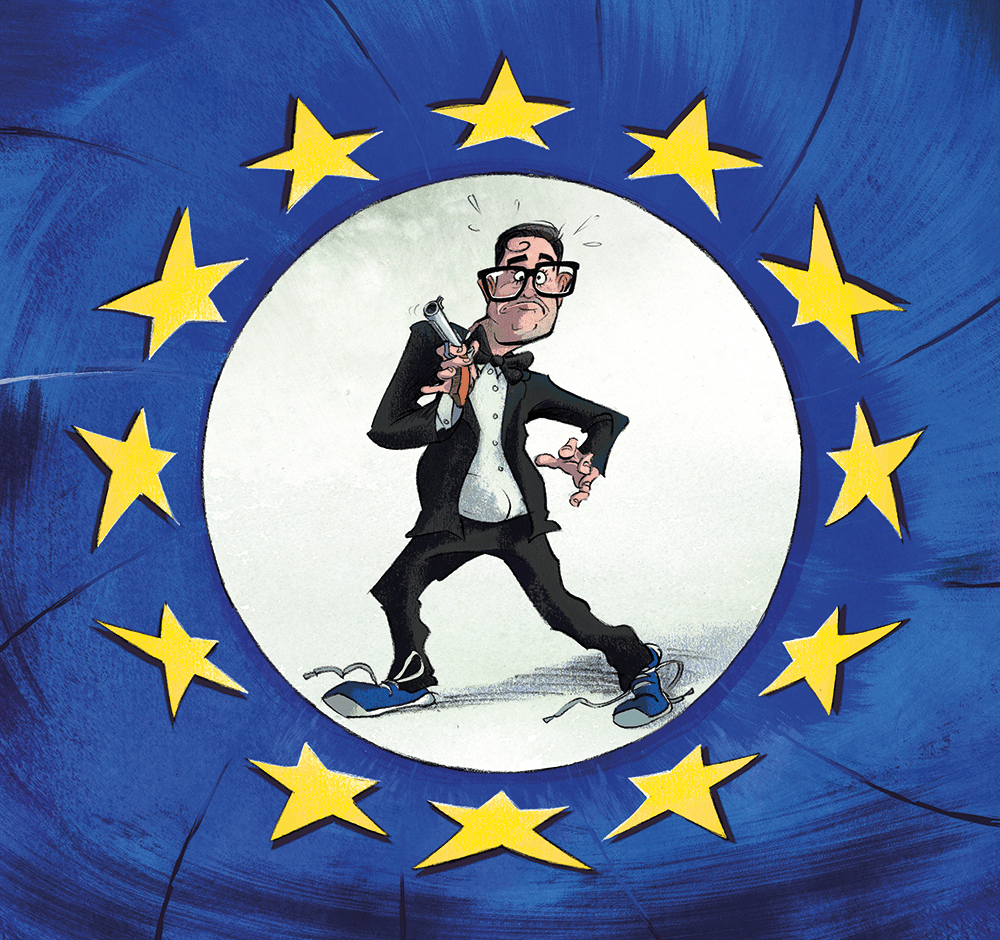
The day after Vote Leave’s victory in the 2016 EU referendum, the campaign director Dominic Cummings turned to a colleague and said: ‘It’s great. We’ve taken back control. The only thing that worries me is who we’re handing control back to.’ This week, that colleague reflected on the ‘prescience’ of these words.
Polls show voters do not believe Brexit was handled well over the past decade – something which Andy Burnham has used to justify thrusting Brexit back onto the political battleground. ‘For me it’s déjà-vu on steroids,’ says Nigel Farage who, like a lot of Brexit-eers this week, seems torn between outrage and excitement at the need to get back in the arena and fight. ‘Burnham has decided to poison the well of British politics.’
On Monday, the Prime Minister said, ‘The hard Brexit we were given is not good enough.’ He vowed not to rejoin the customs union or single market or accept freedom of movement ‘this side of a general election’, but said he would seek a deal which better resembles what voters expected in 2016, before a wholesale reset in the next parliament. It is a row about what is achievable economically and what is possible politically.
A large proportion of the public want Burnham to focus on ‘making Brexit work’ rather than on rejoining the EU
On Friday Burnham will attend a UK-EU summit in Brussels to finalise a deal that will give Britain closer access to the single market for food and animal products in exchange for cheap access for EU students to UK universities and a youth mobility scheme that allows 100,000 under-30s from the EU into the UK. Britain will also pay into EU cohesion funds for access to their energy market. Still at issue is whether the EU will let Britain join their Made in Europe programme, without which UK goods would be discriminated against just like those from China.
A No. 10 source says: ‘This is a deal that has cut costs, kept prices down and created more opportunities for young people.’ Downing Street’s internal polling shows that 71 per cent of voters support a closer relationship to help bring down prices and grow the economy. But Farage warns that aligning again with EU regulations will outweigh the benefits of reduced border bureaucracy. ‘It’ll be easier to sell beef and oysters into Europe, but it might make it even more difficult to sell beef and oysters to the rest of the world,’ he says. For instance, huge strides in gene editing for crops, where EU regulations are highly restrictive, will be lost. ‘Agri-tech is going to the moon now. We will lose more in agri-tech, more in lost fertilisers, more in compliance costs on the entirety of the food chain than we’ll gain. Europe, with its precautionary principle, is falling behind at a very rapid rate.’
Boris Johnson says Burnham’s deal will ‘close down whole avenues of scientific inquiry for no reason at all’. The same applies to AI, where the UK is ahead of the EU and where aligning with tight regulation could neuter one of the major Brexit benefits. The better-than-expected economic growth in the last quarter came predominantly from AI improving productivity.
Johnson – like the European Research Group (ERG), led by Mark Francois and Bernard Jenkin – brands Friday’s deal a sellout. ‘Burnham is already surrendering control of our money, our borders and our laws,’ Johnson says. ‘Why the hell should we be subsidising EU students but not Australian students? There are no good arguments for going back into any form of EU membership, even the attenuated one that Burnham is signing up to.’
However, the polling suggests the PM is pushing at an open door by seeking a closer relationship. ‘A majority accepts that Brexit is not working,’ says a Downing Street source. A Labour strategist who has conducted focus groups says: ‘On the cost of living, immigration and security, voters – including a majority of Leave voters – say Brexit is partly to blame.’ Added to that, the sense that Vladimir Putin and Donald Trump have made the world a ‘scarier place than in 2016’ has convinced many that working with our neighbours makes sense. Polling by More in Common shows that 59 per cent would vote to rejoin, while 41 per cent would vote to stay out.
So is this all a cunning plan, the opening moves in a game of 4D chess to get the UK back in the EU? Even defenders of Burnham do not claim so. One sympathiser quotes Henry Kissinger’s line that ‘Diplomacy isn’t classical music, it’s jazz’, an exercise ‘with no sheet music’. Burnham’s approach seems most obviously a ploy to unite left-of-centre voters to ensure his re-election. Some 79 per cent of Labour and 77 per cent of Liberal Democrat voters want to rejoin, compared to 34 per cent of Tories and just 14 per cent of Reform supporters.
Farage’s concern is that Burnham’s politicking plays into a civil service/deep state desire to rejoin, which has a momentum of its own. ‘Institutionally, they’ve been waiting for this for a decade,’ he observes. Another Brexiteer says: ‘Is he driving us to a bad destination or is he just drunk and swerving all over the road? Either way you end up in a bad place.’
There are also warnings in the data for Burnham. A large proportion of the public want him to focus on ‘making Brexit work’ rather than on rejoining the EU (46 per cent to 38 per cent). A colleague quotes Matthew McGregor, Burnham’s head of strategy, saying this in private: ‘In 2016, the British people probably wanted as much “out” as they could get while still being “in”. In 2026 they probably want as much “in” as they can get while still being “out”.’
The PM has also reopened the issue of freedom of movement. More in Common’s numbers show 51 per cent support it, with 21 per cent opposed, when it is described as ‘the right to live, work and study in the EU’. But framing it as ‘giving up control of Britain’s borders’ knocks support down to just 26 per cent, with 48 per cent against.
A former Vote Leave focus-grouper sums up the public mood: ‘Has Brexit been a disaster? “Yes.” Whose fault? “The politicians.” Would you go back in? “Yeah, maybe.” Would you accept the trade-offs? “Fuck, no.”’ Another Vote Leaver adds: ‘Do you want free movement? “I want to get through the airport without all those queues.” Do you want unlimited immigration from Albania? “No, of course not.”’
A source says of Stay Out: ‘This is all about creating the political conditions to stop a referendum’
Budget contributions are an even bigger barrier. Sixty-four per cent say sending even £20 billion to Brussels would be unacceptable. Which explains why the Stay Out campaign which launched on Friday, run by Vote Leave veterans, claimed that, on current EU rules, Britain without its old rebate would have to pay in £39 billion a year, or £750 million a week – more than double the £350 million which was emblazoned on the side of the Vote Leave red bus in 2016. By Wednesday morning 13,000 people had signed up.
The campaign is being run by Oliver Lewis, the deputy chief negotiator with the EU under Johnson and Rishi Sunak. Cummings was consulted four weeks ago, and gave the campaign his blessing, but he is not formally involved. The Vote Leave diaspora chips in ideas on a ‘Stop the Steal’ group. ‘Dom thinks it’s good to have a campaign,’ a friend says, ‘but he’s mostly in the States and he thinks his involvement would be counterproductive.’ When Lewis broke cover, he received a large number of messages saying ‘bat signal’ – in honour of Cummings’s declaration that if Brexit was in danger the Vote Leavers would issue a public warning.
This is not a campaign to win a referendum, but a fight to prevent one. Insiders compare it to Business for Britain, the ginger group which preceded Vote Leave. ‘It’s just a few people in a room eating cold pizza at the moment,’ says one. Another source says: ‘This is all about creating the political conditions to stop a referendum. This is about making Labour MPs realise what they’re doing is stupid.’
However, inquiries are already being made into hiring ‘multiple buses of truth’ daubed with the £750 million claim. Johnson tells me: ‘I don’t want to have to get back on the bus and go and campaign for Brexit again. But I bloody well will if I have to. That’s the truth.’ Three weeks ago he did a speaking event with David Cameron in New York and discovered that, ten years on, they are now on the same side, opposed to a new referendum. ‘I think this is just madness and such a waste of time. I have a sense of absolute frustration and weariness. It’s not the right thing for the country. It’s all about getting angry Remainer votes from Lib Dems and the Greens.’
Farage and Arron Banks, the Bad Boys of Brexit, who led Leave.EU, are also ready to launch their own campaign. ‘I have been in talks with Arron,’ Farage admits. Aides predict an ‘old-school press conference’ launch ‘in the next week’. Reform is already pushing the line that rejoining would mean ‘a million more legal migrants into the country over the space of the next parliament’.
The Bad Boys campaign will make three arguments. First, that Burnham is an ‘un-elected Prime Minister’ trying to take us back into the EU ‘without a mandate’ – an argument their internal polling shows is effective. Second, that it would lead to ‘open-door immigration’. Third, that ‘the people don’t want this debate’ and it is a ‘distraction’ from Labour’s ‘failing domestic agenda’.
So far relations between the largely Tory Stay Out campaign and Team Farage are good. Reform’s Richard Tice, the third Bad Boy of 2016, was quoted on Stay Out’s first press release. A former Vote Leave chief notes: ‘Burnham has achieved something remarkable. For the first time you’ve got the Tories and Reform agreeing on something.’ Just as in 2016, having different groups with different target audiences could pay dividends. Farage says: ‘There was little doubt that Boris being on board with Vote Leave made a big difference in Cheshire, in Surrey, in Devon, with those middle-class audiences. But Leave.EU’s different style of messaging reached the council estates of Sunderland.’
You wonder how long this truce will last, since Farage will seize the moment to try to revive Reform’s fortunes – at a time when Kemi Badenoch is explicitly appealing to Lib Dem voters in the south. No senior Tory has repeated the claim of her deputy, Alex Burghart, that a future Tory government would reverse every part of Burnham’s new deal. Nine members of the shadow cabinet, and her two senior aides, Mark McInnes and Stephen Gilbert, backed Remain.
Going on the attack, Farage says: ‘We voted Brexit. We got years of dither and delay. Then the Tories completely betrayed the electorate on immigration and on regulations.’ He points out that Badenoch, as business secretary, ‘refused to sign the document that would have got rid of 4,000 EU rules’. He adds: ‘She doesn’t want to talk about this because she’s got Lib Dem voters. But the government are going to talk about it. You’ve got to decide whether you’re on the field. They don’t want to be on the field. We will be.’ He, like some in No. 10, thinks this points to the main choice being between Labour and Reform. ‘If you want to stay out of the EU, it’s Reform,’ Farage says. ‘If you want to join the EU, it’s Labour.’
When Burnham addressed the cabinet about Brexit last week, he told them his new deal is ‘a win-win for both sides’. Aides say he ‘really believes’ that the ‘adversarial approach’ with Brussels ‘did more harm than good’: ‘We don’t want to go back to the division of 2016.’
‘Andy could have united the progressive bloc by just leaning into the reset’
But key cabinet voices – including Lisa Nandy, the Culture Secretary, and Shabana Mahmood, the Home Secretary – regard reopening the issue as misguided. A Labour MP said: ‘Lisa is completely bemused, she thinks, “What the fuck is he doing?” Shabana is similar. Lou Haigh [Burnham’s deputy] is not completely on board either.’ Jonathan Reynolds, the Business Secretary, whose department has spent years on trade deals that would be torn up in the event of Rejoin, has also voiced concerns. Most remarkably, for a government wanting to make an economic case for closer ties, John Healey, the Chancellor, is also concerned. ‘His roots in Rotherham are real,’ a cabinet aide says.
The vast majority of Labour MPs want to rejoin the EU, but two-thirds of them sit in seats that voted Leave. MPs in Red Wall seats met in recent weeks with the ERG to discuss collaboration. One Labour MP says: ‘If you’re giving the impression you’re going to rejoin, do you think that’s going to make them give you a better deal now? Andy could have united the progressive bloc by just leaning into the reset.’ A prominent Labour figure agrees: ‘It’s rank incompetence to talk about joining again when you’re about to actually deliver a bunch of things that are tangibly good for the British economy and for cost of living.’
Leave veterans believe Burnham has miscalculated because his absence from the fray ten years ago means he underestimates the passions the issue unleashes. ‘He spent the whole time playing with buses, ignoring the one bus that mattered,’ a Stay Out insider says. ‘Brexit and Europe are not normal issues. They trigger very deep emotions.’
The case for aligning with the EU also took a hit on Wednesday when revised figures published by the Office for National Statistics (ONS) undermined the established view that Brexit has mortally damaged the economy. The ONS dramatically revised up productivity growth since 2010, showing it accelerating away from the EU after 2016, rather than shadowing it as previous figures had suggested. Brexiteers point out that this time the business community is more divided. ‘Banks and tech companies don’t want to rejoin,’ one says. ‘Even the CBI is sitting on the fence.’ Even if Burnham confines his ambitions to the customs union, voters who have moved from the Greens and Lib Dems back to Labour may feel betrayed. ‘Whichever way he turns now,’ a leading Brexiteer says, ‘he’s going to piss off a third of the population’.
Yet Labour high command remains hopeful. They regarded the Stay Out launch video, with its rehash of budget contributions and threat of Albanian migrants, as ‘retro’ and ‘fighting the last war’. What is certain is that one side is misreading things badly.
What will happen? This, from a former Labour adviser, makes sense: ‘[Burnham] publishes four options – status quo, single market, customs union, rejoin. He concludes rejoin is not politically possible. He concludes a customs union neuters the UK. He goes for a new free trade agreement in limited sectors (pharma, chemicals, cars) and calls it a deep single market access deal that preserves no free movement and no payment to the budget (though we will have some discrete payments). Couple that with a defence and security agreement and sell it as a major revolutionary reset.’
Burnham reminds me of something Geoffrey Cox said about Boris Johnson in 2019, comparing him to a boxer, feeling out his EU opponent, throwing jabs, looking for openings. But as Mike Tyson said: ‘Everyone has a plan until they get punched in the mouth.’





Comments