
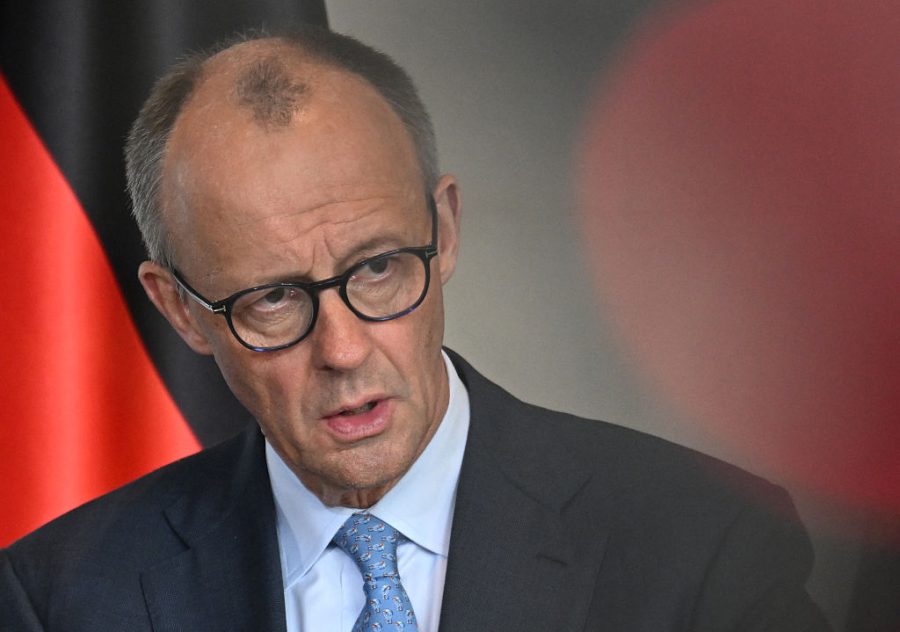
Germany’s conservatives voted for decisiveness after the dreary Scholz years. Instead, they got another moderator-in-chief – one very much like Angela Merkel.
On the campaign trail the promise was simple. Friedrich Merz would be everything Angela Merkel was not: decisive where she dithered, confrontational where she compromised, ideological where she triangulated. Conservative voters, exhausted by 16 years of Merkel’s anaesthetic centrism and then three more of Olaf Scholz’s leaden continuation of it, were ready to believe him. Germany had endured nearly two decades of chancellors who moderated rather than led, who treated conviction as a liability and caution as a virtue.
Merz, the sharp-tongued former BlackRock man who needed three runs at his own party chairmanship before anyone let him near the top job, was supposed to be the corrective. He was supposed to be the man who actually stood for something. It has taken him less than a year to prove that he does not. At times in which Germany faces one crisis after the next.
Merkel perfected the art of sitting problems out – absorbing crises into the bureaucratic process
The crisis summit held at Villa Borsig a couple of weeks ago – the Foreign Ministry’s lakeside guesthouse in north Berlin – confirmed what many in Berlin have suspected for months. Merz does not govern. He chairs meetings. He brokers between factions. He avoids fights with the SPD the way Merkel once avoided fights with everyone, and when one of his own ministers dares to pick a fight on his behalf, he punishes her for it by not standing by her.
The immediate trigger was fuel prices. The Iran conflict and the disruption of shipping through the Strait of Hormuz have driven energy costs sharply upward, squeezing households and businesses alike. Merz tasked his Economy Minister Katherina Reiche and SPD Finance Minister Lars Klingbeil with finding a joint response. Predictably, they returned with incompatible proposals. Klingbeil, channelling the SPD’s ancestral instinct that excessive profit is always evidence of wrongdoing, pushed for a windfall tax on oil companies and direct market intervention.
Reiche dismissed the proposals as expensive, ineffective, and constitutionally dubious. This was a textbook free-market position that the old Merz, the campaign Merz, would have delivered himself with a smirk.
Instead, the Chancellor was reportedly furious – not with Klingbeil, but with Reiche. His own minister. From his own party. For defending his own supposed principles. She was frozen out of the Villa Borsig talks entirely. The coalition negotiated economic policy without the Economy Minister in the room. That tells you everything you need to know about where power lies in this government.
What emerged on Monday last week was about as ambitious as you’d expect from a process like that: a €0.17 (£0.15) cut to fuel duty, limited to two months; a €1,000 (£866) tax-free crisis bonus that employers may choose to pay but are under no obligation to; and a tobacco tax rise which will hardly cover the bill.
The AfD party said it was too little, too late. Business groups noted the bonus effectively transfers costs to employers. State premiers from the CDU’s own ranks, facing elections in the autumn, were barely hiding their anger. Even by the low standards of German coalition arithmetic, it was thin.
The parallel to Merkel is not one of policy but of political character. Merkel perfected the art of sitting problems out – absorbing crises into the bureaucratic process, letting them drift until they either resolved themselves or became someone else’s inheritance. She moderated between coalition factions with such practised neutrality that nobody could say what she actually believed. It worked, in its way, for sixteen years – though the bill for her inaction on energy, defence, infrastructure, and immigration is still being paid.
Merz is reproducing the method at double speed. The much-heralded ‘autumn of reforms’ never arrived. It has since been quietly downgraded to a ‘reform window’ – one that will conveniently close before the next state elections. The deindustrialisation of Europe’s largest economy is observed from the sidelines, with no inspiring solution to be found within the Kanzleramt. And whenever the SPD advances a proposal that any self-respecting conservative ought to reject on instinct, Merz reaches not for the veto but for the compromise.
What makes this so ironic is the personal history. Merkel was the woman who ended Merz’s first career in politics. She outmanoeuvred him for the parliamentary leadership in 2002, sidelined him, and spent the next two decades embodying everything he claimed to oppose: ideological flexibility to the point of emptiness, coalition management as a substitute for governing, a deliberate refusal to lead where leading might cause friction. Merz built his entire comeback on being her antithesis. He is now her sequel.
The German voter, who wanted a chancellor with a visible set of convictions and the nerve to act on them, is left watching a man who cannot even defend his own Economy Minister when she says what he used to say himself. The strong man of the campaign trail turns out to be something rather less than that – not weak, exactly, but cautious in a way that amounts to the same thing when the country is crying out for someone to actually make a decision.


Comments