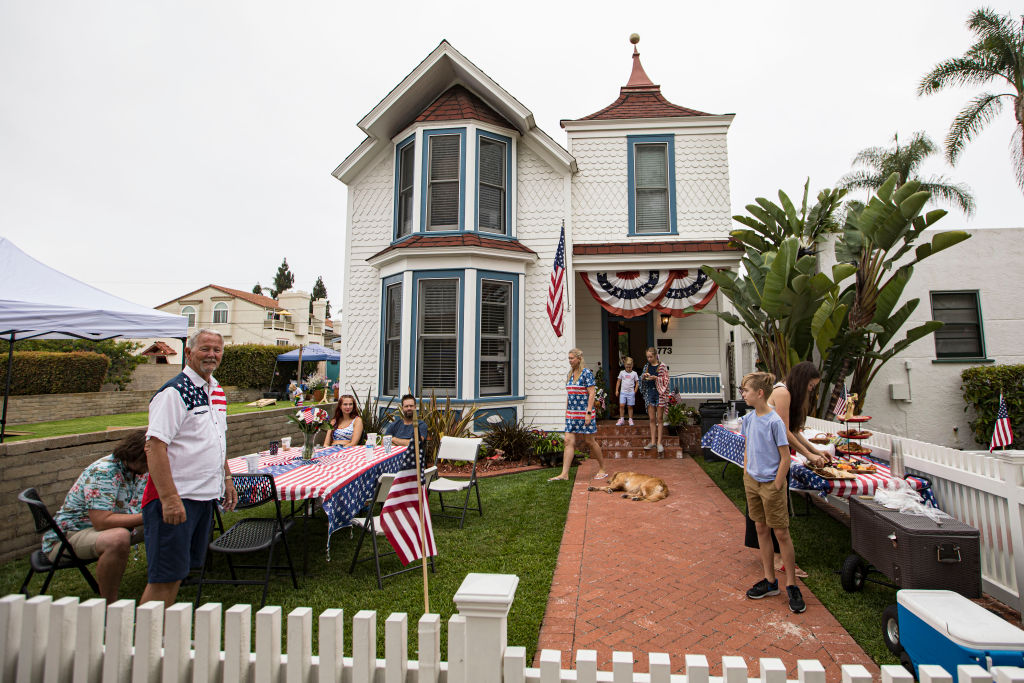

Barbecue, like fireworks and flying red, white and blue flags, is one of our oldest Independence Day traditions, dating back to the early days of the American republic.
A celebratory feast was the centerpiece of the holiday from the very beginning. On July 4, 1777, the Continental Congress in Philadelphia commemorated the first anniversary of the signing of the Declaration of Independence with “an elegant dinner,” as newspapers described it, followed by rounds of toasts to liberty and the memory of those who had fallen in the ongoing war.
In the decade that followed, the public dinners grew larger, and perhaps a little less elegant, as they moved outdoors and began to feature whole animals cooked on pits in the ground. On July 4, 1788, a “respectable body of gentlemen,” per the Pennsylvania Packet, gathered about a mile outside Richmond, Virginia, “where an excellent barbecue was provided.” On that same day, the citizens of York, Pennsylvania, and Augusta, Georgia, celebrated with barbecue, too. All three gatherings ended with cannon salutes and the drinking of 13 patriotic toasts, one for each of the newly united colonies.
By the first decade of the 19th century, massive outdoor barbecues were being staged throughout the country on July 4, bringing together entire communities to celebrate and affirm their shared civic values. The celebrations became surprisingly formal and standardized, as town after town adopted an almost identical set of ceremonies, culminating in a barbecue feast.
Newspaper accounts of these events read like boilerplate. The day began with the citizens forming a procession and parading to a central location, like a church or courthouse, the local militia unit in dress uniform leading the way. Then there was a prayer, before the Declaration of Independence was read aloud and the crowd sang patriotic songs, accompanied by the local band.
The ceremonies always concluded with an oration delivered by a prominent citizen, who expounded upon topics such as the principles of the revolution and the importance of the Constitution. After the florid oratory, the citizens would retire to a shady grove where the barbecue awaited – whole pigs, sheep and goats that had been roasting since dawn on pits filled with hardwood coals. The meal was followed by rounds of celebratory toasts to political leaders and patriotic ideals, beginning with a series of 13 “regular” toasts given by citizens chosen in advance for the honor. The 13th was usually devoted to honoring American women (or “The American Fair,” as it was usually phrased.) As each toast was shouted out, the crowd would respond with “loud huzzas and the firing of guns,” as the Camden Journal put it in 1831. Then followed any number of “volunteer” toasts – often 30 or more – offered spontaneously from the crowd.
Not surprisingly, considering the sheer amount of toasting, Independence Day barbecues became quite notorious for drunkenness and violence. In his memoirs, Dr. Samuel B. Latham recalled that during his childhood in antebellum South Carolina, the local militia companies would really let loose once the speechifying and the eating were done. “Hard liquor would flow,” he wrote, “and each section would present its ‘bully of the woods’ in a contest for champion in a fist and skull fight.” It wasn’t complete barbarism, of course. As Latham noted, “butting, biting, eye gouging, kicking and blows below the belt were barred.”
Even with all the booze and fisticuffs, July 4 barbecues served an important community-building function. The entire populace came together and, through the reading of the Declaration and the patriotic orations, affirmed and propagated the guiding principles of the young nation.
Over time, Independence Day barbecues began to lose their rough edges and became more respectable affairs. Amid the rise of the temperance movement in the 1840s, many communities staged “cold water” barbecues where no liquor was served at all, but those were the exception and not the rule. Americans have been celebrating the Fourth of July with barbecue ever since.
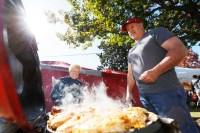
This year, for the momentous 250th anniversary, I’ll be celebrating in originalist style. A group of friends and I are gathering outdoors and cooking a whole hog on an old-school wood-fired pit. There will likely be a few toasts over the course of the afternoon, though perhaps not a full 13. We’ll probably dispense with the orations, too, and hopefully the fist and skull fighting. There will be plenty of barbecue, though. We wouldn’t have the Fourth of July any other way.




Comments