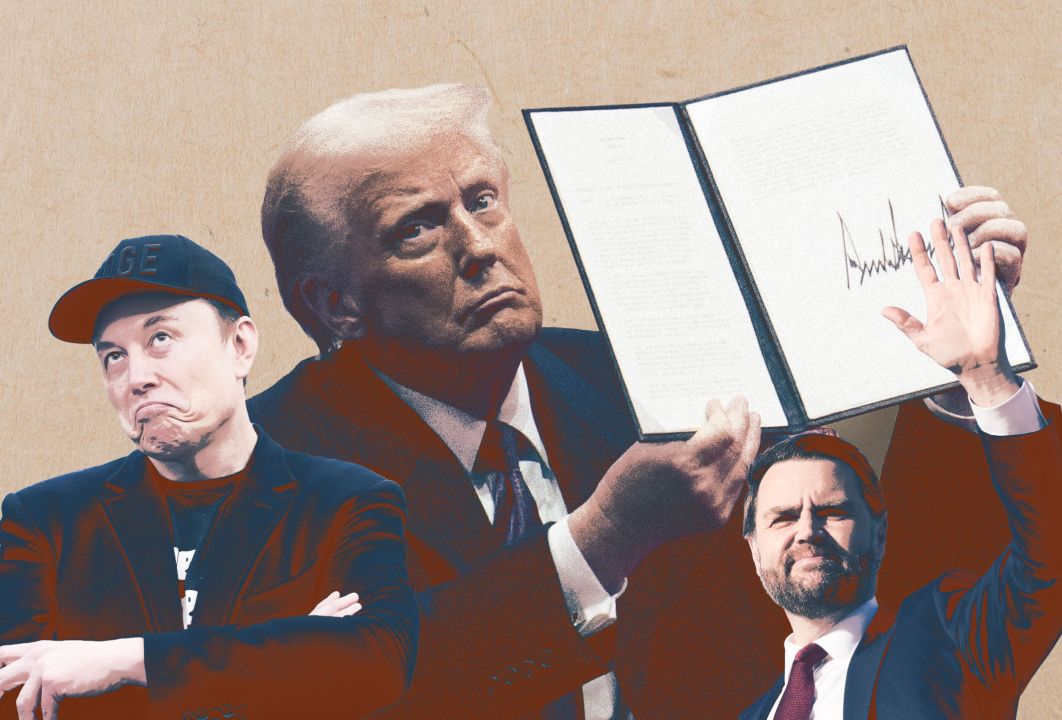

At the start of the second Trump administration, the words on everyone’s lips were “breakneck speed.” On the day of his inauguration, Donald Trump declared a border emergency, designated drug cartels as terrorist organizations and challenged birthright citizenship. He withdrew from international climate agreements and ditched Joe Biden’s mandates on electric vehicles. He rescinded various Diversity, Equity and Inclusion initiatives. On January 20, 2025, he issued pardons for individuals connected to the 2021 riot on Capitol Hill. And he established the Department of Government Efficiency (DoGE), which empowered Elon Musk to begin hacking away at federal bureaucratic bloat.
Trump signed 143 executive orders in those first 100 days, more than any previous president. He also issued 42 proclamations, 42 memorandums and signed the Laken Riley Act, empowering Immigration and Customs Enforcement to make more arrests. He imposed tariffs, first against Mexico, Canada and China, then on the rest of the world – “Liberation Day,” as he called it. Trump’s political opponents, and even many of his supporters, found themselves paralyzed in the face of such freneticism, lost amid a blizzard of executive action. Trump was moving fast and breaking minds.
The President and his team are full of passionate intensity for any issue that’s dominating the news cycle
But America is a democratic republic and executive power is necessarily subject to the checks and balances of the US Constitution. Even the most ambitious administrations quickly become bogged down in the sludge of process, congressional procedure and the law. In June, the Supreme Court, even with a favorable conservative majority, struck down Trump’s executive order on birthright citizenship. In February, it also ruled that the President did not have the authority to impose unilateral tariffs.
DoGE made a lot of headlines in the first weeks of Trump II, then Musk departed and the effort melted into the bowels of the federal leviathan. In July, the department announced its closure. “While the formal mission of DoGE has come to an end, the mission to eliminate waste, fraud and abuse will continue,” read the press release, which is a proud way of saying “we failed.”
The swamp always wins. In fact, the Trump administration’s manic approach to exercising power – high energy, low attention to detail – appears only to have created more paperwork and legislative backlogs. After the summer recess, Congress will have just a few days to pass multiple hugely complicated and contentious bills. Last July, Trump made a great song and dance of the One Big Beautiful Bill Act, as if the federal economy had all been resolved in one great swoop. A year later, his new obsession is pushing through the SAVE Act, a noble bid to ensure electoral integrity before November’s midterms.
Now there is a whole new set of spending headaches – another reconciliation bill, appropriations, defense costs and a supplemental budget bill for the Iran war. There is another extension of the Foreign Intelligence Surveillance Act to be considered, and countless other farming, digital, aviation and permitting laws that need thrashing out. Mike Pence, Trump’s first vice president, had many faults, but as presiding officer of the Senate he dedicated his time to ensuring Trump’s tax program succeeded. J.D. Vance seems to have no comparable appetite for the agonizing drudgery of Capitol Hill. His wife Usha has just given birth to a fourth child, which will understandably have diverted his attention. But he has also spent recent weeks appearing on podcasts and promoting his new book. Perhaps in our hyper-mediatized age, it is impossible for anyone who possesses presidential ambitions to devote himself to the grind of congressional lawmaking.

That points toward a bigger problem with modern politics, the machinery of government and this administration in particular. Psychiatrists and psychologists tend to over-diagnose the problem of Attention Deficit Hyperactivity Disorder among American children. But, in our screen-addled age, more and more adults seem to suffer from a similar malady. The President and his team are full of passionate intensity for any issue that happens to be dominating the news cycle. Yet they are also quickly frustrated by process, distracted by arguments and all too eager to move on to the next drama.
The Iran war is a good example. Under pressure from Israel, President Trump convinced himself that the regime in Tehran could be defeated in a matter of weeks. The price of oil, he thought, and all concomitant economic anxieties, would have settled long before the next election cycle.
Now, five months on, Iran continues to fire drones and rockets across the Middle East and the conflict is threatening once again to spill over into a regional war. The “technical negotiations” over the Memorandum of Understanding, the so-called peace deal between Washington and the Iranian leadership, have stalled.
On July 22, Trump abruptly announced a nuclear deal with Saudi Arabia, presumably to show Iran that America is still in charge. What better way to stop one terrorist-sponsoring Islamist state from acquiring a nuclear weapon than by enabling another? The announcement caused more panic across the Middle East as America’s allies fear a new nuclear arms race. That’s the trouble with moving at a neck-breaking pace. It often leads to very nasty accidents.






Comments