In the spring of 1722, a 16-year-old apprentice in a Boston print shop began slipping letters under the door at night, signed by a middle-aged widow named Silence Dogood, who did not exist. The apprentice was Benjamin Franklin. His brother James, who owned the paper, had no intention of printing his kid brother, so Franklin invented a woman and let her say the things he couldn’t. Readers wrote in guessing at the author. No one suspected the boy sweeping the floor.
Franklin would go on to be a printer, a postmaster, a scientist famous across Europe for his electrical experiments and a founder of libraries, fire companies and, in time, of the United States itself. He was the first of a restless American archetype the Old World seldom produced: the private citizen who builds, for himself and at his own risk, the machinery on which a public depends.
Historians have long argued that newspapers, pamphlets and almanacs did more than spread the Revolution. By 1776, when 13 colonies declared themselves independent of the British crown, the revolutionaries had come to see their 13 separate struggles as one continental cause. Two and a half centuries ago that infrastructure was cheap and open. Anyone with a few pounds and a grievance could print a pamphlet and go looking for readers at the nearest coffee house. Thomas Paine had neither money nor standing: a failed corset-maker and dismissed excise officer, he had reached Philadelphia in 1774 with a letter of introduction from Franklin, then in London. Little more than a year later, writing anonymously, he published Common Sense and made independence sayable in plain English. “We have it in our power to begin the world over again,” he wrote.

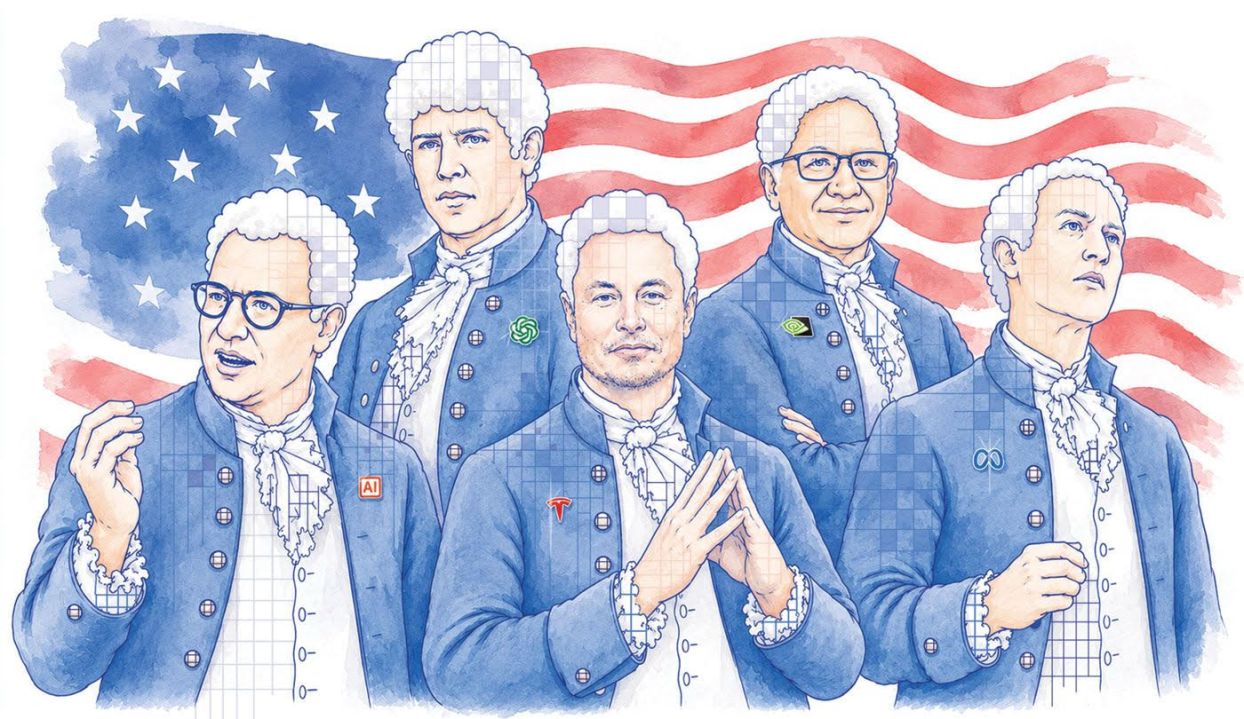
Today, the new machinery has owners, but they talk like the founders of a nation. Dario Amodei, who runs the AI company Anthropic, says he is building toward “a country of geniuses in a data center”: millions of AI minds, each sharper than a Nobel laureate, housed in the machines. Jensen Huang, whose firm Nvidia makes the chips most of the world’s AI is trained on, tells governments they each need “sovereign AI” – the power to “own the production of their own intelligence.” Countries, sovereignty, intelligence: these words belong to a nation’s founding. But the automated geniuses in this “country” – that is, a data center – are inventory, not citizens. Paine was able to add his voice to the argument over American independence. He could not change what every other reader saw. The owner of a social media feed powered by AI can drastically transform what the users see. Elon Musk bought the platform Twitter, renamed it X and reshaped its feeds and algorithms to suit himself. This is a dial on the public’s attention that no pamphleteer ever held.
That’s the heart of it. Print created shared stories: the same pamphlet, the same newspaper, the same sermon, read by strangers who could then disagree in the open. The machine age personalizes them. The feed is tuned to one reader; the assistant answers one prompt in private and the next reader gets a different reply; synthetic text, voice and image make shared facts harder to find. None of this has been shown to dissolve a democracy. The best controlled studies of the 2020 American election found that, over a few months, changing the algorithmic feed reshaped what people saw, but did not measurably shift their views.
The first founders feared a tyrant who would seize the public square. The newer fear is stranger – not one square seized by military coup, but a million private squares, each fed by its own algorithm, with no shared ground left to argue on. None of this is as new as it sounds. Today’s founders are chief executives in hock to shareholders, and we have seen their kind before: the railroad and telegraph builders, John D. Rockefeller’s oil empire, the Bell telephone monopoly, private empires that ran public infrastructure and were brought to heel by the laws and regulators of an elected government.
But consider who owns the presses now, who is inheriting the great revolutionary age of pamphleteers and debaters. Sam Altman’s OpenAI, Amodei’s Anthropic and Demis Hassabis’s DeepMind, owned by Google, build the intelligence; Huang’s Nvidia supplies its engines in the form of chips; Mark Zuckerberg and Elon Musk own the social media squares where the country reads and argues; Marc Andreessen’s venture capital firm pours billions into the build-out and supplies its manifestos. While the old barons moved oil and trains, today’s founders own the very channels through which the public reasons and decides on the future. And here the Gilded Age stops being a reassurance. Rockefeller’s oil never grew cleverer than Rockefeller. Yet today these AI systems already write, solve problems and pass the exams we set for our brightest students.
Geoffrey Hinton, who won a Nobel Prize for developing the methods underpinning modern AI and then departed Google to warn of the risks, puts the odds that AI eventually extinguishes humanity at one in five. In 2023, the chief executives of OpenAI, Anthropic and DeepMind signed a single sentence ranking their own creation “alongside pandemics and nuclear war.” No railroad baron ever feared his creation would outgrow him. None of this reduces the new founders to villains. DeepMind used AI to predict the structure of nearly every protein known to science and gave the results away for nothing.
The power being gathered now is private, answerable to shareholders rather than to the public
The great obsession of America’s founders was constraint. Having thrown off one unaccountable sovereign, they meant never to build another. They quarreled furiously over how strong the new state should be – Alexander Hamilton for more central strength, Thomas Jefferson for less – but every one of them assumed that power of this kind, the power to govern a people, would answer to the governed.
This generation has reversed that assumption. On June 12, SpaceX went public in the largest stock offering ever and made Elon Musk the world’s first trillionaire, at least for a while. Anthropic has filed to follow with its own offering, with OpenAI expected to do the same. The power being gathered now is private, concentrated and answerable to shareholders rather than to the public.
Franklin built machinery the public could depend on, and gave it away. No patent on the lightning rod. None on the Franklin stove. We profit so much from the inventions of others, he wrote, that we should offer our own “freely and generously.” The new founders have made the opposite bet. They mean to own the channels of our thought.



Comments