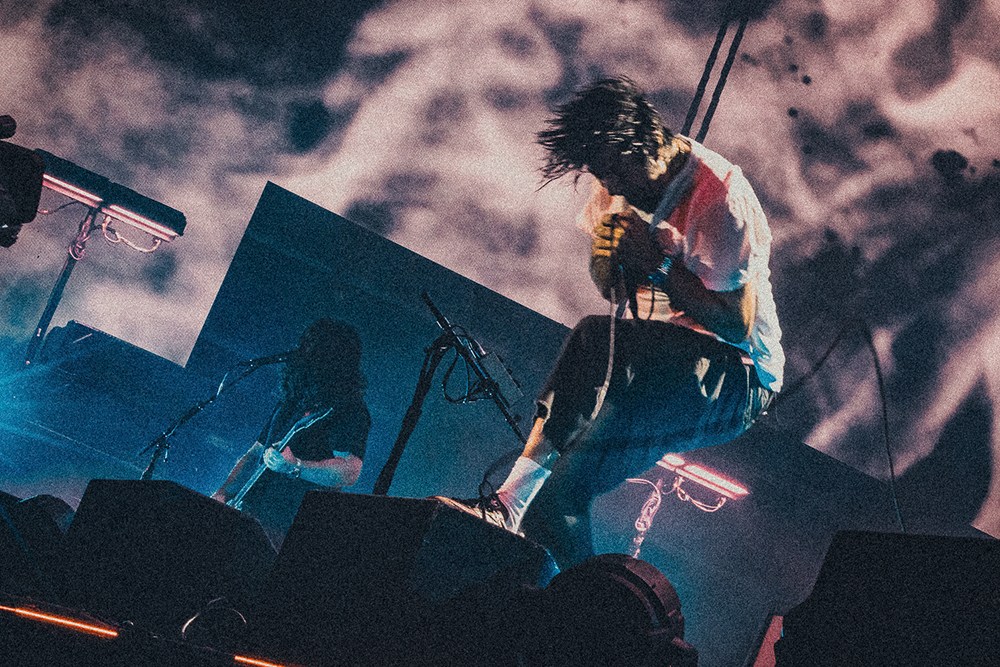
You could have been forgiven for mistaking Hackney for the site of an El Alamein reunion the other Sunday. Victoria Park was cloaked in a cloud of dust. Tens of thousands of feet had scrubbed the grass clear during All Points East festival and were pounding the scorched earth. People were covering as much of their faces as they could with masks, pulled right up to their eyes, sunglasses blocking the remaining skin. I saw a couple of enterprising chaps wearing pilot’s goggles – and given the state of my eyes as I tried to move around the site, I don’t blame them.
The Californian band Deftones were headlining the park as part of an event called Outbreak, in turn part of a multi-weekend series of events under the All Points East banner. It seems now as though you can’t go out in London at the weekend without stumbling over a music festival. Last summer (I counted until I could count no more) there were more than 100 rock and pop shows in the capital with a licensed capacity of more than 15,000. Leaving aside the issue of whether that’s a sustainable number – plenty of industry people feel it is not – it’s impossible to ignore the issue of what it does to London’s outdoor spaces.
Lead Jeff Tweedy is no one’s idea of an effusive frontman but after every song he raised his arms in triumph
I don’t blame councils for renting out their parks: they need to pay for their services somehow. But I hope they’re getting an awful lot because a third of Victoria Park – one of east London’s great spaces – is now an actual desert. (It won’t surprise you to know that the contracts between AEG, the promoters of All Points East, and Hackney council are not publicly available.) Presumably they’ll have got it back in shape in time for it to be ruined again next year, but in the meantime, the local residents just have to lump it. And AEG want that part of the park cordoned off for even longer next year.
Coming from the central valley of California, Deftones are presumably used to extreme aridity. Their singer, Chino Moreno, expressed surprise at the size of the crowd that had come out for them. Active since the 1980s, Deftones are a bigger draw now than they were when they were making the records that defined them: albums that combined roaring, miserable metal with the textures and tones of shoegaze, and drumming that gave them an unusually Zeppelin-esque swing. Live, with big wrap-around screens that were expertly used, it was like being thrust at the foot of a huge mountain face. It was awesome stuff, but completely unscaleable for neophytes.
What’s fascinating, though, is that Deftones keep converting neophytes. Notwithstanding the fact that the man next to me looked and sounded so much like Roger Allam that after leaving I was googling to see if it could have been him (it couldn’t; he apparently despises heavy metal), Victoria Park was full of people who weren’t even born when Deftones started having hits. Of course, no musician ever went broke overestimating the teenage taste for self-pity, but it was genuinely startling to see how young a crowd this old music attracted.

It does feel as though rock music is, if not back back, then certainly back – attracting kids in significant numbers once again. And maybe one reason they’re all at Deftones is that we’re waiting for a young band to be the vanguard the way Arctic Monkeys were 20 or so years ago, or Blur and Oasis a decade before that. Or it might be that Deftones are now seen as, say, the Stones were when I was 20 – an experience you have to have before it’s too late. As we now know, it’s never too late.
Wilco are a band who have passed seamlessly from being a working rock band to a model of creativity and self-fulfilment for young bands to aspire to. Their show at Hammersmith was masterly and unusually cheery: lead Jeff Tweedy is no one’s idea of an effusive frontman, but after every song he raised his arms in delighted triumph. Following an astounding ‘Via Chicago’, a pretty country song repeatedly detonated by explosions of noise, the self-celebration was entirely justified.
A couple of nights earlier, I’d caught one of the children of Tweedy, Greg Freeman, a Vermont musician who started off making country rock but who’s now dealing in fuzzy, scrappy power pop – the kind of music that can’t decide whether to offer you a sherbert lemon or a switchblade. It was loud, fizzy, exciting, and he’d sold out two nights. Honestly, there’s something happening here – even if it ain’t exactly clear what that is yet.




Comments