
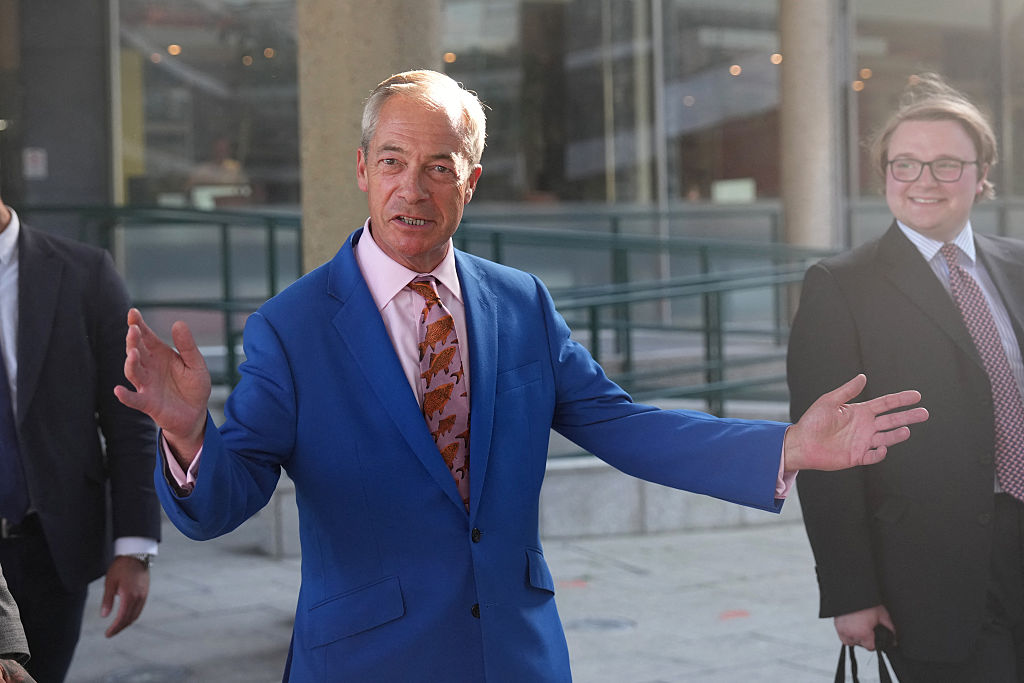
Reporting on the news that Nigel Farage is planning to resign his seat to force a by-election, Le Monde described the stunt as a ‘highly unusual move’, the Wall Street Journal called it ‘unconventional’ and the Australian Special Broadcasting Service called it ‘unusual’.
Now, few of us would call what happened yesterday ‘conventional’. Nonetheless, it may be of help to some parts of the foreign press if we provide a bit of extra context on Farage’s dramatic by-election resignation. While events like this are infrequent, taking the Chiltern Hundreds to make a point still has well-established precedent in British political history.
‘Before the war, the first women to be elected as an MP in Scotland, Katherine Stewart-Murray, resigned her Unionist seat in 1938 in protest of the Conservative government’s appeasement policy towards Nazi Germany.’
Just ten years ago, in 2016, the Conservative MP Zac Goldsmith resigned his seat in Richmond Park over his government’s proposal for a third runway at Heathrow airport, fulfilling a pledge he made when he had won the seat in 2010 to oppose the extension at any cost. Goldsmith then stood as an independent candidate. The Tories decided not to run a candidate in the election, giving Goldsmith a clear run. He was narrowly beaten by Sarah Olney, the Liberal Democrat candidate, who won a majority of 1,872. Goldsmith was able to take the seat back at the 2017 election with a tiny majority of 45, but Olney retook it in 2019 and has held it ever since. Her majority at the last election was a whopping 17,155, a strong example of how much ground the Tories have lost in pleasant West London suburbs over the past ten years.
The most famous recent example of an MP forcing a by-election to make a point is David Davis. In 2008 he resigned his seat in Haltemprice and Howden and his position in Cameron’s shadow cabinet. He did so following a vote on the Counter-Terrorism bill which greatly expanded the scope of policing powers, including extending the period for which terror suspects could be detained without charge to 42 days. The Liberal Democrats, Labour and Ukip all decided that they would not contest the vote. Interestingly enough the BNP decided not to run on the grounds that it supported Davis’s view on ‘traditional British civil liberties’.
Davis won a handsome majority with 71.6 per cent of the vote, as only minor parties like the Greens, the English Democrats, the ‘Church of the Militant Elvis’ and of course the Monster Raving Loony Party opposed him. David Cameron made a public show of supporting Davis but announced that the Conservative party would not fund his campaign, forcing Davis to resort to grassroots funding. The real sting came later, after Davis was returned as an MP: he was left out of cabinet in the coalition years, his career only being resurrected only when Theresa May appointed him as chief negotiator for exiting the European Union.
Interestingly enough, when Davis forced his by-election the cost was around £80,000. Adjusted for inflation this would be £131,174 today. Compare that to the estimated cost of Farage’s by-election – £250,000 – and it looks like the cost of holding one has doubled in real terms in eighteen years.
In 1985 and 1986 a much larger protest was staged through resignations. Following the signing of the Anglo-Irish Agreement by Margaret Thatcher and the Irish Taoiseach Garret FitzGerald – the first agreement to accept the principle of power sharing with the Irish government – all fifteen sitting Unionist MPs in Northern Ireland (including the UUP, DUP and the UPUP) resigned on mass in protest. Fourteen of the 15 resigning MPs were returned, often with stronger majorities as the nationalist parties stood back in certain seats. Ian Paisley won 97.4 per cent of the vote in North Antrim, an increase from 54.2 per cent at the 1983 general election. Enoch Powell saw his majority increase slightly in South Down. The only Unionist casualty of the night was Jim Nicholson, who lost Newry and Armagh to the SDLP’s Seamus Mallon.
In 1973 Dick Taverne, a Labour MP from the right of the party, decided to resign and force a by-election because his sternly pro-Europe views were causing consternation within his local constituency Labour party. Taverne stood as ‘Democratic Labour’ and defeated both Labour and the Tories handsomely, winning a majority of 13,191, helped in part by the decision by the sympathetic Liberal party not to stand. Taverne held his seat again in the first of the 1974 general elections, but lost it when Wilson called a snap election later in the year. This episode presaged the eventual emergence of the pro-European centrist SDP out of the Labour party – which Taverne later joined, staying with it through the merger with the Liberal Party, eventually being appointed a Lib Dem peer in 1996.
Labour has also seen by-election challenges from its left. In 1955, Richard Acland, a left-wing Labour MP who had formed a political party called the CWP during the war to oppose the unity coalition government, resigned as Labour MP for Gravesend. His intention had been to force a by-election over the Labour Party’s decision to endorse the then Conservative government’s nuclear weapons policies. His plan was foiled by Anthony Eden’s decision to call a snap election after succeeding Winston Churchill. Acland stood as an independent in the subsequent election, which allowed the Conservative candidate Peter Kirk to win a slim 2,909 vote majority.
Before the war, the first woman to be elected as an MP in Scotland, Katherine Stewart-Murray, resigned her Unionist seat in 1938 in protest of the Conservative government’s appeasement policy towards Nazi Germany. Stewart-Murray had been on quite the political journey. Born into an aristocratic family (her official title was Duchess of Atholl), she had begun her forays into politics as part of the anti-suffrage movement in Scotland, campaigning strongly against giving women the right to vote.
After taking up her seat (this apparently not contradicting her view that women should not vote) she became one of the leading voices in the Commons against fascism. She campaigned vigorously against fascists during the Spanish Civil War, wrote angry essays attacking supporters of Mussolini and denounced Adolf Hitler after reading Mein Kampf. She was given the nickname the Red Duchess, such was her anti-fascist fervour. She resigned the Conservative and Unionist whip and ran against the Unionist candidate for Kinross and Western Perthshire, losing by 1,313 votes.
This brings us back, finally to the 1912 Bow and Bromley by-election. George Lansbury, who would later go on to lead the Labour Party, decided that he would trigger a by-election on a platform of ‘votes for woman’. The Labour party did not give him their endorsement so he was forced to contest the by-election as an independent Labour candidate. Lansbury lost the election by 751 votes.
There have also been several occasions on which MPs who have changed party have decided that their constituents deserve to confirm their choice in a by-election. This was the general policy of Ukip defectors in the early 2010s. Both Douglas Carswell in Clacton and Mark Reckless in Rochester and Strood called by-elections, winning in both cases. More embarrassing in our history are the defectors who went on to lose. In 1982 Bruce Douglas-Mann defected from Labour to the SDP, calling a by-election in his constituency of Mitcham and Morden, only to lose the seat to the Conservatives.
Beyond the Commons, in 1984, when Margaret Thatcher wished to abolish the Greater London Council (GLC), ‘Red Ken’ Livingstone decided to have some protest resignations of his own. In August of that year, he and three other GLC members resigned to force by-elections in their seats, on the grounds that the subsequent votes would be referendums on the abolition of the council.
Thatcher called the move a ‘gimmick’ and said that the Conservative Party would have nothing to do with it. Livingstone and his comrades went on to win their seats easily that September, standing almost unopposed. Two years later, the GLC was no more. No doubt Kemi Badenoch is hoping her decision to avoid the Clacton by-election will yield similar results.




Comments