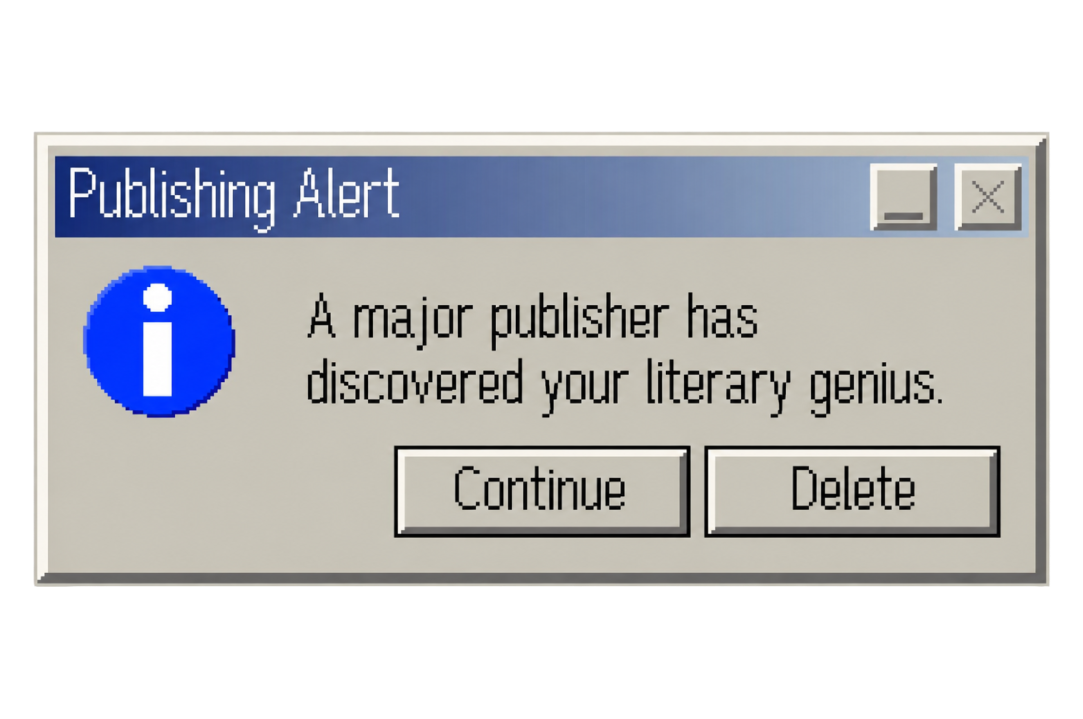

“Hello, James Gray. I am [ABC, a well-known executive editor at Macmillan, New York]. I recently came across your work and was genuinely captivated by it… I’d love to learn more about any projects you may be developing… I’m also curious whether you are represented by a literary agent. If you are, I would be happy to continue the conversation via them.”
This was a shot straight to the pumped-up ego. I’ve been slaving away more or less unnoticed for many years and published a few books, all pretty modest. Small things but mine own. At last, I’ve been spotted by a major publishing house. My name in lights. Here comes the big time. So I shot off some manuscripts, a résumé, a blurb.
They continued: “If you do not currently have an agent, I would be happy to introduce you to a trusted literary agent, and we can continue to develop our publishing relationship through her. Here are her details…”
Naturally, I emailed. “ABC at Macmillan suggested I should contract you about becoming my literary agent… here are some manuscripts and details about my background, etc. etc.”

Then came the reply: “I am currently closed to unsolicited submissions, but because you were referred by ABC at Macmillan, I’m glad to make an exception and take a look… it’s wonderful to hear about your background… 27 years in the House of Commons and ten books published with various houses is a remarkable foundation and sounds like you’re now sitting on some genuinely compelling material. Behind Closed Doors: An Insider’s Guide to the House of Commons sounds like it has good appeal…send me your manuscripts etc. and I’ll put together a representation agreement.”
Wow. What a charming, well-written personal letter. I’m really on to something here. All going very smoothly. Very professional agreement arrives, signed. Huzzah! I’ve got myself a highly thought-of literary agent with good connections with major publishing houses. My worth will at last be fully recognized.
“Well done. You write clearly and engagingly and it’s obvious from your letter why ABC from Macmillan is intrigued by the book. However, there are a few specific things you need to tighten up on before we can start submitting your book to publishers,” came the reply, accompanied by a list of ten very sensible improvements. I was to provide a clear, punchy, opening pitch; my track record; reviews, awards from previous books should be spelled out, not left to the résumé; audience/market framing needs sharpening, etc. All very sensible, and six or seven easily handled. But what about “correct formatting preferred by publishers?” This is beyond my limited expertise.
“You’re welcome to take another pass at it yourself or I’d be glad to introduce you to a specialist, [PQR, an editor]. She polishes query letters and submissions that have caught major publishers’ eyes.” (PQR is another New York-based expert editor.)
So comes the email from PQR. “Your book is genuinely compelling and I would be very excited to help edit it for publication… Behind Closed Doors is a genuinely compelling premise. Twenty-seven years inside parliament paired with a mission to correct the caricatures most readers carry about is exactly the sort of hook that publishers respond to. Below are two packages available for you: Plan A Emerald Package. Total Investment $1,250 or Plan B Diamond Package $1,750.” This comes with a two-page list of all the wonderful things she would do for my book and for me.
I’m truly sucked in now, and almost ready to hand over some money. But my political antennae twitched. There was something just not quite right about it all. The language sounded like AI – and besides, how have I gone from Macmillan, through a highly trusted literary agent, to someone seeking $1,750 to rewrite my publisher’s submission? A quick check (ironically enough, using AI) alerted me to what has recently become a widespread scam in the New York publishing market and is apparently now in its early stages in the UK.
I’m truly sucked in now, and almost ready to hand over some money. But my political antennae twitched
Using only slightly tweaked lookalike emails, a well-known publisher contacts an aspiring author (there are a lot of us around) out of the blue. The email lards you with flattery about your literary genius. What wannabe author would not glory in praise from such lofty sources? That leads to an introduction to an equally convincing and charming literary agent, who (apparently reluctantly) agrees to a contract. A bit of work is needed, so here’s the specialist – who is the first to ask for money. Doubtless the first of many.
AI tells me that you get more and more sucked in after that. “A major publishing house loves your book and is keen to publish. Just need some marketing materials/some further editing/travel to New York to meet publishers, etc. etc. Please remit $10,000.” And then you hear no more from them.
A lingering suspicion stirs. Reluctantly, blearily coming to realize that I have been scammed (thankfully before handing over any money from my meager MP’s pension.) That prompts a detailed look at the falsified email chain and the other very flattering tactics of these highly sophisticated and energetic scammers.
So authors: beware of fake publishers bearing gifts. Own up to your own egotistical readiness to be flattered. But know that publishers do not make unsolicited approaches, agents do not refer you to other paid editors or the like – and at no stage in the publishing process should money change hands, or at least not from author to publisher/agent.
They very nearly got me. So please don’t follow in my perhaps naive footsteps.






Comments