


At the opening night of the first ever “midterm” Republican convention in Dallas, Donald Trump roasted the local Democratic candidate for US Senate, whom he calls James “Talafreako.”
“He was also somebody that hated eating meat, but he ran a campaign to beat meat. He called it ‘beat meat,’” said Trump, to cackles of laughter from the MAGA faithful. “I don’t know what the hell he meant by that. These people are going to tell me ‘what the hell… he wants to beat meat?’ But it was bad for his image, so he started eating meat, and he recently – it’s getting worse. I’m getting myself in trouble.” That was the highlight of the President’s almost two-hour-long remarks.
Trump had announced the GOP’s inaugural midterm convention in June, with the intention of offering a shot in the arm to the Republicans’ prospects of keeping both Houses of Congress in November. “Pretend I’m on the ballot,” Trump implored the crowd on both nights. As the first of its kind, the impromptu RNC invited comparisons with two of the strongest events the American right has held in the past five years. First, the 2024 RNC, where Trump was nominated days after the Butler assassination attempt. The atmosphere in Milwaukee’s Fiserv Forum reached fever pitch thanks to an impassioned address by the wrestling legend Hulk Hogan. And second, the aftermath of Charlie Kirk’s assassination, which served as a major catalyst for grassroots involvement across the country. The one-year anniversary of Kirk’s death fell on the second day of the midterm convention.
That was always a high bar to reach – and sadly the comparisons did not flatter. “I was going suite to suite, a load were empty,” a Republican official divulges at the bar. Though the dates and location were announced in June, details on who would be speaking in Dallas were under wraps until three weeks beforehand. Sure, there were big sponsors such as Spotify and Substack, but fewer fringe events than you’d expect at the RNC proper. Then of course there’s the awkward matter of crowd sizes.

“See that man up there? He’s leaving for the bathroom. He’ll be back in two minutes,” Trump said in his night-one speech, teeing up a line about how unfairly he’s treated by the media. “They’ll take a picture of his seat while he’s gone, and they’ll say, ‘Trump did not fill up the arena. The arena was not filled. Look at the seat.’ So, please, if you don’t mind, don’t anybody go to the bathroom.”
“I’ve been speaking for an hour and 20 minutes. Nobody’s left,” he said later. At least three women were traipsing toward the exits as he spoke. To be fair, the American Airlines Center was more full on the evening of the second night, though still probably a little more than half of the 20,409-person record set by the Dallas Wings WNBA team last year. “The highest rafter, no empty seats,” Trump said Thursday. The entire upper ring of the auditorium was vacant.
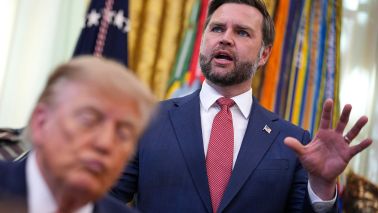
The Charlie Kirk tributes were led by Vice President J.D. Vance in his night-two keynote address. The VP reminisced about how Kirk was in the front row of the 2024 RNC when he was nominated as vice president, and offered a message to Kirk’s children: “History will record that your father was a great man.” The arena broke out in cheers of “Charlie!”
There had been murmurs that the RNC stage could amount to an anointing of Vance as Trump’s 2028 successor. “J.D. 48!” a woman yelled midway through his address, inspiring chants from the crowd. “Let’s take care of business this November, then we’ll worry about what comes next,” Vance responded. At the very least, the VP’s well-received remarks quelled the chatter about a Rubio, Cruz or Hegseth bid. For now.
Every American election eventually devolves into an approximation of a European civil war, with the so-called communists fighting the so-called fascists. The “c” word was flying all over Dallas. Trump decried “the pundits, the fake news media and the radical left communists”; his son Don Jr. proclaimed that “communism is on the march,” while former White House press secretary Karoline Leavitt warned about “extreme liberal socialist Democrats.”
Cutting against this neat party line was President Trump’s surprise announcement that, if the Republicans win the House and Senate in November, “I will issue a dividend to every adult citizen in the United States of America for $5,000.” This, if it happened, would be the largest US government handout in history. The proposal raised eyebrows in the arena. “I would like to know how they would plan to pay for, back of envelope, well over $1 trillion,” Representative Chip Roy, a Texas Republican and fiscal hawk, said. Potential 2028 candidates also sounded the alarm. “What I don’t think you want to do is borrow another trillion-and-a-half dollars and then just try to flood that into the economy, because that will lead to more inflation,” Governor Ron DeSantis of Florida said in his Thursday press conference. “Personally, I would rather see it tied to work because as a conservative and a Republican, I believe incentives matter, and I want to incentivize work,” Senator Ted Cruz said. Trumpworld embraced the opportunity to bop their old rivals. “Ron and Ted – the co-captains of your old high school Math-Lete Team – will nerd out on this while jockeying for 11th place in ’28,” a White House senior advisor told Politico Playbook. “Meanwhile POTUS is putting cash in Americans’ pockets.” In other words: caring about the debt is libbing out.
Ostensibly, the purpose of an American party’s political convention is to nominate a suitable candidate for president. Beyond that, it’s meant to offer chances for delegations to meet and mingle, and to offer a platform to turn local candidates national and lay the groundwork for future ambitions. As House speaker in the 1990s, Newt Gingrich was credited with recognizing “an opportunity in the newly installed C-Span cameras” in the chamber, the Atlantic’s McKay Coppins once wrote. He “began delivering tirades against Democrats to an empty chamber, knowing that his remarks would be beamed to viewers across the country.” The political convention stage now effectively serves the same role. “Let’s be honest, they’re living off the clips,” a Republican staffer admits. A couple of candidates will leave happy with their showing. But to build momentum, you need moments. There were far too few on display in Dallas.


Comments