
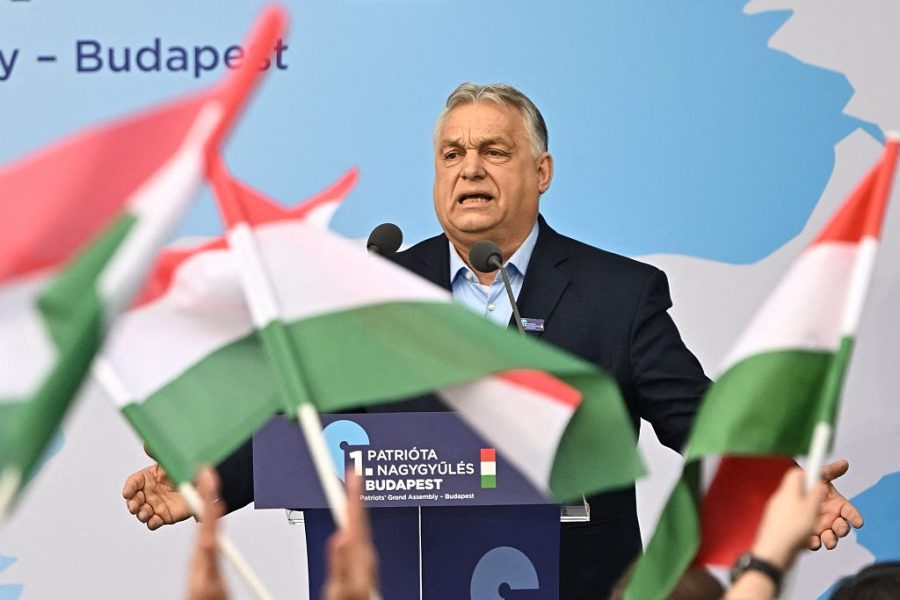
With a week to go until Hungary heads to the polls, Prime Minister Viktor Orban is fighting to save his political skin. Unusually for a set of Hungarian parliamentary elections, on 12 April, eyes across Europe and beyond will be glued to this set of results. Whether or not Orban remains in power will have widespread ramifications, not just for Hungary but also for the EU – and even Ukraine and Russia.
After 16 years in power, Orban’s Fidesz party is trailing in the polls with roughly 39 per cent compared to the approximately 49 per cent of his opponent and former Fidesz colleague Peter Magyar’s party, Tisza – relaunched under his leadership just two years ago. Since the election campaign got under way in February, accusations of wiretapping, vote buying, espionage and foreign interference have been levelled by both sides. With Magyar’s lead expected to solidify in the final days of the campaign, his supporters are daring to be hopeful. The Prime Minister’s campaign, meanwhile, has acquired more than a whiff of desperation.
Orban’s advocacy on behalf of Moscow in Brussels has been anything but spontaneous
Orban’s fight has been far from clean. Having won four terms in office under increasingly dubious circumstances, this is the first time he has been faced with a serious, solo political challenger as opposed to a brittle coalition of opposing parties. A right-wing populist who has leaned into closer ties with Vladimir Putin’s Russia, Orban has made Ukraine, with its president Volodymyr Zelensky and its backing by the EU, the central bogeyman of his campaign.
Orban’s anti-Ukraine rhetoric has grown more extreme as election day draws closer. In an attempt to harness Hungary’s nationalist sentiment, Fidesz has tried to smear Magyar as a ‘puppet’ of both Zelensky and Brussels. Zelensky himself has also featured on Orban’s campaign material, with unflattering pictures of him laughing accompanied by slogans such as ‘We must not allow Zelensky to laugh in the end’. At a rally in February, Orban went further, declaring that ‘Ukraine is our enemy’.

These are stark terms for the leader of an EU member state to use to describe Ukraine – not least given the extensive support Brussels has given to the country since Russia invaded four years ago. And yet, it is just one of a set of examples of Fidesz taking advantage of, and further stoking, fear of the war between Russia and Ukraine in an effort to portray Orban as the only politician capable of shielding Hungary from the conflict.
If that weren’t enough, in the past few weeks, Orban has found a bigger stick with which to bash Ukraine, inflicting real-world damage on the country – all in the hope of scoring himself a few more political points. In January, a section of the Druzhba pipeline – which carries Russian oil to Hungary via Ukraine – was damaged in a Russian drone strike, preventing oil from flowing through it. Having repeatedly accused Ukraine of sabotage and dragging its heels over repairs for the past two months, on 25 March Orban declared that Hungary would restrict gas supplies to Ukraine until Druzhba was restored.
Going further still, Hungary’s representatives to the EU Council used the Druzhba pipeline as a pretext for blocking a crucial €90 billion (£78 billion) loan for Ukraine needed by the country to fund public spending. Budapest is also currently holding the EU’s 20th Russian sanctions package hostage for the same reason.
It’s easy to see why the Druzhba pipeline issue in particular has so incensed Orban – and why he is milking it for political clout. Hungary is one of Russia’s biggest customers for oil, relying on it for approximately 93 per cent of its supply. Far from weaning itself off Russian oil as most of its European neighbours managed to after Vladimir Putin’s invasion of Ukraine in 2022, Hungary has done the opposite, doubling its dependence since 2021.
Reports have also surfaced in recent weeks suggesting that Moscow has been conducting an information campaign on Hungarian social media in Orban’s favour, promoting the Prime Minister as a strong, influential leader. A report by the Washington Post last month hinted at the degree of anxiety the Kremlin is feeling about Orban’s prospects at the election: incredulously, the Russian foreign intelligence service reportedly proposed staging an assassination attempt on Orban in a bid to boost his ratings in the final weeks of the campaign. How high up Moscow’s food chain this plan ever got, or if the Hungarian Prime Minister was even aware of it, remains unclear.
Most concerningly for Hungary’s fellow EU members, though, the past fortnight has revealed that the Orban administration’s advocacy on behalf of Moscow in Brussels has been anything but spontaneous. The leaked transcript of a phone call between foreign minister Peter Szijjarto and his Russian counterpart Sergei Lavrov made in 2024 has revealed the degree to which Budapest and Moscow have been in cahoots.
In the call, Szijjarto pledged, at Lavrov’s request, that Slovakia would push the EU remove sanctioned oligarchs from the bloc’s blacklists. Rounding off the call, the Hungarian Foreign Minister reassured Lavrov that ‘I am always at your disposal’. Another leaked recording of a phone call between Szijjarto and Pavel Sorokin, the Russian deputy energy minister, from last year revealed that the Hungarian proposed lobbying the EU to remove Russian banks from its sanctions list. He added that he was also ‘doing his best’ to thwart a sanctions package targeting the Kremlin’s shadow fleet of oil tankers.
It is not just Putin who feels invested in the result of Hungary’s election. Over in Washington, Donald Trump has openly endorsed Orban, urging Hungarians to ‘get out and vote’ for him. His vice president J.D. Vance is due to arrive in Budapest for a two-day visit on Tuesday, where he will meet with Orban and give a speech. Whether such direct interference in a foreign election by the Trump administration will work in shoring up Orban’s grip on power remains to be seen, but it has nonetheless made liberal administrations in Europe warier of a White House intent on guiding friendly, right-wing politicians to power.
Closer to home, Brussels is contingency planning for Orban to win a fifth term in office. European politicians – including Poland’s foreign minister Donald Tusk and Irish prime minister Michael Martin – confirmed this week that they have had suspicions regarding Szijjarto’s communications with Moscow for some time. Nevertheless, Brussels is believed to want to wait until after 12 April to respond officially or potentially punish Hungary, to avoid influencing the election’s outcome.
Brussels is hoping that, despite Magyar’s nationalist bent, his endorsement of the EU and Nato alliance along with pledges to root out corruption in Budapest would make his administration a pragmatic member of the bloc. Magyar’s ultimate aim is to secure a supermajority in next Sunday’s vote (133 or more of the parliament’s 199 seats). Only then would he have the numbers to overhaul Orban’s self-proclaimed system of ‘illiberal democracy’ in the country. The Tisza leader has promised to investigate Orban on suspicion of treason should he win, as well as work with Brussels to unfreeze EU funds withheld from the Orban administration.
At the moment, the polls suggest that Magyar should comfortably cruise to victory – although a supermajority may be elusive. But as four previous sets of increasingly unfair elections have shown, Orban won’t go quietly. The fear is that Fidesz is laying the foundation for a post-election narrative about a stolen vote, perhaps inspired by Trump in 2020. How Hungary navigates the coming weeks won’t just set the course of their own history, but will touch the lives of many far beyond their borders.


Comments