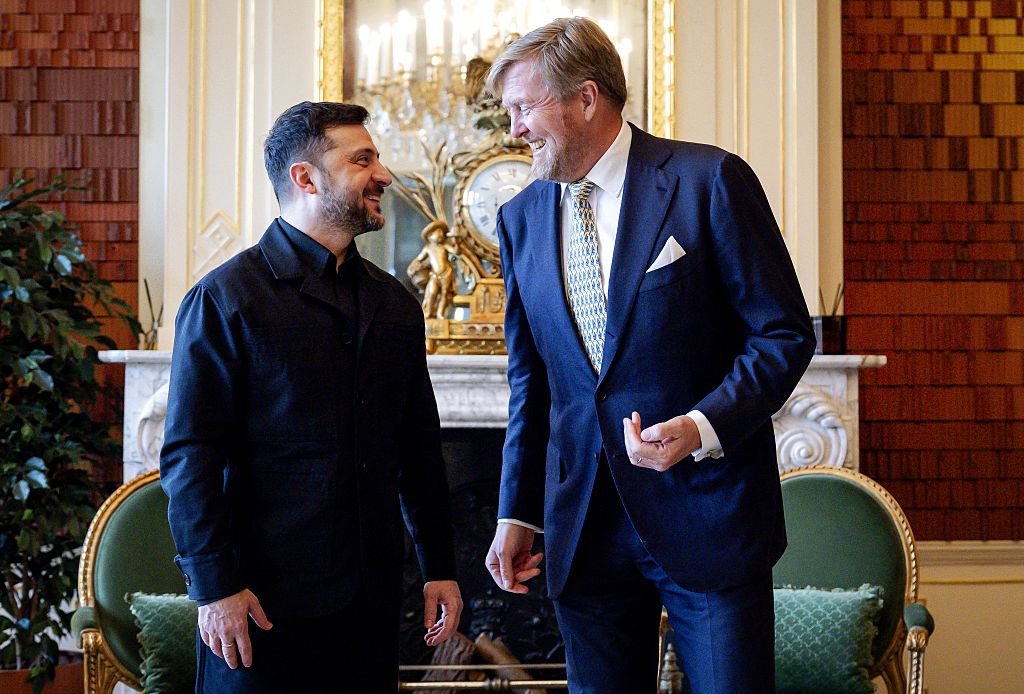


Ten days after Thanksgiving, news watchers were exposed to one of the more culturally incongruous images in recent history: Ukrainian President Volodymyr Zelensky and French President Emmanuel Macron beaming in front of the British Prime Minister’s house at 10 Downing Street, giving each other the locked-thumbs handshake familiar to African-American jazz musicians and professional athletes of the 1970s. Right on, brother!
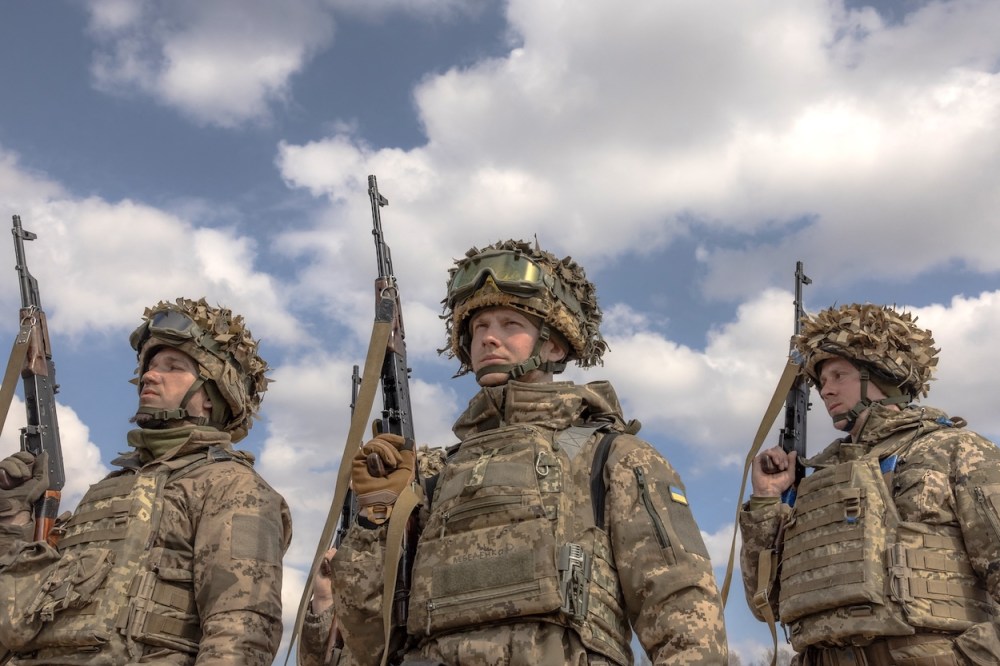
At that moment, according to Ukrainian media, thousands of Zelensky’s soldiers had been encircled by Russian troops near the city of Pokrovsk (or Krasnoarmiisk, as it may well soon be renamed). Large gaps were appearing in the Ukrainian front, desertions were rising and Russians appeared to be opening a new front east of Kharkiv. US President Donald Trump, whose country’s arms underwrote the Ukrainian effort for three long and expensive years, is urging Zelensky to come to the negotiating table. But Europe’s leaders, lacking the means to provide for their own defense, let alone Zelensky’s, are urging him to fight on. What has happened to them?
The Ukraine war that was going on in the weeks and months after the Russian invasion of February 2022 apparently took place on a different planet than the Ukraine war that is going on now. Back then there were fights for Kyiv airport, artillery barrages and a line of Russian tanks halted by sophisticated rocket attacks just west of the city. There was the occasional drone. There were feats of battlefield and naval targeting carried out against Russian assets such as the Black Sea “flagship,” the Moskva, that were outright astonishing – though these feats appeared less astonishing when it emerged, through journalistic dribs and drabs, that they had been carried out largely by Americans.
There was also a propaganda show such as the world had never witnessed: plucky little Zelensky traveling to different western capitals and delivering a fundraising pitch to each national legislature themed to each respective national mythology, as if in a Mad Lib: “Together let us follow in the footsteps of [local national hero] when he fought for [local historic triumph].” On Capitol Hill he was Abe Lincoln writing the Emancipation Proclamation; in Paris he was a combination of Joan of Arc and Jean Moulin; and in Westminster he was Winston Churchill, fighting them on the beaches. The approach mixed the bloody shirt and a “microtargeting” campaign worthy of a Harvard Business School casebook.
A near-unanimous consensus was formed to defend what just weeks before had been considered a basket case among western economies and a sink of corruption. Just 15 years after Barack Obama entered the White House on the strength of his opposition to the Iraq War, Joe Biden had brought the US back into the business of democracy promotion and “leadership,” whatever that is.
There were those who were not so enthusiastic. It did not escape their notice that the extraordinary performance of the Ukrainian army against one of the most advanced armies in the world was in fact suspiciously extraordinary. Retrospectively it vindicated Putin’s casus belli – namely that a certain hostile western superpower with a recent track record of promiscuous imperialism had set up shop in a neighboring country and was arming it to the teeth. It was coming to look like something unseen since World War Two – a direct military conflict between two superpowers. Back then, European leaders were among those urging restraint on Biden. But something has changed in the intervening three-and-a-half years. Now Trump is President, and Europeans are goading Ukraine to persist in an unpopular war that it cannot win. Again, what happened?
The explanation has little to do with Trump or even with Ukraine. It is largely that, since the war began, the political class of Europe has taken one blow to its prestige after another. For a generation since the Maastricht Treaty established the European Union in 1992, it has been natural to separate the Old Continent’s voters into Europeanists (who favored the EU) and Euroskeptics (who wanted to get rid of it and go back to just being France, Germany or Italy). The baseline psychological reality of the past generation is that Europeanists were able to cast themselves as a vanguard party that only a troglodyte would oppose.
But in 2016, Brexit triumphed and the taboo broke. EU-friendly political elites, bereft of their air of historical inevitability, have had to make the case for their rule, and their case is not a strong one. The European economy has stagnated since the financial crisis of 2008 – growing just 13 percent since then, versus 87 percent growth in the US. The EU has no significant role in the newest information technologies, such as AI. Its net-zero mandates and green-energy subsidies have killed the continent’s auto industry while failing to create a low-carbon sector to compete with China’s. State finances are crumbling. With the election of Giorgia Meloni in Italy in 2022 and Trump last year, with Germany’s AfD and France’s National Rally each polling as its country’s largest party, Europe’s leaders find themselves with little to say to their public.
In such circumstances, the giddiness of wartime command may be a delusion, but it offers Europe’s leaders the only context in which they can speak as leaders of the people. France’s budget deficit stands at 6 percent and Macron has no way to control a legislature bent on driving it higher. Financial collapse is a real possibility. If you found yourself in Macron’s shoes, you wouldn’t be going on talk shows. You’d be playing the warrior, standing with Zelensky in front of 10 Downing Street and looking like Churchill – if Churchill had had mutton-chop sideburns and known how to do the Soul Train handshake as they did it back in 1975.
This article was originally published in The Spectator’s December 22, 2025 World edition.





Comments