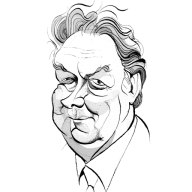

European Central Bank President Mario Draghi secured a place in history by his demonstration, on 26 July 2012, of the power of words in a financial crisis. Not long in office, he had already shown willingness to act firmly, averting a liquidity crunch by providing three-year lending facilities for European banks. That day, he told a conference in London: ‘Within our mandate, the ECB is ready to do whatever it takes to preserve the euro. And believe me, it will be enough.’ While the rest of the speech was an opaque metaphor about the euro as a bumblebee — ‘a mystery of nature because it shouldn’t fly but instead it does’ — ‘whatever it takes’ was clear enough to steady the bond market and ease borrowing costs of eurozone governments.
A central-banking veteran from the same mould as Mark Carney (both have also done time at Goldman Sachs), Draghi has achieved more authority than either of his predecessors — the downbeat, chain-smoking Wim Duisenberg and the posturing, ineffectual Jean-Claude Trichet. Most of Europe is now hoping he has another trick up his sleeve to head off the threat of deflation and restart growth, which fell back to zero across the single-currency zone in the second quarter. The trick they are expecting is, of course, quantitative easing (QE) — a bond-purchase programme that would pump cash into the system, pushing prices upwards and, theoretically, boosting the availability of credit for businesses.
Investors are busy buying government bonds (and driving down yields) in anticipation of selling them at a profit to the ECB. At a meeting of central bankers at Jackson Hole, Wyoming, last week, Draghi signalled that stimulus is in the offing — but it remains unclear whether QE as practised in Washington and London is actually permissible ‘within our mandate’, and he’s up against resistance from Germany to any measure that might stoke inflation. He also has to contend with the results of the Europe-wide bank stress-testing exercise, due in October.
So he’s unlikely to do anything significant until late in the year — and in the meantime, European politicians would do well to listen more carefully to his words. He never fails to make the point that primary responsibility is theirs, not his, because ‘no amount of fiscal or monetary accommodation can compensate for the necessary structural reforms…’ (Jackson Hole last week) ‘…that will actually graduate the bumblebee into a real bee’ (London, July 2012). He means that without labour-market flexibility, incentives to invest and radical trimming of public-sector fat, sustained recovery is impossible. The Irish and the Spanish have heard that message. The French, Italians and Greeks are holding out against it, in the vain hope that Draghi can solve their problems for them. He can’t.
Fireworks ahead
Speaking of France (I’m still here), it’s good to know President Hollande has taken my criticisms to heart and — though the reshuffle made him look, if anything, even weaker — formed a new cabinet without the trouble-some left-wingers who habitually oppose every reform Draghi advocates and Hollande himself knows (having read it here) he must reluctantly advance. The man to watch on the left, and first to depart this week, is ex-economy minister Arnaud Montebourg, who is positioning himself for a presidential run in 2017. That will make for fireworks if the centre-right candidate turns out to be Alain Juppé, former prime minister under Jacques Chirac and long-time mayor of Bordeaux: it was Montebourg who as a young advocate in 1995 launched a corruption case against Juppé over the occupation by Juppé’s son of a luxurious but unusually low-rent Paris council flat (it was eventually dropped on condition that Juppé junior moved out).Mere hallucination
After five years at school in Perthshire I went up to Oxford in 1973 — an Englishman with a Flemish surname — sporting a slight Scots accent and an SNP ‘It’s Oor Oil!’ T-shirt. One of the few intelligible remarks my philosophy tutor Michael Hinton ever made to me was that he liked the shirt and hoped Scotland would ‘become the crucible for an experiment in radical socialism’. Well, if Alex Salmond’s battering of Alistair Darling on Monday night translates into a late surge of yes votes, perhaps that wish will at last be granted — though as one who retains a deep affection for everything north of the border, I sincerely hope not. The weakness of Salmond’s economic presentation was veiled by aggression and slipperiness, but the picture he communicated to me was of a tartan Albania shunned by international investors, taxed to paralysis by the need to pay for welfare promises as North Sea oil revenues dwindle, and ‘keeping the pound’ only in the way that street commerce in bankrupt eastern Europe used to be transacted in US dollar bills. The contrast with Darling’s shouted-down recital of the benefits of union brought to mind dear old Michael Hinton trying to explain his theory of disjunctivism: ‘The perceptual appearance of a rabbit is either a genuine perception of a rabbit or a mere hallucination of a rabbit.’ Salmond’s prosperous independent Scotland is surely the latter.Cri de coeur
My observation that too many of the current crop of graduates seem to want to work in ‘wealth management’ provokes a cri de coeur from a veteran in that field, who describes his working life as ‘deathly, mind-freezing… Our treatment of regulation is so paranoid that a simple client transaction can now take three or four hours of data entry to process, and will always fail technical checking. The firm is frightened of its own shadow — in the form of inevitable future fines and adverse media reaction. We’re just holding our breath waiting for the next hit. Hard to think of a worse career choice for new grads, certainly if they ever want to exercise any thought of their own.’ As I said, better to run away and join a circus for a few years first. 


Comments