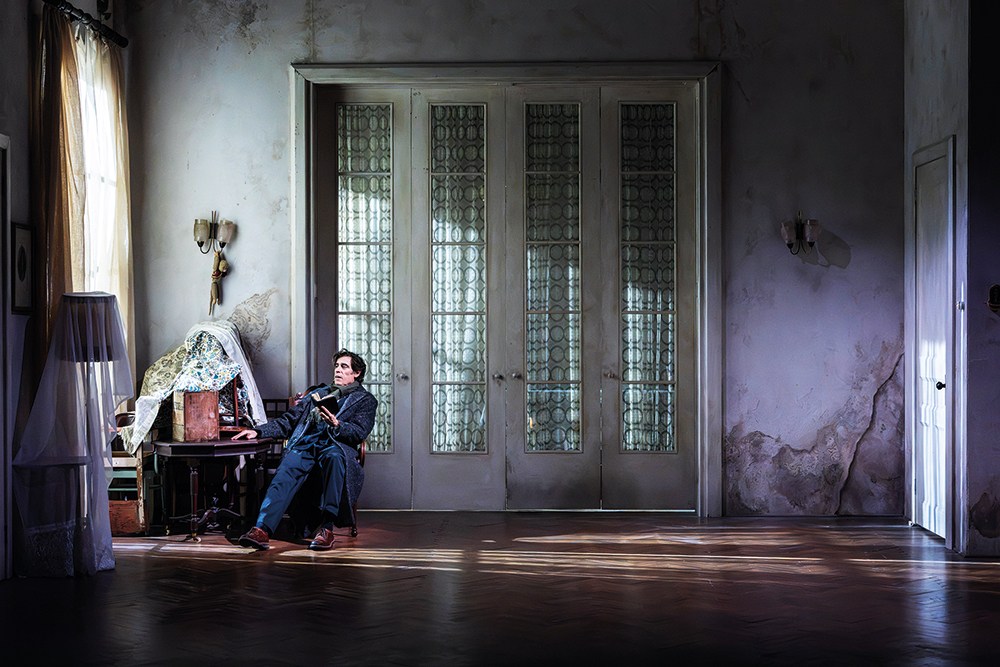

Where are we? That’s the question raised by Ian Rickson’s version of The Cherry Orchard adapted by Conor McPherson. The setting appears to be a capitalist Russian society that never existed. The young characters wear casual 1950s gear – T-shirts, wristwatches and sunglasses – but the older men can recall a time before the emancipation of the serfs in 1861. Slightly confusing. Has the revolution happened or not? It might be simpler to set the play in 1903 when it was written.
The high-status characters use posh Home Counties accents while the servants and hangers-on seem to hail from Scotland, Ireland and Germany. That chaotic set-up works better than it might. The show never fully coheres and it almost feels like three separate plays. A gossipy romantic comedy involving excitable women discussing men and proposals. A larky sitcom about three old codgers losing their marbles. And a tragedy in which a grief-stricken heiress fails to confront reality.
If you have tickets for The Cherry Orchard, you’ll be envied by those who haven’t
Stephen Mangan’s Lopakhin is a crumpled charmer whose attempts to save the estate become increasingly funny. He never loses his cool but he enjoys taunting Trofimov, the unemployable student, whose scholarship is clearly bogus. ‘Still hitting the books?’ asks Lopakhin. ‘When’s the big exam?’ Nearly all the characters deceive themselves. Ranevskaya (Kristin Scott Thomas) is so beautiful and so brittle that no one dares to tell her the truth about her looming bankruptcy in case she shatters into a million pieces. Gaev (Peter Wight) loses himself in a dream world of half-imagined snooker games.
The show has several moments of unexplained weirdness which make it feel oddly naturalistic. A character walks in and says, ‘I thought I smelled fish’ and walks out. The dull accountant, Yepikhodov, aims a loaded pistol at his head and declares that he longs to shoot himself. Gaev makes a speech while the dotty butler Firs sidles up from behind and attempts to bundle him into an overcoat. Why? No idea. Karl Johnson’s work as the deranged but lovable Firs is exquisite. Vinette Robinson plays Varya as a nervous busybody whose devotion to her household chores conceals a deep inner wound. Her final scene with Lopakhin is so heartbreaking that you want to leap up on stage and solve the problem for them. It’s easy to fix but it doesn’t happen. Inertia descends and they condemn themselves to many more years of frustrated longing. If you have tickets, you’ll be envied by those who haven’t.

Don Black’s From the Heart celebrates the life of Don Black, a Hackney-born lyricist, whose dazzling CV includes collaborations with Michael Jackson, Shirley Bassey and Andrew Lloyd Webber.
He walked on to the stage and told the crowd that he was thrilled to host a West End tribute to his work, ‘so early in my career’. He loves to collect gags by his fellow humourists, and he quoted Oscar Levant’s description of a musical as ‘a series of catastrophes followed by a party’. Black once asked the lyricist Johnny Mercer if he minded that he was rarely cited as the co-author of ‘Moon River’ which he wrote with Henry Mancini. ‘There’s nothing you can do about it,’ said Mercer. ‘It’s like being ugly.’
Black’s best work feels like comic poetry. He singles out a tiny human foible and brings it to life in a few concise stanzas. He’s like Pam Ayres, but wealthier. His song ‘Straight Men’ imagines three lonely women expressing their frustration over the dearth of heterosexual consorts. ‘Small Hands’ is about a girl who dreamed of becoming a pianist but her hands were too petite. Luckily, her fingers were just the right size for a suitor’s ring.
Black is a contemporary of the playwright Caryl Churchill, who prefers to write sketches these days rather than full-length dramas. Her latest 20-minute skit, Triumph, is an odd mix of ancient and modern. It combines Suetonius’s biography of Nero with a series of televised press briefings at the White House.
A blonde spokeswoman lists the achievements of her megalomaniac leader. She praises him for recreating sea battles in flooded arenas; for arranging deadly duels between greedy lawyers and wealthy swordsmen; and for building a pontoon bridge that enabled him to drive a chariot across the ocean. But she tires of spouting these flattering exaggerations and decides to tell the truth about her leader’s personal depravity and lack of moral principles. For damaging his image, she expects to be condemned to death but she suffers a different fate altogether.
The surprise twist is quite funny, and it suits Trump’s unpredictable style, but it’s a pretty threadbare pay-off for a comedy sketch. And Churchill has taken a long time to spot the resemblance between Nero and Trump who was first elected to the White House nine years and 11 months ago. She must be the tardiest wag in the history of political satire.






Comments