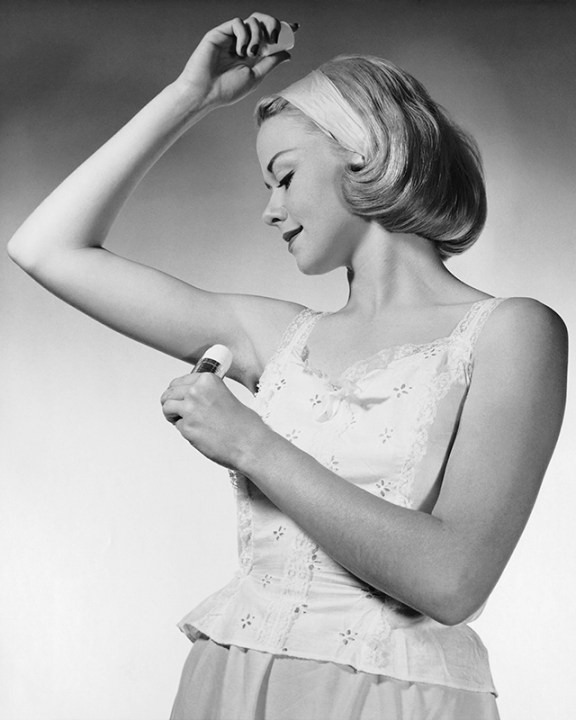
As summers grow hotter, the one thing that self-appointed experts seem absolutely agreed upon is the need for a blast of chemicals to cover up the merest possibility of anything resembling the smell of a warm body. One Mariah G. Humbert, an American etiquette dictator, was asked by the Guardian about this and insisted: ‘Deodorant is absolutely necessary. The way you care for yourself and your hygiene is a form of self-respect, but also respect for the people you work with. It’s the same socially.’ Of course you should use deodorant! It’s vital to hygiene! It’s like wiping your bum!
Miss Humbert’s other point, that the lavish application of deodorant shows respect for people around you, could only have been made by someone who has never eaten breakfast in the budget Hilton hotel in Bath, or similar. The mass assembly of recently risen middle management on a training course and coach parties of ageing Americans produces a fug of recently applied aluminium, and renders the idea of eating any food in this chemical miasma nauseating. A morning trip on the District Line, pressed up against estate agents intensely sprayed, like crops, with anti-pong prophylactic, infallibly induces a vile headache. The afternoon ride home is much less obnoxious, when the deodorant and the ‘respect’ and ‘hygiene’ have faded and there is nothing worse to deal with than a few clean bodies.
The truth is that, unless there is something wrong with you, you probably don’t need deodorant to mask anything, and any doctor will tell you that the aim of antiperspirant to stop you sweating would be a terribly bad one, if it worked. In general, the only thing necessary in any condition is a bath every day and to change your clothes at the same interval, making considerate use of washing machine and dry cleaner. If you wear the same suit to work every day for the month of July, no amount of Right Guard will render your presence appealing.
About 40 years ago, I had the staggering revelation that an intimate encounter with another person was always dismal to repulsive if the nervous application of deodorant was detectable. On the other hand, the whiff of someone fresh from the sea, an energetic walk in the park, even a couple of hours dancing shirtless in a club, could be very appealing. I took a radical decision. I didn’t believe I smelt worse than the rank and file of humanity. From the late 1980s to now, I have never bought or used deodorant or antiperspirant. There was no detectable social effect from dropping the stuff from one day to the next. No consequences seem to have followed in a life otherwise dedicated to cleanliness and a nice clean shirt. For most people, I’m convinced, it’s a gigantic conspiracy.
Modern deodorants have been around since the 19th century, but really took off when advertisers invested heavily in paranoia and self-doubt. A product called Odorono coined the bleak condition of B.O. in an advertising campaign of 1919. The thing was – you might have it, but nobody would tell you! The only way forward – buy Odorono, in massive quantities. There might have been some elementary objections to this proposition. The first could have been that the reason that your dearest friends aren’t telling you that you smell is that you don’t smell. The second is that if, in the different world of 1919, you do whiff a bit, the answer might be to take a bath every day and wear clean clothes.
But the commercial exploitation of paranoia is a very powerful one, surviving any number of changes of habits. Maybe you are one of those rare unfortunates who really do stink. After all, the advertisers suggest, nobody, not even your husband or wife or most direct friend would ever tell you. For most people, this is a Procter & Gamble remake of Pascal’s Wager. You don’t think you smell that bad. You probably don’t, in fact. But a tiny doubt creeps in; let’s not risk the small possibility of being catastrophically wrong about this. For the same reason, people like me who just don’t use it generally keep quiet about the fact. A friend who once confessed to me that he doesn’t use it either admitted that he still buys a stick of the stuff every so often, throwing the last unused tube away. His wife hasn’t noticed that his hygiene is limited to soap and water, and he’s not planning to tell her.
The whiff of someone fresh from a couple of hours dancing shirtless in a club could be very appealing
For most people, the force of self-doubt and worry is impossible to escape. The only way forward is to invest consistently in the global deodorant industry, forecast to rise to$47 billion in the next decade. Whether the increasingly heavy use of deodorants has any causal relationship to the well-documented reluctance of Gen Z to go to bed with each other must remain a matter of speculation.
I have an experiment to suggest to the confident. For a week or so, just lay off deodorants. Don’t tell anyone. Carry on with a daily bath, towelling and drying thoroughly. Wear clean clothes daily. It’s not compulsory, but if you want to smell particularly nice, give yourself a squirt of something handsome. I recommend Andy Tauer’s deliciously smutty leather and birchwood, cowboy-inspired Lonestar Memories. If people are starting to offer you unsolicited advice about your personal hygiene, then by all means return to the heavy use of Lynx Jungle Fresh XXL, but you deserve everyone’s sympathy. It must be pretty awful to smell worse than that.
Comments