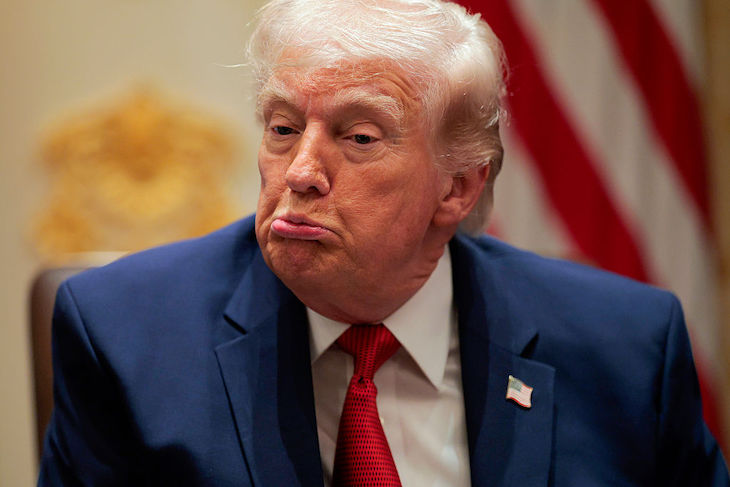
Donald Trump has yet again raised the prospect of the United States leaving Nato. The US president called the alliance a ‘paper tiger’ and said he ‘was never swayed by Nato’. It is tempting to dismiss it as political theatre. But this time feels different. Trump’s frustration with European allies has sharpened, particularly over their reluctance to back his approach to Iran, where the absence of a clear political end-state has made support difficult to sustain. That hesitation has deepened transatlantic irritation. Combined with tensions over Greenland and Denmark, this is no longer an abstract complaint about burden-sharing but an accumulation of grievances. What once sounded like brinkmanship now carries the weight of intent.
Trump’s frustration with European allies has sharpened, particularly over their reluctance to back his approach to Iran
It is important to be clear about what would not happen. The United Kingdom would not suddenly be cut adrift from Washington. The bilateral relationship runs far deeper than Nato: intelligence cooperation through Five Eyes, the shared ecosystem underpinning the Trident nuclear programme, joint procurement such as the F-35 jet, and collaboration through Aukus. These links would endure.
But that is precisely the problem. Britain would still have America, just not the system that makes American power predictable and usable in Europe. Nato is not merely a military alliance; it is the machinery through which Western power is organised. It embeds U.S. leadership, disciplines allies, and underpins deterrence. Remove it, and the West does not simply become weaker. It becomes less coherent: cooperation turns conditional, coordination frays, and the scope for miscalculation widens.
The immediate consequence would be a sharp erosion of deterrence. Nato without the United States is not Nato diminished but transformed. The credibility of collective defence would be thrown into question, and it is precisely that ambiguity which invites testing. Russia would not need to defeat Europe outright. It would only need to probe, to exploit hesitation, to identify where political resolve falters.
For Vladimir Putin, this would be a great strategic gift. The fracture of the transatlantic alliance is something Moscow has long sought; a U.S. withdrawal from Nato would deliver it in one stroke. Britain, as one of Europe’s most consistently hard-line powers on Russia, would find itself especially exposed, still prominent and targeted, but far less securely backed.
Europe, including Britain, could in time compensate. But not quickly. The capabilities the United States provides, intelligence, command-and-control, strategic lift and missile defence, are not easily replaced. There would be a dangerous interval in which the political framework weakens faster than the balance of power can adjust.
For Britain, that interval would be expensive. Defence spending would have to rise sharply and immediately, not deferred to the next Parliament. This is not a matter of marginal increases but of rebuilding capabilities long underwritten by the United States: logistics, airlift, naval power, stockpiles and industrial capacity. Britain has underinvested not simply out of neglect, but because it operated within a system in which America over-provided. That implicit subsidy may be ending.
The nuclear question would also return. The Trident nuclear programme would remain operational, but its ecosystem is deeply entwined with the United States. The issue is not immediate viability, but confidence in the assumptions behind it. France would, in theory, assume greater prominence as Europe’s only other nuclear power and with an indigenous nuclear capability. Closer coordination would be possible, but Britain has little confidence in relying on a French deterrent, and even less willingness to depend on it in place of the United States. The likely consequence would be pressure to develop a more sovereign nuclear posture, at significant cost.
Nato is often portrayed in Washington as a burden. In reality, it is one of America’s most effective instruments of power
Beyond defence, the deeper shock would be to Britain’s foreign policy. For decades, London has defined its role as the bridge between Washington and Europe. That role becomes far harder to sustain if the structure linking the two unravels. Britain would face a more complex set of choices: align more closely with Europe, manage a more transactional United States, or attempt to navigate between them without the framework that once made such balancing possible. There would be a temptation to lean into Europe. But a U.S. withdrawal from Nato would impose severe economic and strategic strain on the continent itself, forcing rapid rearmament and injecting uncertainty into the bloc. Aligning more closely with a Europe under that pressure may prove less a solution than a further constraint.
Yet this is not simply a binary choice. A world beyond Nato may open a third path. Britain is well placed to convene a network of advanced middle powers, countries such as Japan, Australia and Canada, linking defence cooperation with technology and trade. Elements of this already exist in Aukus and newer economic groupings. Such a network would be looser and less institutionalised than Nato. It would not replace the alliance. But it may become one of the few ways for Britain to retain strategic weight in a system no longer anchored by American guarantees.
The economic effects would be less immediate but still significant. There would be no single shock, but cumulative pressure: higher defence spending, fiscal strain, and uncertainty for investors. If American policy becomes more transactional, U.S. firms may become more cautious about Europe, while European states, including Britain, hedge more broadly. Security fragmentation rarely remains confined to the military domain.
The consequences would not be confined to Britain. The United States would also lose something fundamental. Nato is often portrayed in Washington as a burden. In reality, it is one of America’s most effective instruments of power, allowing it to organise and direct allied strength at relatively low cost. Outside Nato, the United States would still be a superpower, but one forced to manage alliances on a more conditional, bilateral basis, with less control over how they function.
It would also be less constrained. Nato does not only deter adversaries; it disciplines behaviour within the West itself. Issues such as Greenland illustrate the point. As long as Denmark and the United States sit within the same alliance, any serious attempt at coercion is strategically incoherent. Remove that framework, and the barriers begin to fall away. What was once unthinkable becomes easier to contemplate.
Britain, then, would not be abandoned. But it would be exposed. The shift is not simply material but structural: from a system of guarantees to a landscape of negotiation, from an order that could be relied upon to one that must be constantly managed. For decades, British strategy has rested on the assumption that American power would be present, organised and committed to Europe. If that assumption no longer holds, Britain will have to decide, quickly and at significant cost, how it intends to secure itself in a far less forgiving world. It would still have allies. What it would lack is the American power that made those alliances mean something.



Comments