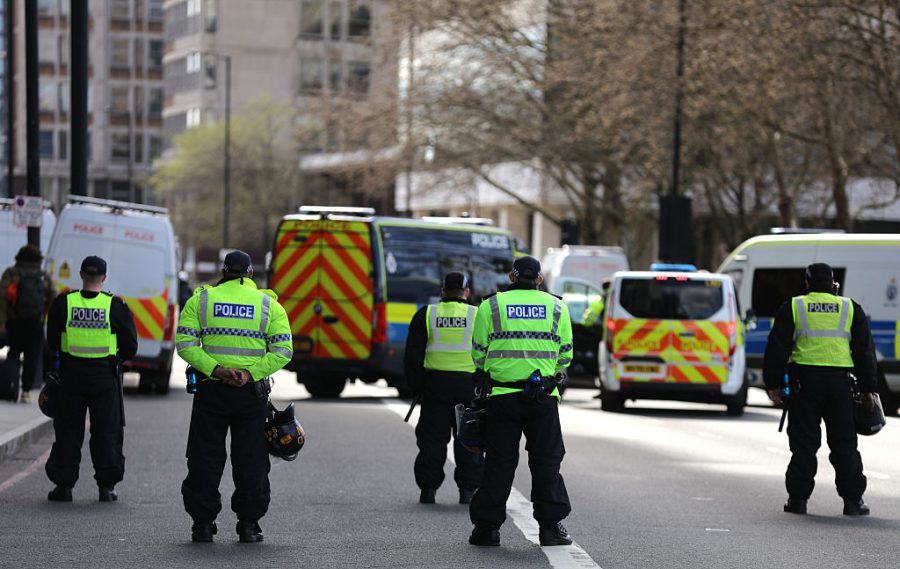
To whom are the police accountable and how? Certainly, if you ask the public, they might well suggest that the answer is the Home Secretary. After all, the Secretary of State for the Home Department is one of our four ‘great offices of state’ – nominally, at least, in command of some of the most coercive arms of government: policing, border control and immigration and the security services.
I wanted to understand the answers to these two questions as part of my series of exclusive on-the-record interviews with fourteen former home secretaries who served between 1990 and 2024. Within my interviews, conducted for Policy Exchange, a very different picture emerges to the one you’d expect from the public – certainly for those who have served in the post in more recent years. Over the last decade or so, while ministers have been accountable to parliament, it has proven harder for home secretaries to pull the levers of power when it comes to policing.
The question of who is accountable is one of the most important to ask – it is where all roads of policing failure must lead. It is ministers who are ultimately held to account by the national electorate for the police’s seeming unwillingness to tackle rising levels of anti-social behaviour and shoplifting on our high streets; for the rise of non-crime hate incidents with their chilling impact on free speech; and for the apparent dismissal of the foundational principle of acting ‘without fear or favour’ as a result of the takeover of our police forces by the high priests of Diversity, Equality and Inclusion.
The shift of power away from the Home Secretary created a vacuum
At the core of the question of police accountability is the doctrine of ‘operational independence’ – that chief constables, and every constable beneath them, exercise their power independently of ministers. No home secretary can tell the police who to arrest, who to charge, or where to point an investigation – as Michael Howard put it to me, once politicians can intervene in individual cases, ‘that’s an end of the rule of law’. Every former home secretary I interviewed would agree.
But there is a vast gap between directing an arrest and giving ministers the reach they need to match the democratic accountability they rightly hold. Until 2012, home secretaries had the means to oversee policing and influence how the system operated – both in public and privately. While the public levers of power are obvious – including the ability to legislate and allocate funding – it is the private exercise of influence which is perhaps more interesting.
Jack Straw told me that when it came to some chief constables, ‘I made it clear in subtle ways that it wasn’t going to be career enhancing for anybody if they kept buggering about.’ Michael Howard talked about his relationship with His Majesty’s Chief Inspector of Constabulary:
I always attached a lot of importance to my relationship with the Chief Inspector of Constabulary…and that was my main lever. If I thought that a particular chief constable was not doing what he should have been doing, and there were examples, I would say to the Chief Inspector, ‘Don’t you think you should have a look at this?’
David Blunkett, referring to a terrorist threat to Heathrow airport, recalled:
I spoke with the Met Commissioner and recognised I didn’t have operational responsibility but was clear that they needed to take a proportionate approach so as not to play into the hands of the terrorists.
Such interventions were how home secretaries could exercise their democratic mandate – privately reaching into the operational world without ever crossing the line.
Some of those I interviewed were candid about these sorts of arrangements. Former home secretary and current skills minister Jacqui Smith suggested such things were ‘possibly sort of dubious in terms of good governance’ – she said she couldn’t ‘imagine Ofsted or the CQC [Care Quality Commission] doing what the HMIC [His Majesty’s Inspectorate of Constabulary] used to do when I was home secretary’. Charles Clarke conceded that the role of the Chief Inspector of Constabulary and their relationship with the Home Secretary might well have looked ‘improper’, but it was ‘the safety valve for the system’.
Theresa May’s six years at the Home Office between 2010 and 2016 remade the constitutional plumbing of British policing – principally through the Police Reform and Social Responsibility Act 2011. She stripped the office of Home Secretary of formal involvement in the appointment or removal of most chief constables – apart from London’s Metropolitan Police commissioner. Much policy-making relating to policing was moved out of the Home Office into the unaccountable and now quite rightly much-maligned College of Policing. And the convention that the Chief Inspector of Constabulary should be drawn from the ranks of senior police officers was broken – at least for a decade.
The logic for these changes was not unreasonable. Shifting democratic accountability to local police and crime commissioners who would, by virtue of proximity, have a greater understanding of the crime problems in their communities made sense. As did the move to an Inspectorate which, as Theresa May told me, was ‘very much at arms-length removed’ because ‘people need to know that the Inspectorate is not under political influence’.
However, the shift of power away from the Home Secretary created a vacuum – with chief constables using that space to increase their conception of what ‘operational independence’ means, way beyond merely that politicians should not direct operational matters. Suella Braverman told me that during her time as home secretary, chief constables would:
Regularly pray in aid of operational independence when ministers were seeking better results, whether at a strategic level or otherwise. There are many examples during my tenure where that really played out, largely behind closed doors.
By being able to increasingly resist the influence of politicians including the Home Secretary, chief constables have found themselves further divorced from the public they exist to serve. Instead, they have come to rely on a small number of noisy and politically motivated yet unelected activists – with devastating effects on both police effectiveness and the wider public’s confidence in policing.
The government’s recent police reform white paper suggests that the current home secretary, Shabana Mahmood, is making some efforts to grasp the nettle. Restoring the power to the Home Secretary of having a stronger role in the appointment and removal of chief constables is welcome. But Mahmood should go further. The intention is for much of policing-related policy-making to remain in the hands of the police themselves – through a National Police Service under the control of a National Police Commissioner. As Lord Chancellor, Mahmood rightly asserted that policy-making must principally be the remit of parliament and ministers – just as this was the case concerning an over-reaching Sentencing Council so this must also be the case concerning policing.
A return to home secretaries being carefully interventionist – if necessary, behind closed doors – is essential to the rebuilding of British policing from its current nadir. Never before have so many former home secretaries gone on the record to candidly share their experiences of office. This is a historical record which provides this government and future ones, of whatever political stripe, with the lessons of how they can make those interventions effectively.




Comments