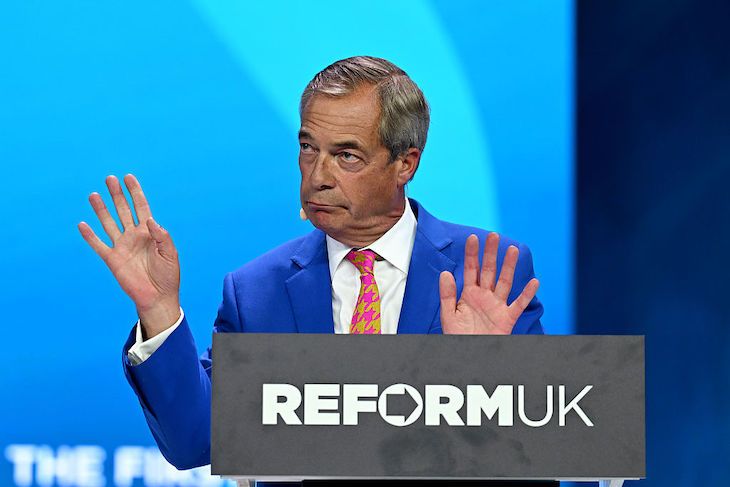
Well chaps, it’s over. Reform have buckled under the pressure. The towel has been thrown in. The party in teal are walking away from it all, having recognised that they can no longer win. Have I lost the plot? Maybe. Quite possibly. Almost certainly yes. But bear with me, because I think I’m onto something big.
A party can do a hell of a lot with £72 million, but winning an election might not be one of them
We all know that Reform have been embroiled in repeated controversies over their donations for some time now. On the eve of their party conference, Channel 4 released footage of a sting operation which appeared to show Nigel Farage and his senior staff attempting to circumvent electoral law. For those of us outside the NEC in Birmingham, the footage was, as my mum so eloquently put it to me via WhatsApp, ‘damning !!!’. Proof, if any more were needed, that Farage cannot be trusted with the keys to Number 10.
But to the party faithful, it didn’t matter. ‘It doesn’t faze me’, one loyalist remarked. Another quipped that ‘this is politics’. They didn’t give two hoots. The base remained steadfast in its support for Reform, unflinching in the face of scandal and controversy.
And this is the basis for my nutjob theory. Reform’s base is unbelievably strong. It is so strong, in fact, that controversy is no longer something which necessarily damages the party’s standing. Much like their MAGA-adjacent in America, some of Reform’s supporters view criticism of their party as proof that they are on the right path. That they’ve got the establishment on the run, and any attempt to shut them down is yet further evidence that their Clacton-based messiah has got it right.

It really is an ingenious strategy. Any criticism is a stitch-up or hit job done by some lefty hack. It doesn’t matter how clear the evidence is, because everything is proof that the Westminster elite are quaking in their polished Oxfords.
As if on cue, the controversy has continued, with Reform raking in two separate £36million donations from crypto-billionaires last weekend. Reform remains insistent that the duo want nothing in return and that the money is merely a philanthropic endeavour.
Come off it. Do they take the British public for fools? Are we but a bunch of dense, moronic sheep who stare unblinkingly at the TV, brain matter oozing from our eyes, ears, and noses? Are we really supposed to believe that Reform’s proposed relaxation of crypto rules is purely a coincidence and not connected in some way to the generosity of two crypto billionaires?
But maybe, just maybe, Reform don’t care if the public believe them. They don’t need to woo the 70-odd per cent of voters who won’t vote for them. Those voters are already lost, and are unlikely to be won back. They are lost to the mainstream herd forever.
Polling released last week suggests that Reform’s support from outside their voters is really rather vulnerable. Of those who were aware of the allegations, 62 per cent said that it was a ‘real problem’, with 41 per cent saying the allegations would make them less likely to vote Reform. When Reform voters were asked, meanwhile, 90 per cent of respondents said that they were undeterred by the findings.
In a separate poll, 35 per cent of the public said that they would vote against Reform in a general election, trumping the likes of Labour, the Greens and the Tories. Not only are swing voters turning away from the party, but they are now willing to vote for anyone but Reform.
The point here is not that Reform can never lose voters. No, the point is that the party may be capable of losing voters without losing its core, and the core is different than that of any other party.
And upon realising this, Reform have changed tack. Their messaging is no longer designed in a way to persuade would-be voters to jump the fence, but to entrench the support of their loyalists. Brazenly shrugging off multi million pound donations, showing no empathy toward a protester who was assaulted: these are not the moves of a party that wants to win, it’s emblematic of a party that wants to lose. Of a party that wants to be in perpetual opposition.
Winning a general election would force Reform to take responsibility and govern. But they are not built for such a task. They are a form of protest against the mainstream parties that can point the finger of blame at every opportunity, and being in government would take such a privilege away.
That is why they don’t want to win. Because suddenly the supposed party of protest becomes the party of government. They may well have topped up their war chest with some sizeable donations, but the voters that will decide whether they get a majority or not have been turned off from the party for good. A party can do a hell of a lot with £72 million, but winning an election might not be one of them.






Comments