As a keen student of economics, Mr Steerpike has been hungrily devouring Liz Truss’s new book, Bank Job: A short book on how the Bank of England broke the Bond Market and brought down the government.
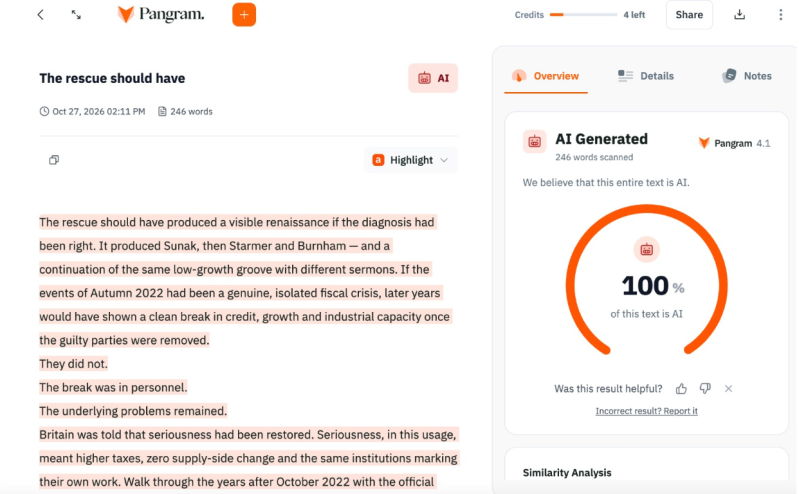
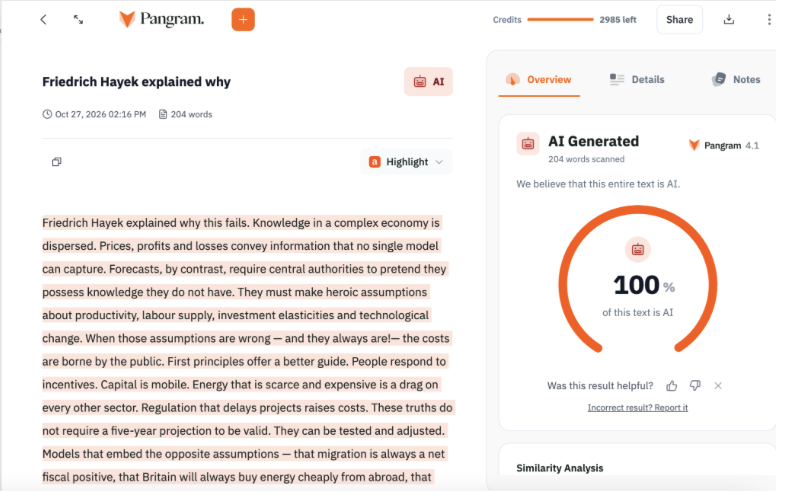
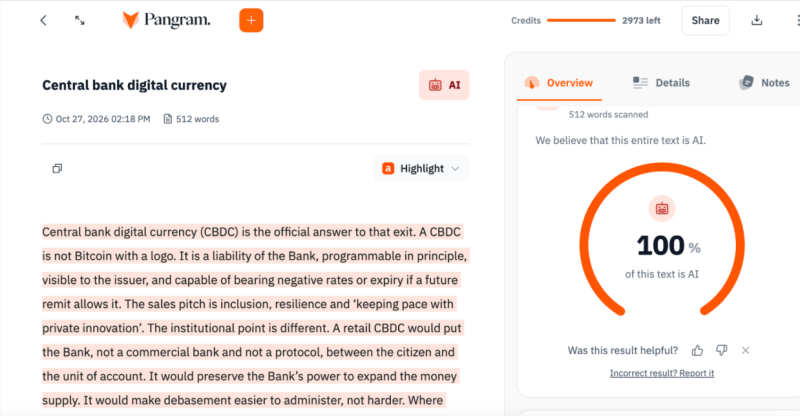
The prose is admirably clear and well structured considering its provenance. After consulting with the Artificial Intelligence detector tool Pangram, Mr Steerpike has thoughts about why this might be…
Have a look at this section of Truss’s book (if you dare):
The rescue should have produced a visible renaissance if the diagnosis had been right. It produced Sunak, then Starmer and Burnham — and a continuation of the same low-growth groove with different sermons. If the events of Autumn 2022 had been a genuine, isolated fiscal crisis, later years would have shown a clean break in credit, growth and industrial capacity once the guilty parties were removed.
They did not.
The break was in personnel.
The underlying problems remained.
Britain was told that seriousness had been restored. Seriousness, in this usage, meant higher taxes, zero supply-side change and the same institutions marking their own work. Walk through the years after October 2022 with the official promise in mind. The promise was that seriousness would restore growth, settle gilts and protect industry. Growth per head did not catch up with the United States. Gilt yields followed global rates more than they followed the morality play. Energy-intensive sites continued to close or shrink. Public productivity stayed weak. Migration stayed high enough to flatter GDP and OBR charts housing and low-end wages took the strain. Deindustrialisation is a long British story — coal, steel, shipbuilding, then ceramics, then chemicals — but the 2020s version is energy and permission. A country that prices power at a premium and takes years to approve a grid connection should not feign surprise when the plant opens instead in America.
The Mini-Budget was an attempt to change that trajectory in one political moment.
How interesting. And here, from another section:
Friedrich Hayek explained why this fails. Knowledge in a complex economy is dispersed. Prices, profits and losses convey information that no single model can capture. Forecasts, by contrast, require central authorities to pretend they possess knowledge they do not have. They must make heroic assumptions about productivity, labour supply, investment elasticities and technological change. When those assumptions are wrong — and they always are!— the costs are borne by the public. First principles offer a better guide. People respond to incentives. Capital is mobile. Energy that is scarce and expensive is a drag on every other sector. Regulation that delays projects raises costs. These truths do not require a five-year projection to be valid. They can be tested and adjusted. Models that embed the opposite assumptions — that migration is always a net fiscal positive, that Britain will always buy energy cheaply from abroad, that history has ended and global supply chains are permanent — simply hard-wire one worldview into law and into unaccountable bodies. Policies that challenge those assumptions are scored as ‘unaffordable’ before they are even tried. The same pattern appears outside fiscal policy. Climate and Covid modelling both large, confident numbers that justified radical interventions and proved incredibly fragile when reality intervened.
And one more time for luck:
Central bank digital currency (CBDC) is the official answer to that exit. A CBDC is not Bitcoin with a logo. It is a liability of the Bank, programmable in principle, visible to the issuer, and capable of bearing negative rates or expiry if a future remit allows it. The sales pitch is inclusion, resilience and ‘keeping pace with private innovation’. The institutional point is different. A retail CBDC would put the Bank, not a commercial bank and not a protocol, between the citizen and the unit of account. It would preserve the Bank’s power to expand the money supply. It would make debasement easier to administer, not harder. Where Bitcoin removes the committee, a digital pound reinstalls the committee inside the wallet. The money-supply failure of 2021–22 and the hostility to Bitcoin are the same story. Remove money from the inflation model and you will miss the surge. Miss the surge and you will call it a shock. Call it a shock and you will blame the elected government that happened to be in office when the bill arrived. Meanwhile refuse any asset that would have let the public step outside the debasement. Then propose a digital pound so that the next debasement can be delivered with better software. That is not modernisation. It is the old clipping of the coin, updated and defended as stability. It is the background tax the Bank administered while telling the country that two per cent was stability. Broad money, not a climate scenario, should sit in the published dashboard before every rate decision. Bitcoin should be treated as a lawful asset, not as a reputational contaminant. A digital pound, if it is ever issued, should be non-programmable, non-expiring and forbidden from negative rates — or it should not be issued at all. The point of monetary reform is to make exit from debasement possible, not to digitise the monopoly that carried it out. Removing money from the inflation story had a practical consequence in 2021 and 2022. If you do not watch broad money and the fiscal-monetary mix, you tighten too late. If you then tighten into a leveraged LDI system you helped create by suppressing rates for a decade, you get a gilt crisis. Ideology is not separate from plumbing. The same institution that had talked down the importance of money talked up the importance of climate and talked past the leverage in pensions. When the crisis came, it had a language ready: the government did this. The language was ideological. The plumbing was real. Mervyn King used to talk about the money supply in a way his successors did not. The crisis of 2008 pushed the institution towards credit spreads, then towards asset purchases, then towards a view of inflation as expectations plus slack. Broad money became a back-page item. When pandemic QE met locked-down supply, money grew and prices followed with a lag. The Bank’s forecasts stayed low. The miss was called global. Global was part of it. The neglected aggregate was the rest.
Remarkable coincidence? Perhaps. Large Language Models are, after all, trained on our speaking patterns. Perhaps this is simply just a case of AI imitating one of our very best orators. Pangram doesn’t think all of the book is AI, and besides, Pangram admits that it has found false positives in the past. Mr S put the Pangram results to Truss’s team. “Liz wrote the book herself. It’s not AI,” said her spokesman.
So we can’t be certain. Nonetheless. Mr S wonders how the mini-budget might have gone if its architects had been able to check some of their assumptions with Claude. In a parallel universe perhaps…






Comments