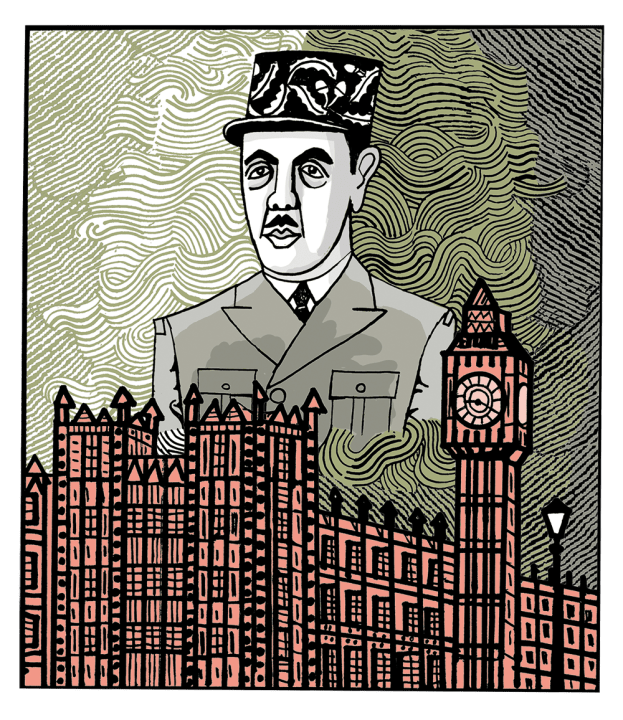
The first time I set foot in the White House as a Labour political adviser, in spring 2024, to see a then all-powerful Jake Sullivan as the US National Security Adviser, I went as an Atlanticist. By my final visit to the West Wing in January, accompanying David Lammy as his aide to see J.D. Vance, I was an Anglo-Gaullist. In between lay the humiliation of Chagos, twists and turns over Ukraine, surprise American strikes on Iran and the realisation that our closest ally, the superpower we had built our entire security around, had become erratic, emotional and unpredictable.
When Labour came to power, I truly believed the country had been suffering mainly from Tory problems. I learnt the hard way that our instability stemmed mostly from British problems. And this brought me to Gaullism. What we’re living through, the penny dropped, is a little like the Fourth Republic: those agonising postwar years where France, its confidence collapsed, became ungovernable and lost in the world.
By the end of the Fourth Republic in 1958, France had cycled through 22 governments in 12 years. Its party system was wildly fragmented: except for the communists, no party held more than a sixth of the vote. This was the logic behind Charles de Gaulle’s Fifth Republic: a radical concentration of power. Ignoring the wails of republican traditionalists, Gaullism turned the president from a symbol into an executive that could overcome paralysis. At the same time, de Gaulle brought in electoral reform. France’s two-round first-past-the-post system allows voters to select their first-choice candidate, then to choose between the two frontrunners, endowing the winner with an actual majority.
The magic of Gaullism was that it masked retreat with a determined effort to boost national morale
True, our affairs are not quite as bad as those of 1950s France. But No. 10 isn’t an Élysée, let alone a White House. It’s a glorified Victorian private office, understaffed not just compared with its French and American counterparts, but even to Australia. In the most centralised country in the developed world, this is disastrous. It leaves the prime minister without the staff to wield power and creates civil service blockages and departmental disputes. The result is a paralysis of state.
What, then, might a British version of de Gaulle’s stunning French turnaround actually look like? Anglo-Gaullism would start by creating a proper Department for the Prime Minister and follow French wisdom when it comes to electoral reform. The best way to manage a now five-party system is to adopt Australian-style, ranked-choice voting, with an automatic, instant run-off for Westminster. Like France in the 1950s, we have splintered blocs on the left and right. This will produce successive, chaotic, unrepresentative, winner-takes-all results if you keep using first-past-the-post. Can we hope for stability when either Zack Polanski or Nigel Farage could win hollow landslides on less than a third of the vote? Of course not.
De Gaulle knew governing was more than a constitution. ‘Nothing is possible for the state when its powers do not have a civil service that can exercise them,’ he pronounced after becoming president. In 1945 he founded L’École Nationale d’Administration with urgency as he loathed the sluggish mediocrity of the civil service and sought an elite cadre to replace it. Such vanguardism is unfashionable. But there is no British Gaullism without it. That means injecting Whitehall with a generation of experts in the technological frontier of AI, biotech and beyond.
The old man in a hurry worked with a speed no French government has mustered since Napoleon’s consulate. ‘Without these efforts,’ he said of his first drastic policy, ‘we would remain a country that lags behind, oscillating between drama and mediocrity.’ He was talking about the public finances. At the start and very pinnacle of his power, when he knew the Algerian crisis would allow him to do almost anything, de Gaulle ignored his ministers and implemented the 1958 Rueff Plan. This included tax hikes, a devaluation of the franc and cuts to tariffs and subsidies. It also took on France’s two most powerful lobbies: farmers and veterans. And it worked. For the first time in a century France’s GDP overtook Britain’s. Our lesson is clear: an Anglo-Gaullist prime minister, should they ever have the opportunity, must take on welfare and end the pensioners’ triple lock.
But what to do with the money? I will pause here to consider the critics. Jonny Ball, in a thoughtful essay for UnHerd, correctly warned that any Anglo-Gaullism only ‘hawking a message of salvation-through-defence spending, with rearmament presented as a catalyst for national renewal’ will fail. Well I quite agree. Which is why any Anglo-Gaullism worth its name must stick as close as possible to the French original and avoid being a Bevinite reheat. De Gaulle did not fall into that trap of crude military Keynesianism. He chose instead to treat a France that had fallen behind almost like a developing country in chronic need of modernisation. He had no other choice: France in 1958 had just 45 miles of motorways and more than 20 per cent of the population were still peasants. Neither do we have much choice: with only 67 miles of completed high speed rail and some of the highest energy prices in Europe.
Franco-Gaullism was a form of futurism. Anglo-Gaullism must be the same. The president talked endlessly to the French about tomorrow and a distinctly French modernity. And he struck ground, building France’s first thousand kilometres of motorways, five new towns around Paris, the city’s main airport and France’s first nuclear power plant. Gaullism was nothing less than a generational investment in infrastructure. It would be left to his successor, George Pompidou, to launch the legendary Messmer Plan for nuclear energy autonomy. Thirty-seven currently operating nuclear reactors were built in the 1970s, leading to a French grid that is 70 per cent nuclear-powered today. Anglo-Gaullism must be about building fast: from the Oxford-Cambridge Arc to affordable high-speed rail to a nuclear plan of our own.
The magic of Gaullism was that it masked retreat with a determined effort to boost national morale. France might no longer be an empire, but she was entering a promising new future. And the genius of de Gaulle was to re-enchant through storytelling a nation that had utterly lost confidence in itself. Although he had been born in 1890, he was obsessed with television. Every night, alone or with his wife Yvonne, he would watch the evening news. He would call in TV executives for ‘feedback’ on his interventions at the drop of a hat and experiment with camera angles; he even took lessons from an actor at La Comédie-Française. He understood that politics is performance and performance is persuasion. What the youthful Kennedy was to America, the ageing de Gaulle was to France – its first master of television.
Britain’s de Gaulle will need to speak the language of posts, reels and streams and consume them for hours upon hours. But he or she will also need a story, which this government has so notably lacked. That’s why de Gaulle kept at his side the gifted novelist André Malraux. He was the only man allowed to speak at any length after the president in cabinet, despite being just minister of culture. Why? Because they needed to hear, every week, the story – one that drew on history and ideas to create a vision of continuity and progress. Anglo-Gaullism must weave such new myths to live by. They will not come from a PR agency.
Historical comparisons are always a bit of a stretch. We have no Algeria, thank God. And there was a lot not to like in the French 1960s. The thuggish Service d’Action Civique beating up communists. The françafrique postcolonial web of corruption. The suffocating rigidity that led to May 1968. France at the time operated a state monopoly of television and de Gaulle jealously guarded it. Television was, he believed, his. But what would he have made of social media? Doubtless he’d have had zero tolerance for foreign billionaires algorithmically gaming the national debate on platforms awash with authoritarian bots. Anglo-Gaullism would relish the fight against big tech.
This brings us to de Gaulle at his most subtle: which is to say towards Europe. ‘My most difficult task is to bring down to earth,’ he said to Konrad Adenauer, ‘those nationalist Frenchmen who float in their nationalist cloud.’ De Gaulle courted West Germany because he believed that if the two countries did not share a little sovereignty through the Treaty of Rome, the logic of superpower geopolitics was such that they would end up with none at all.
‘No state is independent,’ he once admitted to Pompidou, ‘for it is in reality more or less always linked to others.’ Rude and intransigent towards the nascent European Commission, de Gaulle sought instead what he called a ‘political Europe’ – a geopolitical team for France around a loose customs and subsidy club. This quest was as important to him as his independent nuclear deterrent.
De Gaulle spoke in grandeur but he also spoke hard truths to France as he pulled out of Algeria. Anglo-Gaullism must do the same. We are going to need much higher defence spending. Because what I saw up close is that the special relationship, as most Britons understand it, in which America gives us special treatment, does not really exist. Instead, we have a ‘specialist relationship’ with Washington when it comes to spying, surveillance and Trident, which confers real capacities at the cost of independence.
Becoming less dependent on America militarily means becoming a better, less needy ally to them
The harshest truth we need to admit is that America has changed. It no longer only cooperates with us as allies but coerces us as vassals. A political movement like MAGA is not an aberration but fundamentally a part of what America is: a society too polarised to practise predictable long-term geopolitics in Europe or Asia. The US cannot be trusted to stay with us on Russia. We are too dependent, in too many ways, on an unpredictable superpower whose zig-zagging trajectory is not ours to influence.
This is why Anglo-Gaullism must seek that geopolitical Europe: to build up our independence and theirs. This begins in Brussels with economics. Hopes for a free trade deal with the United States have not come to pass. Britain needs a customs alliance with the EU: a pact against Trump’s coercion where the UK and EU agree to support each other in the trade wars and to begin exploratory talks for a new customs and regulatory union for goods for growth. This is close to what de Gaulle sought out of the then EEC to defend France’s sovereignty.
The more erratic the US becomes, the less British national interest will align. But there is much more room to disagree and diverge as an ally than we realise. Nothing frustrated me more in my time in the Foreign Office than chunks of our national security state just waiting for cues from Washington on what to think. I often used to ask officials: can’t we be a little more French? Ending this culture of followership doesn’t mean rejecting Washington or anything daft like junking Five Eyes. Becoming steadily less dependent on America militarily means becoming a better, less needy ally to them. From the time I spent in meetings with Vance, that was what I realised he really wanted. Anglo-Gaullism need not be puerile anti-Americanism.
If the leader of the Free French could reconcile with Germany after the war, we can reconcile with France after Brexit. And there is only one basis for a renewed entente this geopolitically profound: working together on that ultimate expression of sovereignty – nuclear weapons. Trident, from its software to its missiles, is critically dependent on the Americans. We should build a new and complementary aircraft-delivered nuclear system with France. And here will be Britain’s grandeur – as a guardian of Europe.

Comments