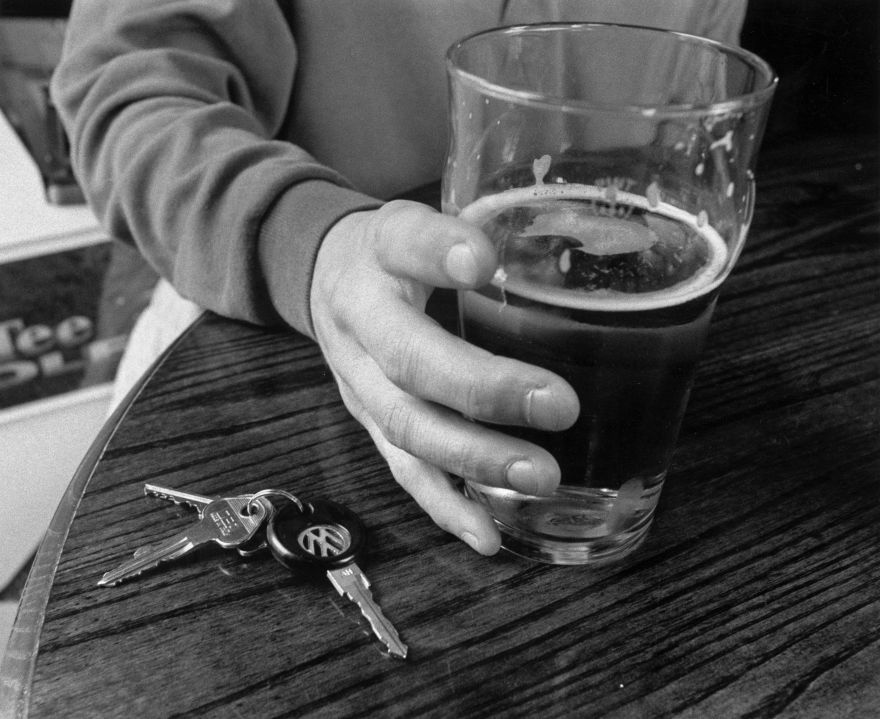
‘Evidence-based policy-making’ is very much in vogue – until, that is, the evidence doesn’t quite support what the government wants to do. Then governments tend to plough on ahead anyway, evidence or not.
Just why is the government proposing to lower the drink-driving limit in England from 80mg/100ml to 50mg/100ml? To many people, government ministers included, it just feels the right thing to do. England does, after all, look a bit of an outlier in Europe, where most countries have a 50mg limit. And then there was a 2010 study by Sir Peter North which concluded that lowering the blood-alcohol limit from 80mg to 50mg would save between 43 and 168 lives in the first year alone, and prevent between 280 and 16,000 injuries. Who, then, could possibly oppose the reduction?
Trouble is that since 2010 we have mountains of real-world data from a real-life experiment. After Sir Peter North’s report was published, the incoming coalition government decided not to enact its recommendation, preferring to engage in better enforcement of the existing 80mg blood-alcohol limit. The Scottish government, however, which had just been handed greater powers in the wake of the Scottish independence referendum, opted to go ahead and reduced the drink-driving limit to 50mg on 5 December 2014.
We therefore have a natural experiment, with England as the control group. So what has been the effect of the reduction in Scotland? Absolutely nothing, it seems. A University of Strathclyde study concluded there was no statistical difference between drink-drive deaths in England and Scotland. So did a University of Glasgow study published in the Lancet in 2019.
The Institute of Alcohol Studies has since looked at it too, and this time analysed the data in various different ways – for example, by homing in on parts of England and Scotland that lie close to the border and have similar roads and socio-economic characteristics. It, too, concluded there was no statistical difference: lowering the limit from 80mg to 50mg in Scotland has achieved nothing.
Various theories have been advanced for this. Maybe the Scottish limit is not being enforced or advertised as well as it might be. After all, who knows how much they can drink before they breach either the 50mg or 80mg limits? The other possibility is that the real problem is not drivers with a blood-alcohol level between 50mg and 80mg but those in excess of this.
None of this is to say that the government should do nothing further to bear down on drink-driving. In 2023, 260 road deaths were attributed to it, along with 1,600 serious injuries and 6,310 casualties overall. Drink-driving has fallen in overall incidence and also as a relative cause of fatal accidents – in 2023 it was blamed for 16 per cent of overall road deaths, down from 26 per cent in 1979.
So what has been the effect of the reduction in Scotland? Absolutely nothing, it seems
But there is very clear evidence to suggest that simply reducing the drink-driving limit is not the answer. Perhaps the government needs better ways to communicate what an 80mg limit actually means. It might be better if the law were expressed differently, to outlaw the drinking itself rather than the measurable effect of the drinking: say, do not drink more than a pint of ordinary-strength beer within three hours of driving – although that would be much harder to enforce. Then, of course, there are the 84 per cent of road deaths not attributed to drink-driving. Maybe we need better ways of tackling drug-driving, motorists who drive while tired or under the influence of prescription drugs, or while using mobile phones, and so on.
Another point is begging to be made here. Sir Peter North’s report shows the dubious value of trying to rely on modelling in order to devise government policies. When it was published it no doubt seemed to many to be a robust piece of science, as did all the Covid models, climate models and all the rest. Yet it has proved to be way off the mark. Admittedly, good real-world data is not always available, but where it is, a far higher value needs to be put on it than on modelled scenarios – the latter of which need to be read with extreme caution and never, ever described lazily as ‘the science’.





Comments