I was in Newcastle the other day and found myself standing beneath Lord Grey’s Monument. The column is 135 feet of Roman Doric, which seems a generous allotment for a man now principally famous as a bergamot-blend tea. Earl Grey passed the Great Reform Act of 1832 and broke the old grand Whiggism, of which he was a scion, in the process. The city built the column while he was still alive. Two hundred years on, Lord Grey is a landmark locals use to orient themselves towards Primark. A few yards away, in the cathedral, I came upon a memorial to Admiral Collingwood, Nelson’s second-in-command at Trafalgar. I doubt one Geordie in a hundred could tell you who he was.
In my own part of London, we have Portobello Road, named for another seaman’s triumph, Admiral Vernon’s capture of Porto Bello from the Spanish in 1739. The road now sells bric-a-brac, and nobody browsing the stalls has Porto Bello on their mind.
A country unable to read its own story cannot think politically about itself at all
And if we move beyond the Scottish Border, Glasgow’s Virginia Street and Jamaica Street map the Atlantic trade in a few hundred yards of tarmac, though for those walking down them the names pass without remark. In the city’s Royal Exchange Square, the Iron Duke sits on horseback, wearing, as he has for decades, a traffic cone on his head.
The Harris Museum in Preston is a full Greek Revival temple on the market square; a Victorian lawyer bequeathed £300,000 to build it because he believed a Lancashire mill town deserved the same architecture as Athens. In Liverpool, St George’s Hall is a Roman basilica on Lime Street, erected by the city’s merchant princes who considered themselves inhabiting a modern Rome and saw no reason to be modest about it. Cicero has not yet called, but every autumn Labour politicians pour out of Lime Street station and walk past it to their conference without a glance. In Manchester, Conservative delegates sleep in the Free Trade Hall, which has been a hotel since 2004, and which stands on the ground where the yeomanry charged a crowd of 60,000 in 1819 – the Peterloo Massacre. Free trade and popular agitation made concrete, now available with a minibar and complimentary wifi. It is an annual ritual of not looking, and it is the condition of British politics in miniature.
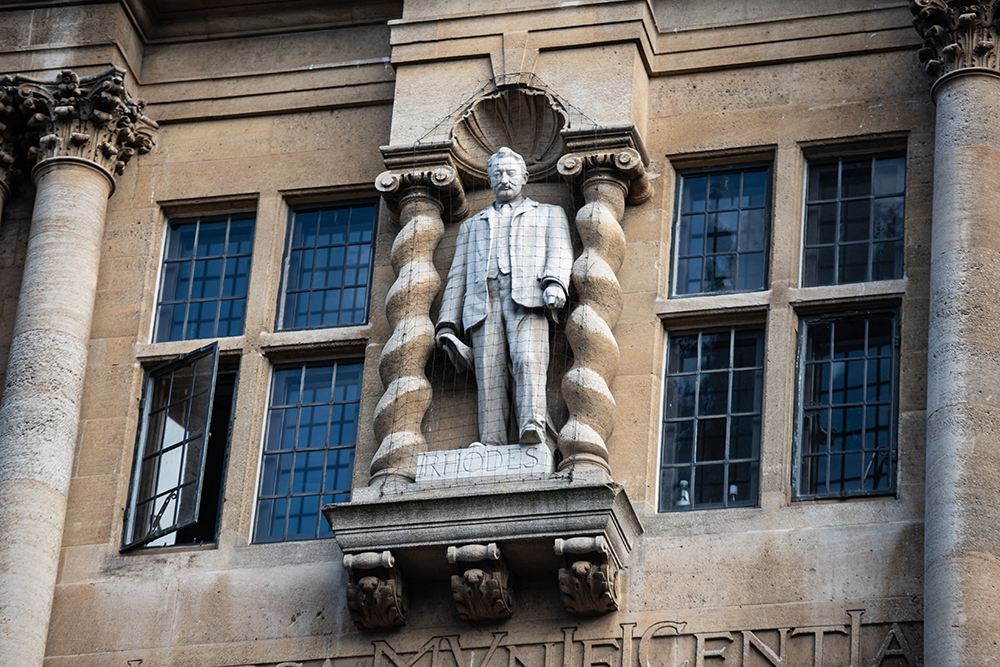
One response to this collective amnesia has been indignation: a fury directed at the past. Edward Colston was hauled off his plinth in Bristol and thrown into the harbour in the apocalyptic summer of 2020. Cecil Rhodes, we’re reliably informed, must fall at Oriel College, Oxford; the governing body voted to remove his statue and then discovered it couldn’t afford to, which carries a certain comic justice.
Even Gladstone is not safe: his name was quietly removed from a hall of residence at Liverpool, the man reduced to a family connection to a plantation and dismissed accordingly; we need know nothing else about him. Grievance treats the past as a courtroom, and a courtroom requires a verdict that closes the case. History that ends in conviction, though, is history that has been disposed of but not understood. Once Colston is in the harbour, you need never think about him, or Bristol or the slave trade, or any of it, ever again.

Then there is an opposite cul-de-sac, more comfortable and far more popular – the National Trust cream tea approach. The Piece Hall in Halifax, a Georgian cloth merchants’ exchange built at the height of Yorkshire’s commercial confidence, now sells artisan gin and sourdough to visitors who admire the proportions without wondering what produced them.
Downton Abbey taught more people about the Edwardian country house than any history department and yet taught them nothing except that the past had better costumes and nicer manners. Likewise, Tudor dramas, Victorian biopics and The Crown have made the past available as a mood and entirely anodyne – beautiful rooms, stiff upper lips, the melancholy of a vanished order. This is history as upholstery: decorative, atmospheric and inert; it is nostalgia, not thought, and in its own way as much a refusal of the past as chucking a statue into a river. You can admire a country house without asking who built it and to what purpose. Then the two dead-ends converge: grievance and history as set dressing, and the past – difficult, strange, contested– is silenced by both. You don’t have to bring down Colston; you can just pretend he never existed or, if he did, admire his clothes.
Neither act is a relationship with the past. One prosecutes and the other embalms, and both achieve the identical result: a country that lives among the evidence of its own history and can no longer read a word of it. This matters beyond the cliché that history provides lessons. A country unable to read its own story cannot think politically about itself at all. Politics at its most serious is an argument about inheritance – what we were given, what we owe, what we keep, what we discard, when and on what grounds.
Every serious political tradition in this country was once rooted in a reading of the national past. Tories and Whigs fought for a century over what 1688 had settled and what it had left open; radicals carried Peterloo as a wound; liberals told themselves a story about progress, socialists one about enclosure and dispossession. They disagreed violently, but they were at least arguing about the same inheritance and therefore something real.
The streets, the statues, the buildings, the columns in provincial squares – they are all still there, saying what they have always said, to a nation that has gradually gone deaf. The past is alive, it is difficult, and it should be contested in good faith without being weaponised or gift-wrapped. Otherwise, any argument becomes impossible. All that remains is some nostalgia here and some accusations there – which are, on close inspection, the same thing wearing different clothes.
L.P. Hartley had it right: the past is a foreign country; they do things differently there. But a foreign country can be visited, studied, even understood, provided one is willing to make the journey and do the work of learning the language. At present, nobody seems to have a passport.




Comments