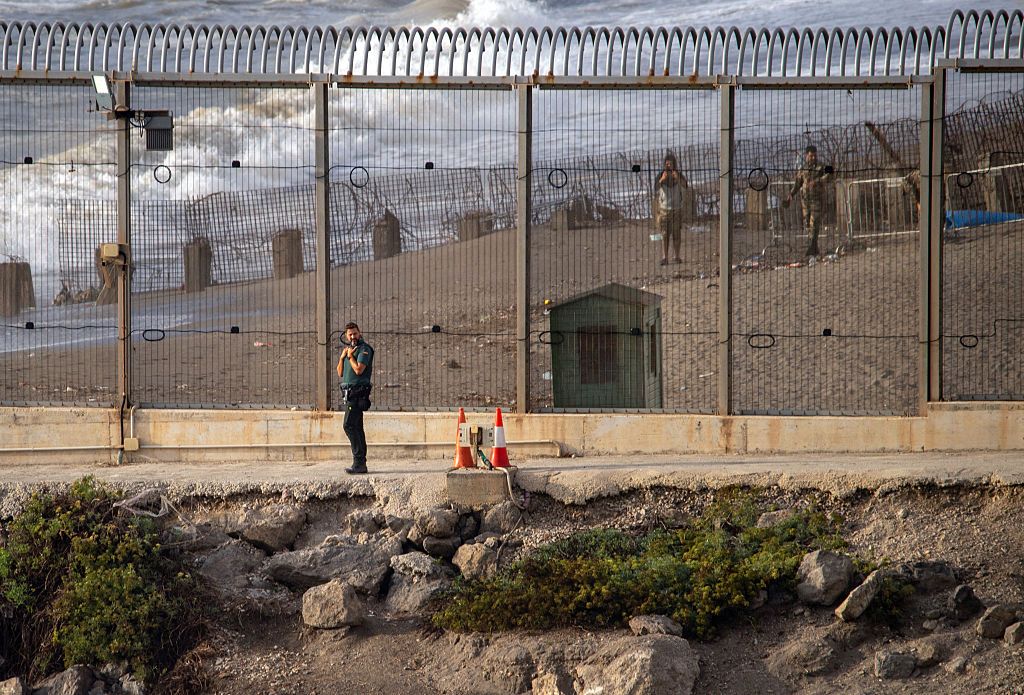
Messages circulating in Morocco are calling for another mass crossing into Ceuta, Spain’s North African exclave, on Wednesday. Spain has activated preventive measures and Morocco has reinforced the frontier with security personnel, water cannon, military vehicles and extra road controls.
Perhaps nothing will happen. A similar online call for Sunday came to nothing. And Spanish foreign minister José Manuel Albares says the latest messages have not acquired the momentum on social media that preceded the extraordinary events of July 30 and 31. Forewarned may prove to be forearmed.
For the people of Ceuta the possibility of a second influx hangs over a city that is still suffering badly from the first
But for the people of Ceuta the possibility of a second influx hangs over a city that is still suffering badly from the first.
Nearly two months after tens of thousands crossed from Morocco, Madrid now estimates that between 9,000 and 10,000 migrants remain in Ceuta, roughly twice the figure it was suggesting until recently. Just over 3,000, several hundred of them children, are still living on the streets.
Where are they all to go? Ceuta has a population of about 83,000 and occupies only seven square miles. It has no hinterland into which the pressure can dissipate: on one side is the Mediterranean, on the other the Moroccan frontier. Transport minister Óscar Puente has summed up the difficulty: “They are asking us to perform magic. I don’t know whether people realize the dimensions of Ceuta. There are very few options.”
Meanwhile, the strain on ordinary life continues. Between July 30 and September 10, Ceuta’s emergency service recorded 1,357 incidents classified as assaults (compared with 93 over the same period last year), 837 intrusions into homes (compared with 16) and 437 public-order disturbances (compared with 43).

Last week hundreds of teachers, parents and other Ceutís demonstrated outside the government delegation. “We are here because we have reached the limit,” declared the teachers’ manifesto. The teaching unions said security is still not adequately guaranteed around every school or along routes traveled by children going to school alone. After education minister Milagros Tolón insisted that security personnel were present even if teachers could not see them, one placard read: “You can’t see them because they’re not there.”
Ceuta’s hospital is also feeling the strain. Health sources estimate that more than 70 pregnant Moroccan women entered Ceuta during the July influx. One gynecologist said migrant women are arriving without previous medical monitoring or documentation, asking about their pregnancies and when they will give birth. Some who have given birth and are medically fit to leave remain in hospital: “If we discharge them, they go onto the street,” one health source told a local newspaper.
The government disputes claims that the health service is collapsing. CEMSATSE, representing doctors and nurses, has called a health-service strike for Thursday.
On Sunday more than a thousand marched towards the Moroccan frontier demanding solutions to the crisis. One of the demonstrators said, “The feeling we Ceutís really have is one of abandonment, sadness, impotence, desolation and fear, because we don’t know whether tomorrow they’ll want to send another 80,000 migrants in.”
Former prime minister José María Aznar has said that Ceuta should be “militarized, without any doubt”, arguing for a greater role for the armed forces in protecting Spain’s territorial integrity. Ceuta already has a substantial permanent military garrison.
Meanwhile Socialist prime minister Pedro Sánchez has defended his government’s response to the original influx. Spain, he says, took “the most humanitarian decision”: absorbing those who had crossed before attempting to return them.
There may well not be another mass crossing on Wednesday. But the fact that thousands of security personnel are preparing for one underlines how precarious normality has become.
Sánchez has said that he hopes to have the situation “stabilized” by the end of the year. For the people of Ceuta, who have already been suffering for almost eight weeks, another three months will seem an eternity.






Comments