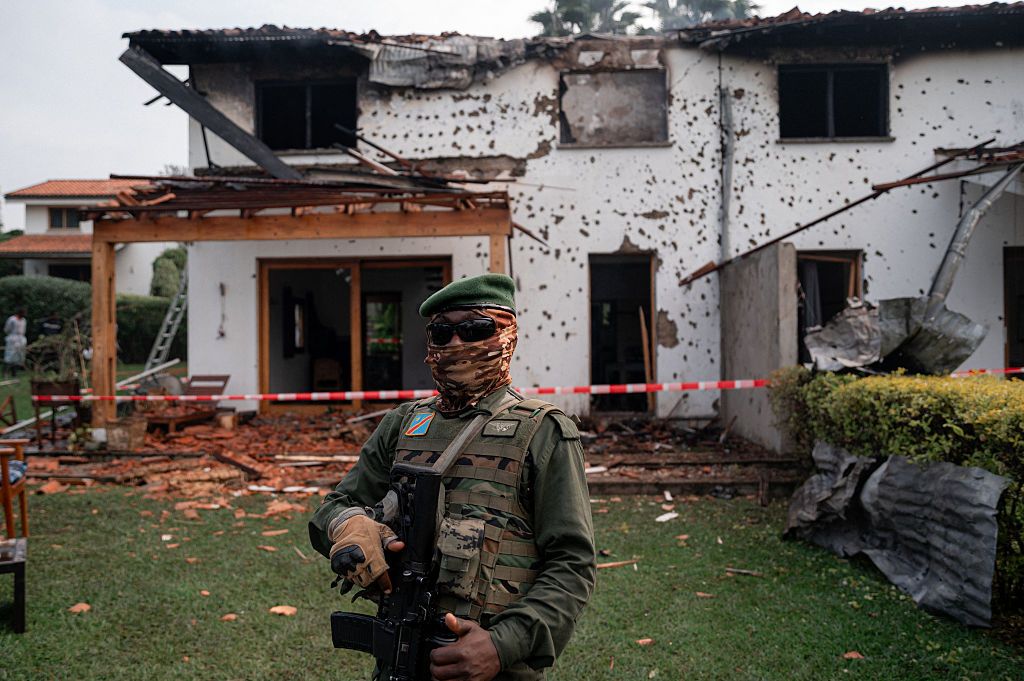
Should we call Gaza a genocide? Maybe. An estimated 75,000 dead is serious. But surely the more pressing question is, why is this the only tragedy that exercises the West? What about the millions of poor souls who’ve perished in Democratic Republic of Congo or DRC?
The ongoing fighting in eastern Congo is the most lethal conflict since WWII, with no end in sight, and bodies piling up by the day. But is there a “Black Lives Matter” protest in New York or London? The war rarely gets a mention on CNN, Fox or the BBC, busy as they are with Russia’s invasion of Ukraine.
And it’s not just the West. South Africa is mounting a legal case against Israel at The Hague, yet Pretoria is silent when people are being slaughtered close to home.
Kinshasa has submitted a case against Rwanda to the International Court of Justice. But it is unlikely to find backing from the White House
In DRC, president Félix Tshisekedi (known locally as FT) leads the first government mandated by a free election since independence in 1960, but his rule has not brought peace or prosperity to the masses. M23 rebels, backed and armed by neighboring Rwanda are making gains. Tiny Rwanda has 14 million people squashed into a country not much bigger than Wales (three million) and there is speculation President Paul Kagame would like to incorporate the eastern section of Congo. DRC is bigger than Alaska and Texas combined but also Africa’s fourth-most populous country touching 120 million: giving up territory is not an option.
Perhaps the global indifference to the Congo atrocity is because rebels and secession groups have been in play here for generations. There was a brief hiatus when, in 1997, the guerrilla army of Laurent Kabila overthrew the late Mobutu Sese Seko who for a quarter century had ruled as dictator while embezzling the treasury. Kabila’s presidency ended with his assassination in 2001 and his son, Joseph was sworn in, making clear this would not be a dynasty and promising Congo’s first democratic election. However, through all this change, secessionist guerrillas in the east have continued their attacks, and the hideous death toll shows no sign of easing. Kabila Jnr now talks of throwing in his lot with M23 against FT, the man he largely brought to power.
Some of the tension stems from Rwanda’s infamous genocide in 1994, when an estimated 800,000 of the Tutsi minority were killed the former Belgian Congo by the majority Hutu. Paul Kagame, who’d been assembling a Tutsi army next door in Uganda, crossed the border with his forces, captured the capital Kigali, and put an end to the killings. His new government turned the country into a model of administrative excellence, but more than 30 years on, he remains in power with sham elections every five years at which he garners more than 90 percent of the vote. And evidence assembled by rights groups including Amnesty International shows that Paul Kagame backs the M23 rebels fighting to control the mineral-rich border provinces in the east.
At the end of 2025, President Donald Trump brought Tshisekedi and Kagame together at The White House where they signed a deal requiring an end to support for all acts of insurgency, along with a peace formula that would stop the war. But observers say there’s been little change on the ground.
Washington, an ally of Kagame after 1994, now has close relations with Félix Tshisekedi who is a regular visitor and, on his watch, Congo has sided with the US on almost half of all issues at the United Nations. In a Trump-pleasing move the nation’s embassy in Israel will relocate from Tel Aviv to Jerusalem. By contrast, when Kagame wanted to attend a meeting at Harvard this year, he was denied entry to America.
As Congo and the US move closer, you’d have thought that millions of civilian deaths in DRC might have raised alarm at the United Nations and the African Union… but still: barely a murmur. The UN says close to 15 million Congolese will need humanitarian assistance by the end of this year. Vast numbers are displaced within the country – 80 percent of them children – and rape has become a weapon of war.
For crimes against humanity, the world’s early warning system is Genocide Watch (GW). Based in Washington DC, GW’s predictions are relied on by the United Nations along with NATO and the African Union. And its founding president, Dr. Gregory Stanton, believes it is time to act on DRC.
Talking exclusively to The Spectator, Dr Stanton says: “The world keeps waiting for Congo to look like a genocide in a form it recognizes from Cambodia or the Holocaust. Instead the killings are slow but continuous and have dominated eastern Congo for so long they no longer make news.”
Stanton believes the UN General Assembly should use its “Uniting for Peace Procedure” to authorize collective action, a global alliance to end the fighting. “Vast areas have become death zones, and it’s vital for the UN and especially America to say out loud and on the record that a genocide is taking place, coupled with a demand for the killers to be defeated and put on trial.”
He said exterminations from the tens of millions murdered by Hitler, Stalin and Mao to more recent atrocities, tend only to be lamented when they are over. Under the UN Genocide Convention passed after the Holocaust, “once the G-word is used, there is an obligation for nations to act and prevent the killing.” Instead, he said, euphemisms like “ethnic cleansing,” are employed as a way out.
Paul Kagame says his country is not involved with M23. Critics say his denials are a cover for the profitability he has enjoyed from coltan, gold, rare earths and other mines controlled by his government across the border in DRC.
The UN says close to 15 million Congolese will need humanitarian assistance by the end of this year
Whatever the reason, Dr Stanton says the world is treating the war as a footnote when it is one of the gravest episodes of our time. “Until the UN, African Union, and the West recognize this genocide and take diplomatic and military action to stop it, there is no chance for peace. If the US is truly a friend of the Congolese people, this is our chance to prove it.” Voicing the G-word, he says, could shock Kigali into rethinking its strategy.
Kinshasa has submitted a case against Rwanda to the International Court of Justice. But it is unlikely to find backing from the White House given Donald Trump’s disdain for international courts. And South Africa is has its hands full putting Israel in the dock. Washington has signed an agreement for mining rights in Congo. Ironically, much of that mineral wealth is in the war zone and an armistice would be in America’s interest. And, for Trump, ending the war could give meaning to his self-awarded title as “Peacemaker in Chief.” But this will take more than a treaty neither side intends to honour.
For all Tshisekedi’s efforts to give his people a better life, vast areas of Congo have no effective administration, and almost no health care and roads turn to quagmires in the rain. Transparency International ranks the country among the most corrupt anywhere. But it is also going through change that was unthinkable just a decade ago. Freedom of expression is at an all-time high and bureaucratic obstacles have been reduced, making it easier for investors to do business and remit their earnings.
None of this stems the level of atrocities, and with Gaza and Ukraine dominating the news and early campaigns underway for the next US election in 2028, Congo gets scant coverage in what Dr. Stanton described as a “silent genocide.” But a call to action from America, Europe and especially from the UN – along with ending Rwanda’s role in the war – would at least give hope to survivors of the five million people who’ve already died in this most tragic of nations.


Comments