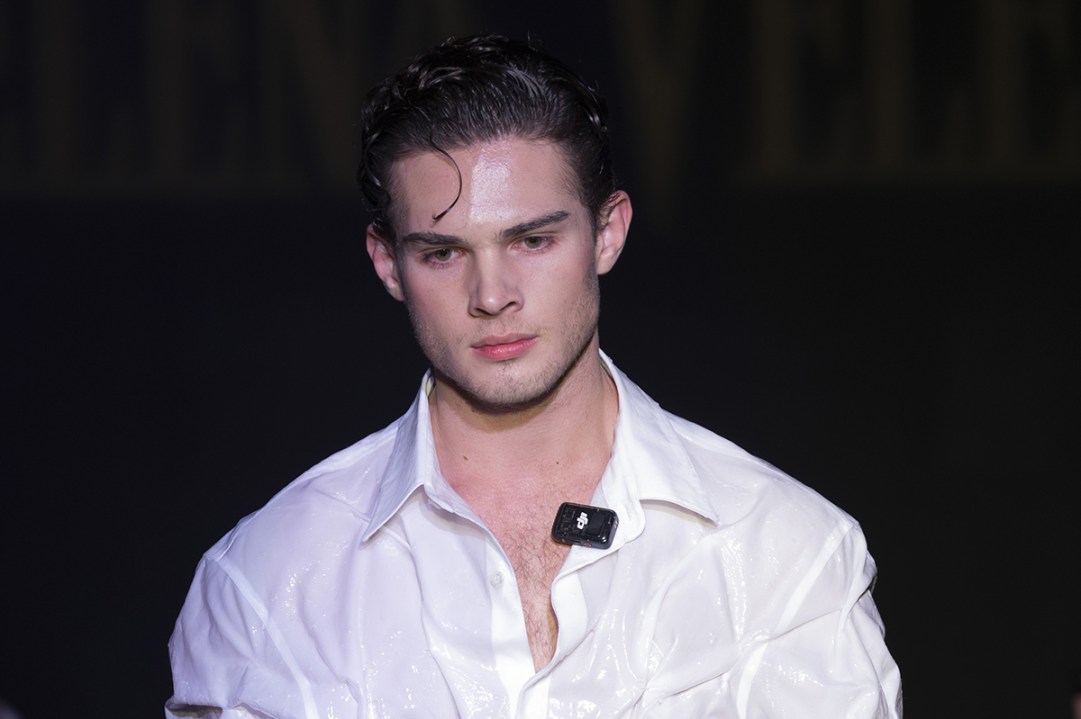
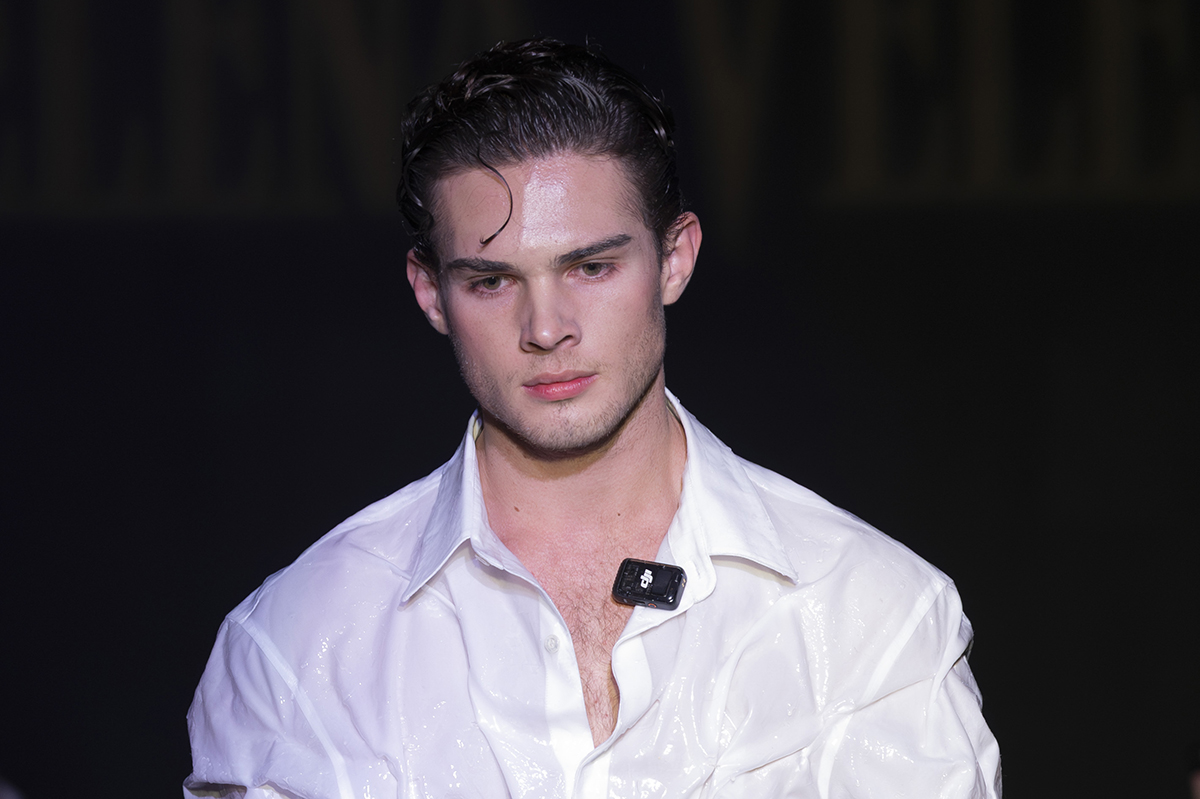
Elena Velez’s F/W 2026-27 New York Fashion Week show centered on “looksmaxxing”: the internet-inspired pursuit of physical perfection at any cost. The runway presentation examined a generation raised under fluorescent ring lights and the judgment of the social-media algorithm. And she capped the night off with a feature from Clavicular, one of the X algorithm’s current favorite characters.
Velez, still in her early thirties, stands out as one of the few designers fluent in the language of the internet. The cultural current is dominated by self-optimization taken to its logical extreme. Faces are flattened into grids, bodies are dissected by comment sections, desirability is quantified in followers, likes and engagement rate. Looks run the show, now more than ever. For the average person, physical appearance now carries the same weight as in the fashion world, shaping how we are judged and valued every day.
Velez also courts controversy, by gathering right-wing personalities and liberal fashion journalists in the same room, such as in her 2023 Longhouse-themed show and her 2024 Gone with the Wind-themed salon (I modeled in both). This creates tension and gives her shows a transgressive charge.
This year’s runway theme was transformation so extreme it borders on violence. Models wore chin straps engineered to carve sharper jawlines, dental apparatuses that looked like torture devices, prosthetics that exaggerated cheekbones, brows and clavicles into hyper-idealized proportions. Corsets, Velez’s signature piece of clothing, cinched waists to near-impossible measurements. Bandages were wrapped around faces and torsos, hinting at fresh surgical interventions, as if the models had stepped onto the catwalk mid-recovery. The collection blurred beauty and brutality, seduction and self-harm. The message was about ascension more than enhancement – and what it takes to “mog” in a world where mediocrity can feel like social death. The designer staged a question in latex, steel boning and surgical gauze: what are we willing to become in order to be seen?
Most popular
Tom Switzer
If Trump hates the Wall Street Journal so much, why is its editorial board dictating Iran policy?

Velez went beyond symbolism. She deployed real figures who embodied that ethos. Take Liv Schmidt, the 23-year-old founder of the Skinni Société, a subscription-based community that coaches followers toward what she calls a “skinni mindset.” Schmidt’s brand looks to reframe thinness as a moral and social achievement more than an aesthetic preference. Through daily step targets, meticulous food tracking and relentless messaging about restraint, she has cultivated an audience of young cosmopolitan women.
Schmidt’s rise has therefore been controversial. She was slammed for promoting disordered eating. A Wall Street Journal exposé in 2024 led to her ban from TikTok ban. Schmidt was unapologetic and recast her philosophy as empowerment – a “rebirth,” in her words, rather than restriction. In Velez’s show, her presence functioned as an artifact more than an endorsement, a parable about how aspiration can curdle into ideology.
But the star of the evening was Braden Peters, better known online as Clavicular. The 20-year-old streamer broadcasts his looksmaxxing exploits to a vast audience of zoomers. He walked in Velez’s collaboration with Remilia Corporation and wore a unisex “Universal Work Suit” inspired by Yakuza tailoring. On his perfect body, the garment looked less like clothing and more like armor.
To understand the charge of Clavicular’s appearance, you have to understand looksmaxxing itself. The phenomenon originated in the recesses of incel forums around the mid-2010s and evolved into a broader online movement by the 2020s. Looksmaxxing is the relentless quest to maximize one’s physical attractiveness – “ascending” from average to elite through a hierarchy of “mogging” (dominating others in looks). Entry-level practices, or “softmaxxing,” include skincare, gym routines and mewing (pressing the tongue against the roof of the mouth to supposedly reshape the jaw). But you can escalate to “hardmaxxing.” Surgeries like bimaxillary osteotomies (double jaw surgery), fillers, steroids, even controversial tactics like “bone smashing” (hitting the face with hammers to fracture and redefine bones) or using methamphetamine to suppress appetite and stay lean. The community obsesses over metrics like clavicle width (hence Clavicular’s moniker), facial harmony and body fat percentages. The trend has exploded on TikTok, drawing in young men disillusioned by societal pressures and amplified by Clavicular himself, who’s been profiled in the New York Times as the face of this hypermasculine vanity.
Clavicular livestreams injections and documents recovery periods in real-time. In an ecosystem saturated with AI-generated faces and curated influencer feeds, his efforts come across as authentic (whatever that means anymore) works of performance art. Clavicular doesn’t perform beauty so much as the pursuit of it. The reckless and aspirational process is the spectacle.
Unlike the biohackers or longevity crowd, who claim their pseudoscientific efforts are in pursuit of health and extended lifespans (think Bryan Johnson’s blood transfusions or Dave Asprey’s bulletproof coffee), Clav is brutally honest. Forget wellness – he admits his focuses are dominance, status and appeal. Study after study has shown that attractiveness confers measurable advantages – higher earnings, lighter criminal sentences, greater social influence. Looksmaxxing is the most literal expression of will to power available to young people who feel sidelined. Can’t control the market or the system? At least you can control your appearance. Clavicular injects fillers, breaks bones and pushes boundaries that others avoid. That’s what makes him so watchable
In Clavicular’s runway moment, he “mogged” the room. That which began in anonymous forums has crossed into high fashion, physical space, institutional legitimacy. The algorithm has stepped onto the runway.



Comments