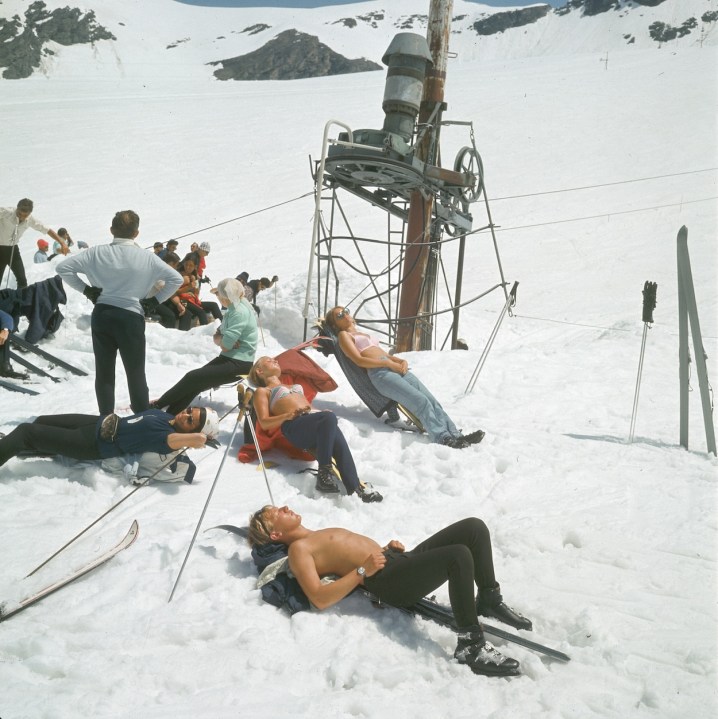
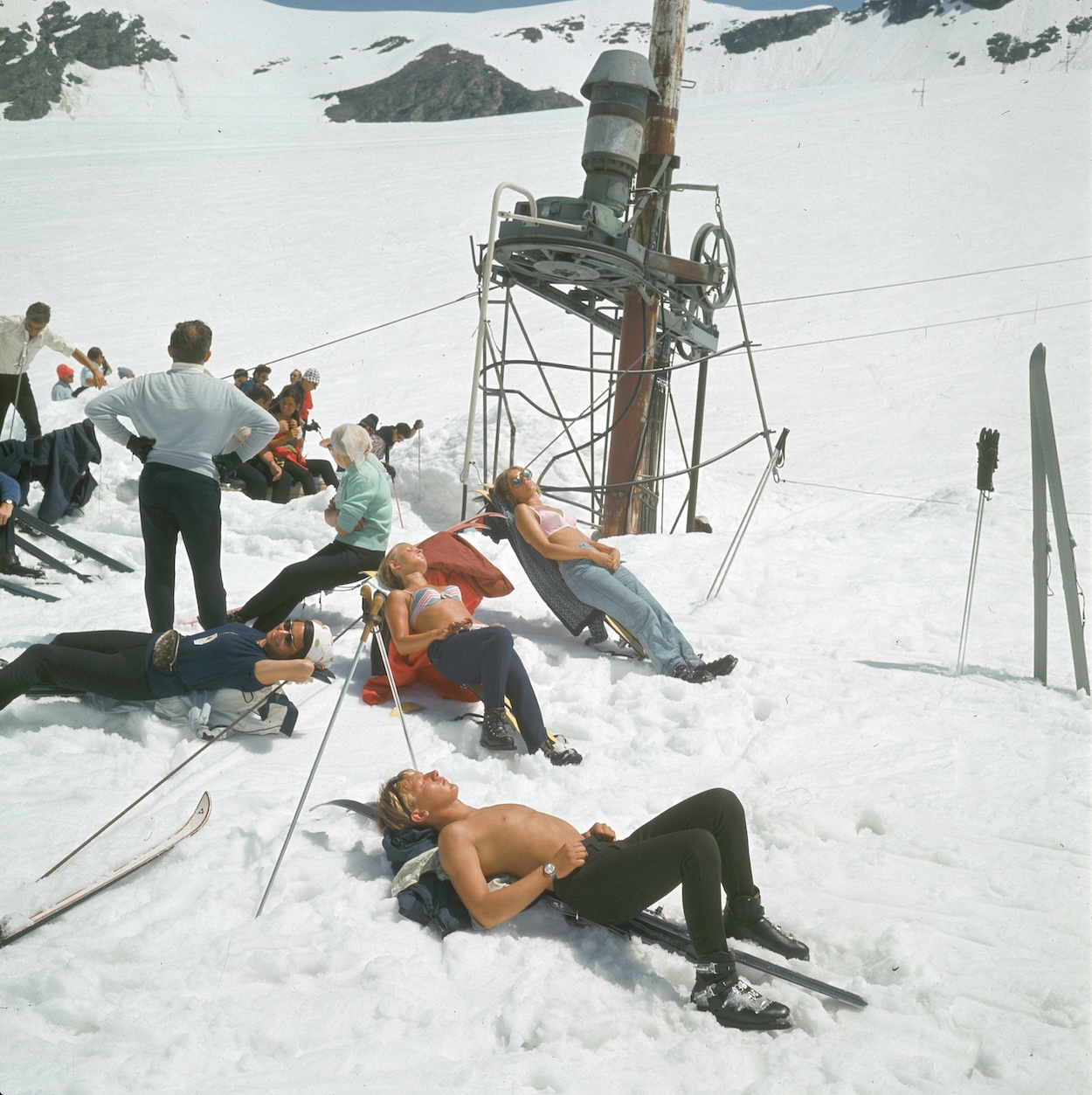
It’s that time of year again. No sooner have you recovered from Christmas than the posh start talking about their skiing jaunts planned for the February half-term. But let’s use the term posh advisedly, because – make no mistake – skiing is now anything but. Where once flinging yourself down the Cresta Run may have been a solid-gold toff signifier or ‘the Sloanest sport’, according to class anthropologist Peter York, now it simply means that you’re rich. No snow cannon pumping out snow on the low slopes can fool anyone. The fact that ski resorts are now melting before our eyes seems to be where this social morality tale ends.
Skiing and British class have long been caught in a complicated embrace. When Sir Arnold Lunn founded the Kandahar Ski Club in 1924 in the Alpine village of Mürren, his masterstroke was to elide ideas of British imperial dominance in the Raj with an infallible plan for victory: foolhardiness. ‘The object of a turn is to get round a given obstacle losing as little speed as possible,’ he said, daring generations of bonkers chins to do their worst.
Similarly, it was Major William Henry Bulpett who apocryphally created the death-defying Cresta Run in St Moritz in the late 19th century, apparently because he was bored. Here were the British upper-middle classes doing what came naturally: crackers risk with a side-murmur of keep out. Fast forward to the shifting social sands of Thatcherite Britain at the time of the 1983 Sloane Ranger Handbook and observe how skiing managed to do two things: maintain its association with European grandee Davos-y opulence while tapping into the British upper-middle-class credo of no-nonsense outdoorsiness. The chairlift went up and away and with it an entire stratum of British society.
In the landscape of British society since the second world war, generations of upper-middle-class skiers have clung on to these associations of old-school elitism even as they have watched them decline. For skiing is now a strange confection of democratised luxury – think James Bond skiing in On Her Majesty’s Secret Service in 1969, or earlier still, Mussolini posing au naturel with only poles and a baseball cap in 1937.
As a signifier for multi-generational upper-middle-class wealth and privilege, skiing ended when you could get a package ski holiday to Andorra or the former snowfields of the Iron Curtain in Bulgaria or Poland. Ski Sunday, the BBC’s flagship winter sports programme that first aired in 1978, soured the raclette further, as toffs bemusedly saw their private passion on the box while they fell asleep under the Sunday Telegraph. It says something about my own childhood that the theme tune to Ski Sunday is associated with guilty pleasure, since I was invariably told to ‘switch the bloody thing off’.
In our time it is no longer enough of a social metric to ski, since all kinds of social anxieties routinely spring up about the quality of the slopes you ski or the height of your chalet above sea level. Verbier still trumps Brides-les-Bains, but only just. Newspaper articles on skiing uniformly bemoan – in a curious echo of the VAT on school fees debate – how the exorbitant cost has priced out the middle classes, while threads on Mumsnet ask ‘what is it about skiing that brings out the snob in people?’. Clearly, the ski boots pinch from whatever corner of the middle classes you hail from.
Comedy stands in for something socially fragile on the verge of collapse
Gone are the days of the rarefied tones of the Kandahar Ski Club or the Marden’s Club in Klosters. Where once you couldn’t ski down the notorious La Face black run in Val d’Isère without revealing the exact coordinates of your class and education – daredevil proficiency, after all, is only born of a childhood spent on the slopes with your parents – now it is perfectly normal to see someone bomb down a glacier who didn’t go to public school. In a particularly modern parody, TikTok is awash with videos of young women aping the ‘posh girl on the uni ski trip’ for laughs (more than 100,000 to be precise). Evidence, if any were needed, of how comedy stands in for something socially fragile on the verge of collapse – see Harry Enfield’s ‘Tim Nice But Dim’ in the early 1990s for proof.
Could climate change reveal the changing fortunes of skiing’s social underpinnings? Quite possibly. A report by Savills Ski Index in 2024 hints at the widespread possibility of ‘ghost resorts’ as rising temperatures of two degrees melt the powder and push the super-rich further up the mountain. Gossip from this current ski season already sounds topsy-turvy: people queuing for hours to get the gondola up only to find themselves unable to ski down to the bottom; an infrastructure of verticals – metaphorical and literal – gone haywire.
I managed to track Peter York down when writing this piece. ‘Wasn’t Fergie once a chalet girl?’ he says, laughing wickedly. ‘But I never had any interest in it whatsoever,’ he concludes. I feel variously amused, cheated and somehow sad. I wanted to tell him that I come from a long line of excellent skiers, but I decided against it. What’s the point?





Comments