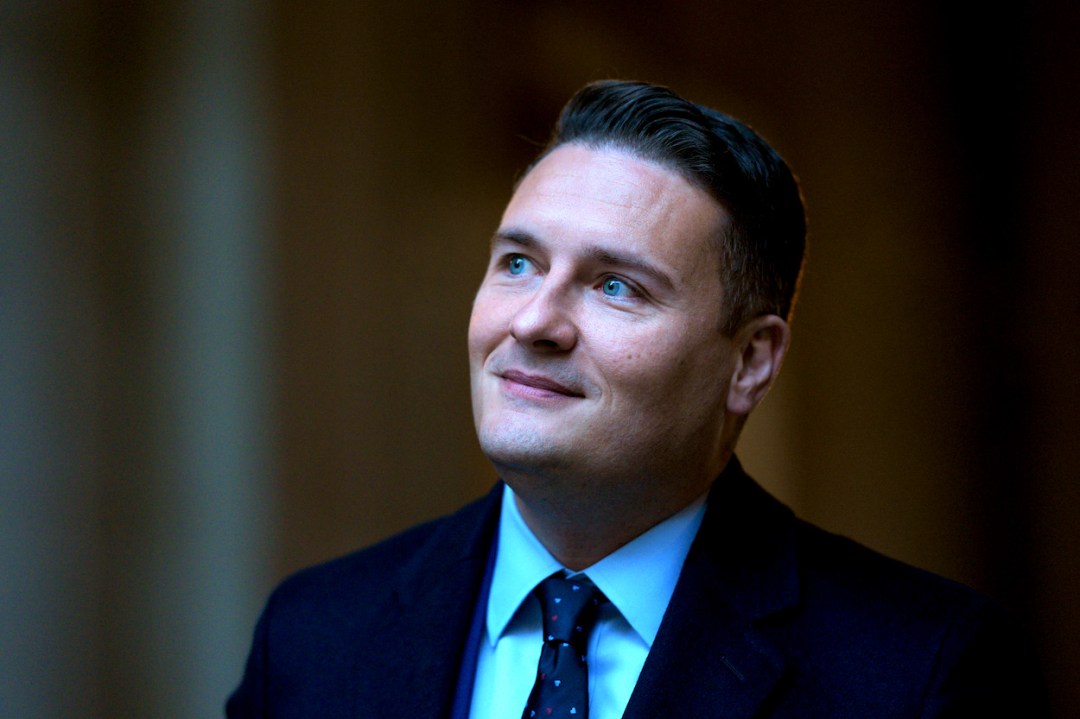
Health Secretary Wes Streeting has tried using the NHS for social engineering before. Previously, he’s suggested that weight-loss jabs could get people back to work. This week he’s gone further. Yesterday, Streeting said that ‘for the first time’ he would be ‘making the NHS accountable for patients’ employment outcomes’.

Streeting is right that ill health is contributing to unemployment. Economic inactivity due to long term illness runs at a record level. The rise has been steep post-Covid, with assessments shifting from face-to-face to virtual. And what’s most striking is that the surge has particularly affected those between 16 and 34.
There are 1.9 million people unemployed, and another 2.8 million – counted separately – who don’t work because of ill health. Back in 1942, Beveridge named the five giants whose evil the state must fight. Why should disease and idleness have suddenly got so much worse? Show me the incentives, said Charlie Munger, and I’ll show you the outcome. Either human biology has fundamentally changed in the last few years, and only in Britain, or the answer lies in our incentives. Medicalising unhappiness is bad for society, and corrosive for the people it traps in a degrading rut.
But what is Streeting actually proposing to do? The government’s press release gave the example of an accountant ‘suffering from fatigue and brain fog’ after a stroke, who was helped back to work with assistance from occupational health. What’s new about that? Is it just more money? There will apparently be ‘£25 million for NHS to continue to innovate how to support work outcomes’ in pilot schemes in South Yorkshire, West Yorkshire, the North East and North Cumbria. Nothing much else is mentioned.
This is part of a long-running campaign for the Health Secretary. In 2024, Streeting announced a partnership with Lilly to see if their Mounjaro weight-loss jab could get people back to work. My wife, who is also an NHS consultant, was scathing. ‘If I’m seeing a patient,’ she said, ‘I don’t want the state to be giving me any priority other than looking after their health.’ Having other priorities that might conflict alters the moral geometry of the consultation.
Still, we work for the state.
With the NHS failing to meet its existing obligations, adding new ones on top of its core brief is remarkable. Asking it to act partly as a job centre may have benefits, but could easily make it even worse at looking after people’s health, while being no better at getting them to work.
The difference between real experiments and performative spending is huge, and not usually one that politicians or the civil service want to understand. Trials need to be good enough to be wrong and reliable enough to be trustworthy, whatever they conclude. If more money is needed to get people into work, we need to understand how much money buys precisely what benefits. Without those things, pilot studies don’t merit the name.
The right test of Streeting’s seriousness is whether this initiative will be tested via a high-quality trial. Will the NHS and the DHSC set up pilots that test their own outcomes clearly and reliably? Or will managers and doctors with no competence at running robust trials throw money at a problem, and then give underpowered before-and-after statistics a dignity they don’t deserve?
There are reasons for pessimism
There are reasons for pessimism. The 2024 partnership with Lilly is a serious five-year randomised trial of what Mounjaro achieves, but, despite Streeting’s publicised ambitions, the gold standard registry, clinicaltrials.gov, doesn’t even list employment as one of that study’s primary or secondary outcomes. The work announced this week doesn’t seem to come close in quality; as far as I can tell, it’s not associated with any formal scientific protocols or registered outcomes.
Huge numbers of young people in Britain have been licensed as too ill to work. Streeting is acknowledging a problem that others prefer to ignore, but what’s currently being proposed is cowardly when set beside the biting changes needed. Targeted extra help needs to go along with dramatically improved gatekeeping of fit-notes, and an attack on the false kindness, or frank laziness, that embeds too many young people into believing they’re incapable. Considering how the NHS might help is reasonable, but half-hearted experiments with uninterpretable results trivialise a problem which merits being taken seriously.
Idleness is a giant evil, to be fought as fiercely as want, disease, ignorance, and squalor. Beveridge was right that it corrupts and demeans and impoverishes. The unemployed, and those currently called unemployable, merit better. They deserve policies tested for truth, not designed for a press release.




Comments