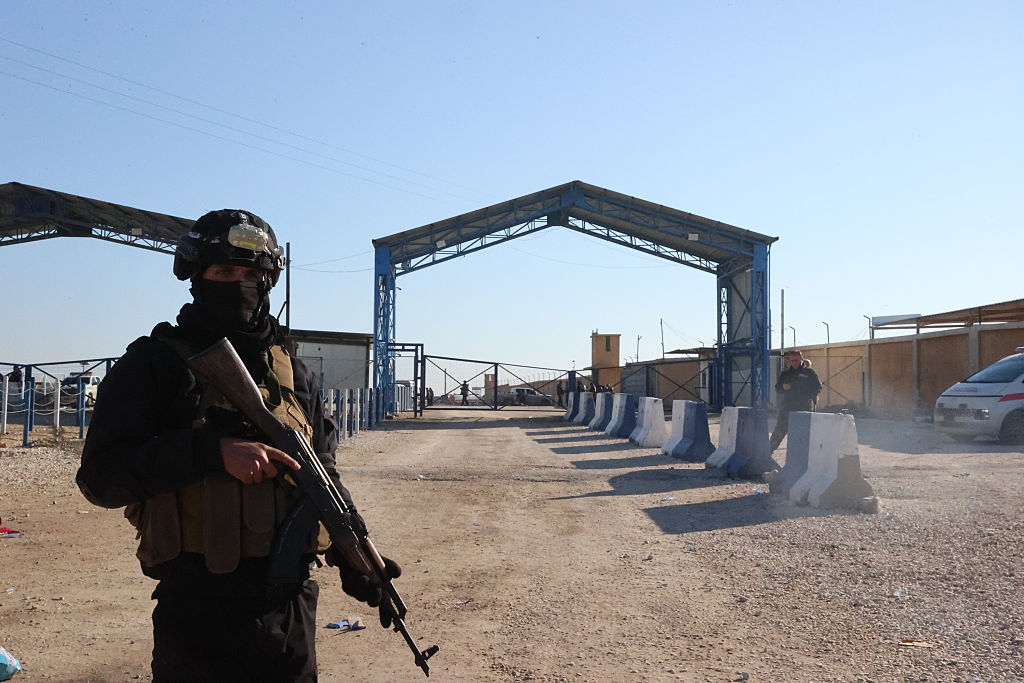
As Syrian government forces advance into the formerly Kurdish controlled north east of the country, the issue of future arrangements at the camps holding Isis members and their families has become a matter of increasing urgency. This issue has two levels – one more immediate, the other more structural and long term. The first level is concerned with ensuring the continued incarceration of the jihadis; the second relates to the nature of the emergent Syrian regime.
Isis maintained its own court system within al-Hol. This extended up to and included the passing and carrying out of death sentences
There are around 8,000 Isis fighters held in facilities in Syria east of the Euphrates at the present time. These are for the most part men captured when the Isis ‘Caliphate’ collapsed after its last stand in the town of Baghouz in the lower Euphrates river valley in the summer of 2019. Around 30,000 Isis family members – wives and male and female children up to the age of 18, are held in the vast and sprawling al-Hol camp, close to the border with Iraq, and in the smaller Roj camp, which houses among other jihadi spouses and widows, the former British citizen Shamima Begum.
I visited both camps on a number of occasions over the last half decade. The impression was that the Syrian Democratic Forces (SDF), the West’s now apparently former partner in the war against Islamic State, were just barely keeping the lid on a boiling cauldron. This was particularly the case at al-Hol.
In talks with the camp’s authorities and with residents as we walked about the market area maintained at the camp, I learned that a new generation of Isis members were being raised and educated at al-Hol. The Kurdish SDF, short of resources and money, essentially held only the periphery. Within the compounds, Isis maintained what its supporters openly referred to as a ‘province’ of their Islamic State.

The jihadis controlled the education of the thousands of young people at the camp. Isis also maintained its own court system within al-Hol. This extended up to and included the passing and carrying out of death sentences. The bodies of those executed would be dumped outside the compound, for the Kurdish authorities to handle.
Isis even managed to maintain the institution of slavery in al-Hol. How was this possible, given that all inmates were required at least to register their names and identities when entering the camp? The answer is that Yezidi slaves were taken as children by the Islamic State when it rampaged across northern Syria and into Iraq in the summer of 2014. They were then forced by their Isis ‘owners’ after the fall of Baghouz to register under false identities when entering al-Hol. But didn’t Syrians and Iraqis have identity numbers which would need to be given, and could be traced? No problem. Islamic state, famously, attracted foreign Muslim volunteers from across the world. Slaves were simply made to register as one of the many foreign volunteers lacking documentation.
It’s easy to imagine what would happen to any enslaved person refusing this instruction. Many such people existed in al-Hol. One of them was rescued by an intrepid Scottish ex-soldier turned film-maker, Alan Duncan. She appealed to him while he was filming in one of the al-Hol compounds.
Throughout the years of these camps’ twilight existence, the impoverished Kurdish authorities appealed to European and Middle Eastern nations to take back their citizens. Their requests were often ignored. The SDF were not representatives of an internationally recognised state, but rather a provisional (and now apparently doomed) autonomous administration. This enabled states simply to ignore their requests, and to leave them with the job of incubating some of the most dangerous people in the world. Still, the slow process of repatriation nevertheless ground forward, with the result that the camp now contains fewer than 30,000, compared to around 60,000 in 2021.
Roj camp, where Shamima Begum is located, is smaller and more tightly run. Many of the 2,500 or so inmates are awaiting repatriation. There are a large number of children and fewer acts of violence against the authorities.
At the present time in north east Syria, a kind of de facto transfer of authority is under way. To put it plainly, the US has chosen to abandon its Kurdish allies, and to align instead with the emergent Islamist government in Damascus. As a result, the government has understood that it has a green light to destroy the Kurdish-led SDF by force and has launched a military incursion across the Euphrates. Government forces rapidly conquered the southern, majority Arab provinces of Raqqa and Deir al Zur. As they have moved into the majority Kurdish north, so they have approached the locations of some of the facilities in which the Isis detainees are being kept. The Syrian army has now entered the al-Hol camp, which was abandoned by the SDF the day before.
In Shadadi prison two days ago, government forces attacked the Kurdish fighters guarding the jail as part of the former’s advance. The result was that in the ensuing chaos, several hundred Isis men escaped. The Kurds complained that forces of the nearby US-led global coalition failed to respond to requests for assistance.
The advance of the Syrian government forces has been accompanied by atrocities, including the execution of prisoners and the abuse and tormenting of captured female Kurdish fighters. In at least one case, a captured Kurdish fighter was beheaded. The Kurds are as a result now gathering their forces in majority Kurdish Hasakeh province, in order to defend against a possible massacre. Their fears are not unfounded.
In the current chaos, there is a danger of mass breakouts from the prisons and encampments, as Kurdish fighters head for Hasakeh to defend their people against possible massacre. An unknown number of Isis residents escaped when al-Hol was abandoned by the SDF. The fate of al-Roj and of Shamima Begum still awaits.
The second, strategic level of concern involves the ideological closeness of many of those serving the new Syrian government to Isis. Visiting al-Hol in 2022, I asked where escapees would head to. I was told that they made invariably for the enclave in the north west controlled by Hayat Tahrir al-Sham, the organisation whose leader, Ahmed al-Sharaa, is now president of Syria. There, while they could not organise politically, they would be left unmolested, with their wives, property and slaves.
Will the Sunni Islamists and jihadis now ruling Syria prove equally reliable custodians of the Isis virus as the secular Kurds the West has chosen to abandon? I wouldn’t count on it.





Comments