
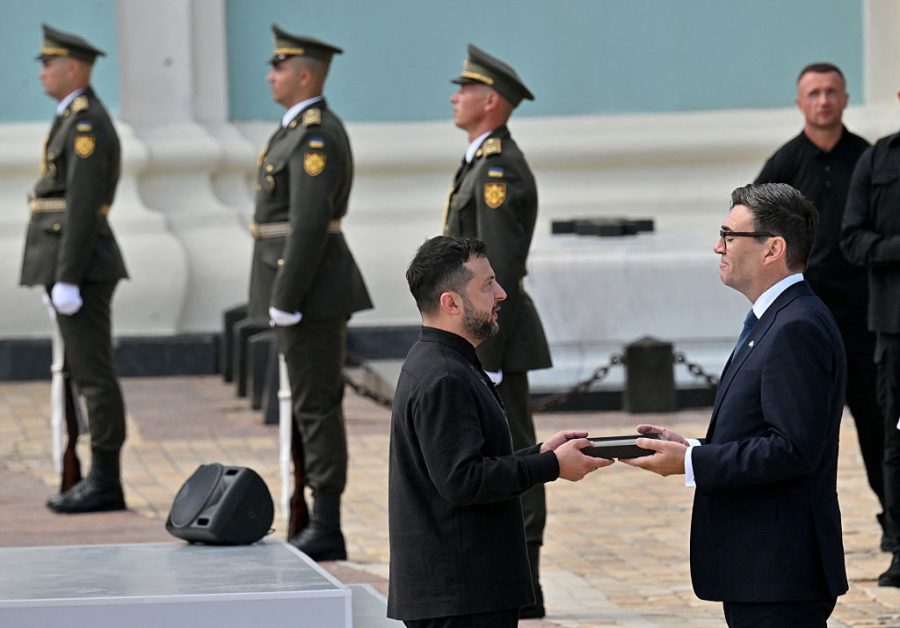
Andy Burnham arrived in the Ukrainian capital of Kyiv this morning, his first trip abroad since entering Downing Street last month. The Prime Minister’s visit has been timed to to coincide with Ukraine’s independence day, marking 35 years since it broke with the Soviet Union. Burnham will later today use the occasion to announce plans to share the blueprints for building the British components of long-range Storm Shadow missiles with Ukraine.
Britain has been supplying Storm Shadow missiles – co-produced with France – to Ukraine since 2023, with Kyiv reportedly firing the long-range weapons in Russia for the first time in November 2024. Storm Shadow missiles have a range of nearly 350 miles, theoretically putting Moscow within striking distance of Ukraine.
Burnham’s announcement today will grant permission to MBDA, the defence company that manufactures Storm Shadows, to declassify information on how the British components of the weapon are made. The Prime Minister will also confirm that the UK will help France set up Ukrainian assembly lines for long-range missiles, as promised by the French president Emmanuel Macron last month.
Burnham is not one to shy away from a little symbolism
Today is a day of firsts for Burnham: as well as this being his first foreign trip, it will also be his first time co-chairing the Coalition of the Willing Ukraine support group alongside Macron. A number of other leaders are expected to join the call remotely, including German chancellor Friedrich Merz. The aim of the call will be to discuss further support for Ukraine, including specifically how to fend off Russian attacks, made all the more damaging by Ukraine’s critical lack of Patriot air defence missiles.
As has fast become clear in the month since he became prime minister, Burnham is not one to shy away from a little symbolism. Choosing Kyiv as his first foreign trip as prime minister comes just under a month after Burnham met Ukrainian president Volodymyr Zelensky for the first time in Britain, making Zelensky the first foreign leader Burnham had hosted since entering No.10.
At the time, Burnham described his meeting with Zelensky as ‘very warm’. Downing Street also announced that it would be sharing electronic jamming technology known as ‘Stone Cloak’ with Ukraine, which will allow their drones to slip through Russian air defences. As was the case last month, the intention of Burnham’s visit today is to reaffirm the solidity of Britain’s support for Ukraine. Ahead of his trip last night, he said: ‘The UK is behind you today and for as long as it takes.’
In the intervening month, tensions between Britain and Russia have grown. The Kremlin’s spokesperson Dmitry Peskov responded to Burnham’s comments this morning, saying:
Britain is methodically and regularly throwing oil on the fire and methodically and regularly plotting schemes to prevent even the slightest progress in the peace process.
Last week, the Russian embassy in London threatened Britain with ‘consequences’ for ‘acting as an accomplice and co-perpetrator of the bloody crimes and terrorist attacks’ it accused Ukraine of committing in the conflict. Intriguingly, it has since become apparent that this statement was issued by the embassy several weeks after the Russian ambassador to Britain, Andrei Kelin, was withdrawn from his post after seven years. Announcing Kelin’s departure, a spokesperson for the Russian embassy added that:
As for the state of Russia-UK relations across all areas, they have deteriorated to an unprecedentedly low level entirely on London’s initiative.
While it is not unprecedented for there to be a gap of several months when there is a change of ambassador – whether at the Russian embassy or elsewhere – some commentators have suggested that Kelin’s withdrawal and the embassy’s statements are efforts by the Kremlin to put Burnham’s government under added pressure over his support for Ukraine. But with the post of Russian ambassador to the Court of St James now vacant, could it also be the case that the belicose growling coming from the embassy in recent weeks is the product of someone within its walls auditioning for the top spot?
Reasuringly for Ukraine, Burnham remains undeterred. Standing in front of Kyiv’s St Sophia cathedral, the Prime Minister declared: ‘Despite Russia’s outrageous threats to my country, we will continue our support for Ukraine.’
Burnham’s focus on Ukraine in the month he has been prime minister tells us little so far about whether the warnings about his lack of interest in foreign policy and diplomacy are substantially true. It is, however, clear that the Prime Minister is falling in behind European efforts to enable Ukraine to stand on its own two feet defensively as Donald Trump’s stifling of American support for the country begins to bite. With expectations on the continent that the US withdrawal of weaponry, finances and support will continue into 2027 and beyond, Ukraine’s European allies have been working to give Kyiv more autonomy in the fight against Russia.
Nevertheless, diplomatic hand-pressing and strong words only go so far on the global stage, as Burnham’s predecessor Keir Starmer learnt to his chagrin. How the Prime Minister navigates the Coalition of the Willing, as well as diplomatic relations with allied countries such as France, Italy and Germany – the leaders of which he’s yet to meet in person – will tell us much more.





Comments