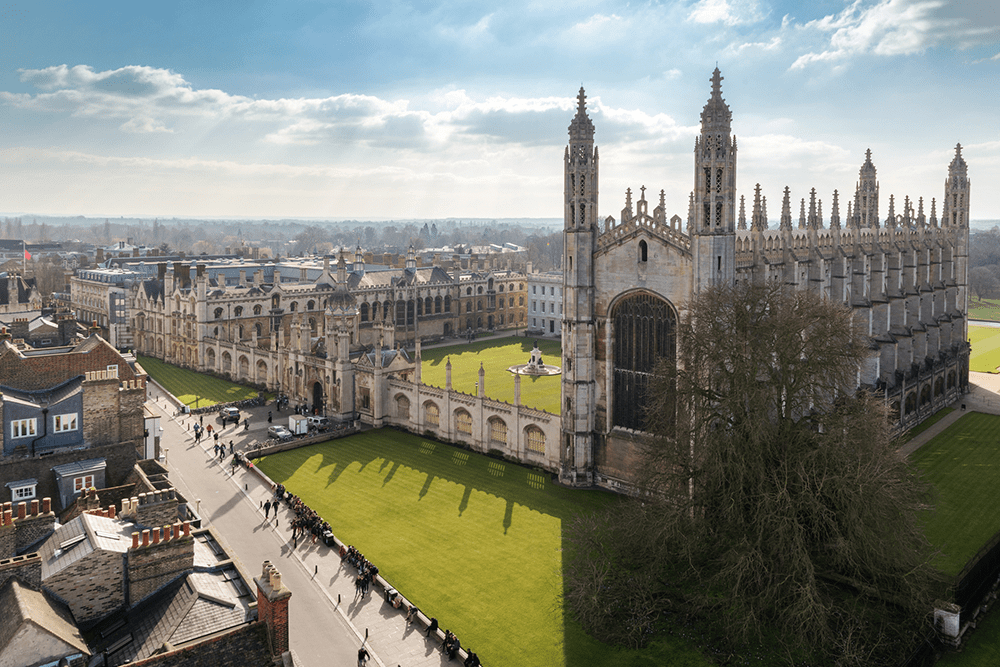
‘What distinguishes Cambridge from Oxford,’ A.A. Milne said in 1939, ‘is that nobody who has been to Cambridge feels impelled to write about it.’ Four decades later, Tom Sharpe would prove him wrong about Cantabrigian reticence with Porterhouse Blue – his riotous satire of the conflict between an idealistic new master and the stuffed shirts of the senior common room. It’s a shame that Sharpe isn’t around to enjoy the Jason Arday scandal – a farce so absurd that even he may have dismissed it as being too silly.
When Arday was announced as Cambridge’s professor of sociology of education, he was lauded as the university’s youngest-ever black professor. His biography had a whiff of Hollywood. Arday had been diagnosed with a developmental disorder at the age of three. He was said to be mute until he was 11 and illiterate until he was 18. But he rose from two GCSEs in P.E. and textiles to complete a PhD, raise £5.5 million by running 30 marathons in 35 days – an achievement so stirring it inspired Andy Murray – and become, in the Guardian’s words, ‘a highly respected scholar of race, inequality and education’.

As Lara Brown writes in her article, Arday’s claims have now been ‘comprehensively debunked’. His published works were discovered to contain dozens of passages lifted wholesale from – or bearing an uncanny resemblance to – other academic papers; his biographical assertions were exposed as hollow and ludicrous, including a suggestion that he had starred in the TV show Seven Up, which began 21 years before he was born. The Guardian has since investigated Arday’s claims, such as an assault by a masked man and an assertion that a pig’s head was posted to his parents after his appointment to Cambridge. When the paper found no evidence to support these claims, they asked him for comment. ‘To be honest, I thought you’d just believe me,’ was Arday’s reply.
Cambridge is sticking by its man. Arday, the university claims, has been the victim of ‘a vile smear campaign to undermine his credibility’ – or, as it is also known, journalism. As Lara points out: ‘Arday’s ascent is a stunning indictment not just of the incuriosity of Cambridge but its corruption.’ Seemingly, ‘no one ever checked Arday’s academic CV, the papers he’d put out for publication or the data he used’. The best explanation is that, amid the Black Lives Matter hysteria, Cambridge hired Arday so he could be sent on ‘an endless, self-flagellating media round’, berating the institution for its past racism and then praising it for improving. In this role, being a fantasist was no hindrance.
Two years ago, the classicist David Butterfield wrote in these pages that Cambridge was in decline due to ‘politicised teaching, grade inflation, authoritarian campus policies and lurid, even laughable, research grants’. Progressive posturing and social engineering had been put before academic standards; an expensive bureaucracy was strangling the freedom on which worthy scholarship was based; an explosion in mental health claims had stifled intellectual development. Those who dissented from Cambridge’s progressive orthodoxy meanwhile had been hounded out.
Some might find the focus on one institution myopic and elitist. But Butterfield argued that the ‘ambitions of our whole education system are ultimately pegged to the achievements at the very pinnacle’.
The impetus must come from within universities, which have become lost in their avarice and dogmatism
A fish rots from the head. Cambridge exemplifies flaws across British universities: grade inflation, campus wokery, academic corruption, vice-chancellor greed and a loss of purpose; Arday is part of a much wider problem.
The greatest victims of this decay are the students, paying ever more for ever less. A third of graduates are not in graduate jobs; some 45 per cent of English higher education institutions are running a deficit, with rising costs becoming harder to meet amid restrictions on student visas.
What is needed is a more ambitious university system demanding higher standards with more sustainable finances. But, while ministers can push for reform, the impetus must come from within the universities, which have become lost in their avarice and dogmatism. If they cannot find their way back, what worth is their teaching?
There were few finer critics of closed-minded, work-shy students or priggish, over-remunerated academics than the late Rod Liddle. Since this issue is a tribute to Rod, he should have the final word. In 2021, a group of Durham students walked out of a speech he gave at the institution. He wrote afterwards that British universities make ‘proud proclamations of their commitment to freedom of speech followed by the immediate disavowal of that commitment, and the persecution of anyone who has taken that proclamation at face value. The kids, meanwhile, will continue hearing only one view, because who now would invite a social conservative to speak at a British university?’




Comments