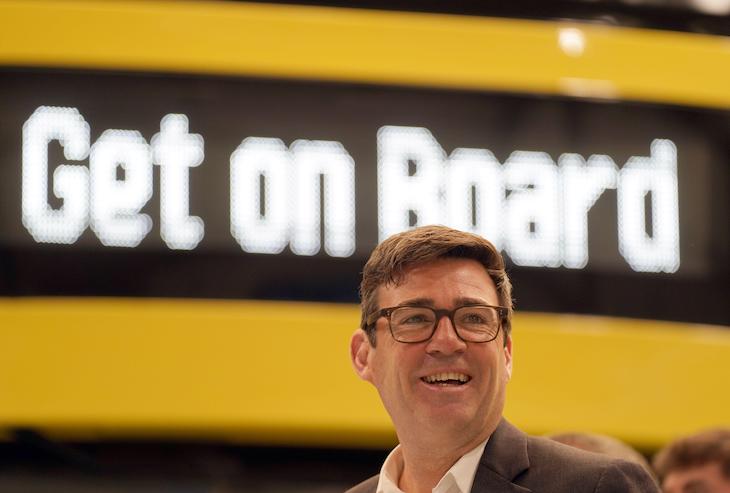
It’s one of those political facts that everyone parrots without really knowing whether it’s true: Andy Burnham has, in his own words, ‘transformed’ Greater Manchester’s bus service. Burnham’s publicly-controlled double-deckers are Exhibit A in the claim that his ‘Manchesterism’ amounts to more than a catchphrase. Real voters, including in Makerfield, bring it up spontaneously. And even the SW1 classes, while often dismissing Our Next Prime Minister as a weathervane and lightweight, usually mention the buses.
What’s the point of being in power if you’re never willing to use your political capital to do anything serious?
I’m a bus lover, a regular bus user and broadly a supporter of Burnham’s ‘Bee Network’, a London-style system operated by private contractors but with timetables, routes, fares and branding controlled and subsidised by the mayor. And I too claim some paternity. As Boris Johnson’s No. 10 transport adviser, I fought off heavy lobbying by one of the big bus companies which wanted us to stop it. As Burnham always forgets to mention, it was the last Tory government which gave him the legal powers, and the large sums of money, that made the scheme possible. Under Johnson we created a ‘bus service improvement’ fund, £95 million of which went to Burnham, and a fund for capital spending on new buses, bus stations, trams and tramlines – from which Burnham got £1 billion in the first tranche alone.
All that is why it’s mildly annoying – and more than mildly dishonest – of the mayor to claim that ‘Westminster just ignore[d] buses’, and that he did all the work. But the bigger problem with the Bee Network is this: it hasn’t been a failure, but because of Burnham’s weakness and cowardice, it hasn’t yet fulfilled its promise. The large sums spent have brought only modest-to-middling improvements.
There is an even more serious problem. Not reported until now, Transport for Greater Manchester’s auditors have refused to sign off its accounts unqualified because of ‘significant weakness’ in its financial arrangements. They have also warned of the risk of a big financial hole in Burnham’s bus project, caused by lower-than-expected fare revenue, which the Mayor has been quietly dipping in to his emergency reserve to fill.
Burnham always forgets to mention is that bus use in Greater Manchester is, in fact, down by 12 per cent since he took office in 2017. It has fallen almost everywhere over that time because of post-Covid working-from-home, rising traffic congestion and the decline of traditional high streets. But bus use has fallen more in Greater Manchester over this period than in any other large authority in the North West, including Merseyside and Lancashire.
To be fair, the Bee Network only started in March 2023, with the first of three tranches, and the final tranche was only completed in January 2025. Since 2022/3 there has, as Burnham says, been a clear increase in bus use in Greater Manchester – 19.4 per cent, according to the latest Department for Transport figures. That is more than double the national average over the period. But it is still nowhere near as good as many other places.
While Burnham has managed 19.4 per cent, the wicked, privately-controlled bus service in Bristol has grown passengers by 33.1 per cent over the same two years. Bus use over the same period in Leicester is up by 20.5 per cent, Southampton by 19.9 per cent, Cornwall by 29.4 per cent, to name a few, and all for a fraction of the sums per passenger that Manchester is spending. In the North West, two other authorities – Warrington and Halton – have grown usage more over this period than Greater Manchester. All these places still operate buses on the old, largely commercial model. Buses do not, in other words, prove Burnham’s claim – likely soon to be tested in the rest of the country – that publicly-controlled services are always better.
I do think that a common brand and ticketing helps drive passenger use, though you can do that with other ownership models. I also think Burnham’s £2 flat fare has helped – though, in something else done for buses by the previous government, the fare in the rest of England outside London was also £2 until Labour raised it to £3 last year. I also supported the Bee Network because I thought the threat of wider franchising would keep the big bus companies in line (as it did) with the broader changes we wanted to make across the industry.
But what really ‘transforms’ a bus service, and what actually gets people out of their cars, is not who controls the buses, who owns them, or what colour they are. It’s the humble bus lane. The main reason people don’t take the bus is that it’s often slow and unreliable. Bus lanes make buses faster, more punctual, and more attractive to passengers, bringing in more fare revenue.
Quicker journeys also let you run the same service with fewer vehicles and drivers, reducing your operating costs. A bus lane is deliverable in about a day, for pennies, with a few signs and a pot of paint. It amounts to one of the most virtuous circles in public policy. Both publicly-controlled London, and privatised Bristol, drove huge increases in ridership with lots of new bus lanes. The ownership model mattered much less than the political willingness to take roadspace for buses.
Even motorists, in the end, can benefit from bus lanes, because more drivers taking the bus frees up space for those who remain. But in the short term, removing roadspace from motorists and giving it to buses makes car journeys slower and creates a political backlash.
That is what Burnham and the other Greater Manchester politicians – unlike the leaders of London, Bristol, and other places – have been almost completely unwilling to risk. As transport adviser, I spent a lot of time asking them to put in more bus lanes. But they mostly wouldn’t, and when Boris moved on, so did I. Result: lots of nice new buses, still stuck in traffic. Another consequence: Greater Manchester’s improvements have been small relative to the amounts of public money spent.
Since the Bee Network began, annual revenue subsidy to GM’s buses has more than doubled, from £40 million in 2022/3 to £84 million in 2024/5 (Transport for Greater Manchester’s own accounts say it has more than trebled, to £122 million). Franchising has incurred set-up costs of a further £134 million. Hundreds of millions more have gone in capital spend. Several rather nice new bus stations – ideal venues for politicians to have their pictures taken – have been built, and Burnham has paid at least £80 million to buy the existing operators’ bus garages, which was totally unnecessary (most of the same operators are still using the same depots as contractors to the Bee Network; publicly-controlled London doesn’t own the vast majority of its bus garages.)
But Greater Manchester’s actual bus service hasn’t doubled or trebled. It has risen by only 7.5 per cent, from 47.14 million vehicle miles in 2022/3 to 50.67 million miles in 2024/5. In Bristol, over the same period, service levels have risen by 24.5 per cent – while subsidy, according to the DfT, has almost halved.
What ‘Manchesterism’ means on the ground is a few new routes, but not that many; some major frequency improvements, but not that many; and quite a lot of routes getting a few extra journeys, often early in the morning or late at night. Makerfield, Burnham’s putative constituency, is typical. The main route serving its principal town, Ashton, ran every 12 minutes before the Bee Network and runs every 12 minutes now. The evening and Sunday service has increased from one bus every 30 minutes to one bus every 20, and the last bus now runs an hour later. Against that, the end-to-end journey time is slower than it was.
I’ve come to realise that the bus network does symbolise something important about a prime minister Burnham
Burnham claims he’s ‘never known anything as impactful’ as the Bee Network. But even his own stated plan for it is incredibly unambitious – to reach 200 million journeys a year by 2030. That is, only fractionally more than the 195 million made in his first year as mayor.
It’s been impactful in another way, of course. The Bee Network has been a PR triumph for Burnham. Little can be more visible than 1,600 big yellow buses. And the myth of transformation, even if it’s not really true, still matters and has power: the network is a real source of local pride.
I’ve also come to realise that the bus network does symbolise something important about a Prime Minister Burnham. First, it shows how useless he is at taking even slightly difficult decisions. In 2024, he won re-election as mayor by a 53-point margin over his closest rival. Yet he still didn’t feel he had the political strength to put in a few bus lanes and annoy a few motorists. What’s the point of power if you won’t use your political capital to do anything serious? That’s a question to which we’ll all soon find out the answer.
Second, it shows he’s bad with money – and not just because of the relatively modest gains he’s shelled out so much to achieve. Close scrutiny of Transport for Greater Manchester’s latest accounts reveals that the auditors have refused to sign them off unqualified.
As they put it: ‘We are not satisfied that the Authority has made proper arrangements for securing economy, efficiency and effectiveness in its use of resources… [there is] evidence of a significant weakness in TfGM’s arrangements for governance.’ The accounts, they said, were submitted months late because TfGM couldn’t properly value the equipment and property it had taken leases on for the Bee Network, such as the new buses and the unnecessary depots.
In another report, also unrevealed until now, the auditors found a further, potentially even more serious, problem. They say there is a ‘significant level of uncertainty in relation to funding to support Metrolink [tram] and bus network services as a result [of] revenues not growing in line with pre-pandemic forecasts.’ Government funding, they say, is ‘non-recurrent’, so Burnham has been dipping into his reserves to pay for his buses. TfGM, they demand, must implement ‘efficiency savings’ (cutting the service back again?) to avoid this supposedly emergency pot becoming drained.
Burnham’s buses are indeed a perfect preview of the soft left in government. But not, alas, in the way he intended.


Comments