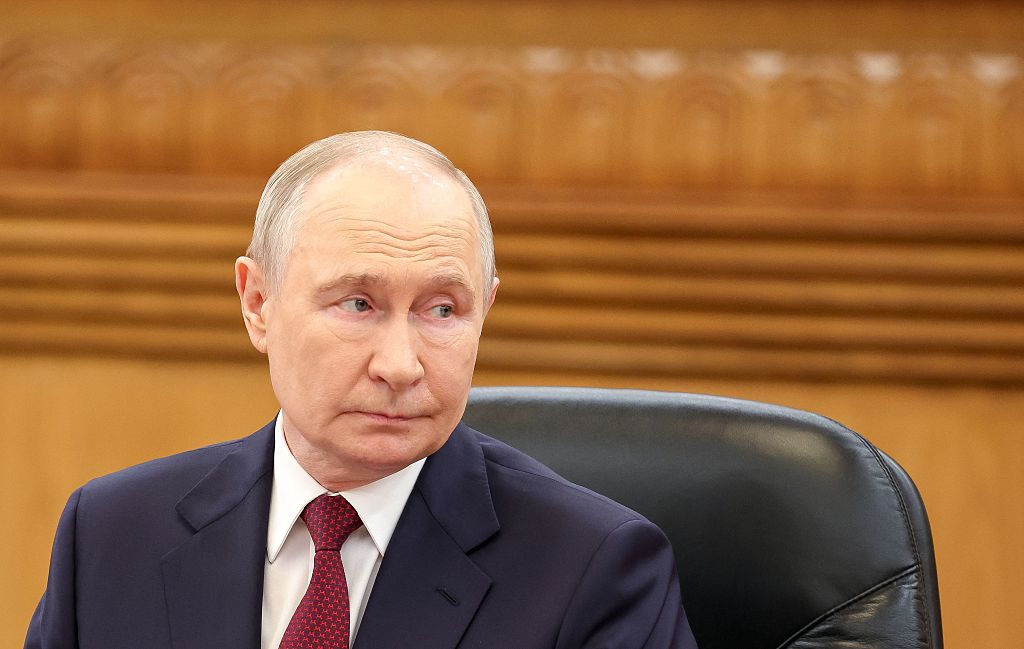
As Vladimir Putin senses the momentum of the war shifting in Ukraine’s favor, he has redoubled his attempts to coerce Kyiv and its European partners. Russian troops are in retreat, losing territory overall for the first time since Ukraine launched its Kursk offensive in August 2024. Drone strikes have forced all of central Russia’s major oil refineries – accounting for a quarter of the country’s refining capacity – to halt or reduce output.
Meanwhile, the cracks are beginning to show as Russians cease believing in their President, with some openly calling for an end to Putin’s so-called special military operation. His only available response, it seems, has been to resort to nuclear intimidation and threats of military confrontation with the Baltic states.
The Belarusian defense ministry posted footage on Telegram this morning showing heavy vehicles said to be transporting nuclear warheads through a forest
In Belarus, Moscow launched joint military exercises involving nuclear forces and 64,000 troops. The Belarusian defense ministry posted footage on Telegram this morning showing heavy vehicles said to be transporting nuclear warheads through a forest en route to the drills. Such nuclear posturing is usually interpreted in Kyiv as a sign that Putin is running out of options. This time, though, Russia’s increased activity in Belarus comes amid warnings from Volodymyr Zelensky that Putin is attempting to draw his ally Aleksandr Lukashenko deeper into the war.
Zelensky said Moscow may be preparing to revive its northern offensive toward Kyiv and Chernihiv. Russian forces operating from Belarus failed in their attempts to seize the capital in 2022. Until now, Lukashenko has been reluctant to jeopardize his regime by directly involving Belarusian troops in the war, given that the vast majority of Belarusians strongly oppose any participation in Russia’s invasion of Ukraine. Zelensky has ordered Ukraine’s military to strengthen defenses along the Belarusian border in case Lukashenko changes his mind.
Most popular
Steven Edginton
Invented claims of lynchings and racist violence are irresponsible — and dangerous

It comes as Nato jets were scrambled this morning after an unidentified drone entered Latvian airspace for a third day in a row. Just last week, Latvian Prime Minister Evika Silina resigned over her government’s handling of Russian-bound Ukrainian drones that had veered into Latvian territory and crashed into empty oil tanks.
Ukraine’s foreign ministry later apologized publicly to Latvia, Lithuania, Estonia and Finland over similar incidents, accusing Russia of jamming the drones and deliberately redirecting them into Nato territory in an attempt to drive a wedge between Kyiv and its allies. Zelensky offered to send Ukrainian drone experts to the Baltic states and Finland to help them strengthen their air defenses.
So far, none of the affected countries have publicly blamed Ukraine, instead saying it’s Russia’s fault that Ukrainians are forced to fight at all. Poland’s defense minister Wladyslaw Kosiniak-Kamysz was the only one who advised Kyiv to direct its drones more precisely.
The Kremlin attempted to escalate matters, falsely claiming that the Baltic states had granted Kyiv access to their airspace to launch attacks on Russia. On Tuesday, Russia’s foreign intelligence service threatened military action against Latvia, accusing it of preparing to facilitate Ukrainian drone launches from its territory. The agency claimed that Russia was fully aware of “decision-making centers on Latvian territory” which it could target, adding: “NATO membership will not protect terrorist accomplices from fair retribution.”
Ukraine, the EU states and Nato rejected Moscow’s allegations. Alexus Grynkewich, the American general serving as Nato’s Supreme Allied Commander Europe, said that the alliance gave no such permission to Ukraine. “If we were allowing drones to go through Baltic airspace in order to get to Russia, we wouldn’t be shooting them down,” he pointed out, after a Romanian F-16 jet shot down a Ukrainian drone over Estonia on Tuesday. European Commission President Ursula von der Leyen called Moscow’s threats “unacceptable” and pledged further measures to strengthen security along the eastern flank of the alliance.
It seems that, for now, Putin’s game has failed to sow division between Ukraine and its allies to make them force Kyiv to scale down drone attacks against Russia. But, he is unlikely to stop trying.





Comments