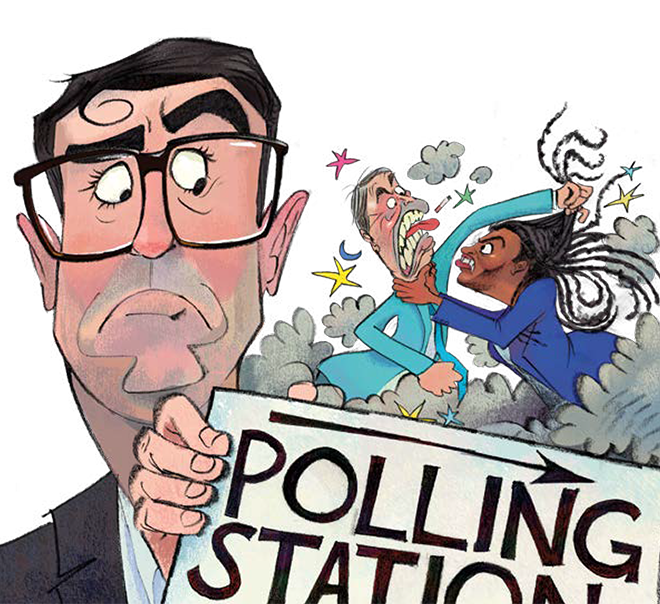


On 1 September, Andy Burnham gathered Labour MPs in No. 10 for a rousing speech. ‘We are a fighting force,’ he said. ‘We can win the next election. We have an opportunity now. We’ve got the initiative.’ Some of those present wondered if this was the Prime Minister rolling the pitch for an early election.
One MP recalls a comment by Burnham in a smaller group that night: ‘We’ll hopefully see some of you back after the election. Er, most of you!’ Downing Street is adamant the PM would say no such thing, even as a joke. A party adviser accused the source of ‘trouble making’. Burnham’s senior aides deny there is any prospect of an early election. ‘Not going to happen,’ says one. A senior figure in No. 10 states bluntly: ‘I keep telling people: there’s “the line”, which is there won’t be an early election. And then there’s the actual position – which is that there won’t be an early election!’
But those of us who were around in 2007, 2017 and 2024 recall equally emphatic statements from close allies of Gordon Brown, Theresa May and Rishi Sunak – and in the case of the last two they were only true until they were not. In Brown’s case, he came mightily close to going to the country. Burnham was a member of Brown’s cabinet and the unelected Labour leader missing the opportunity to secure a mandate of his own haunts many to this day.
Labour officials in Holborn and St Pancras have discussed whether a win there could be ‘lift-off’
‘I think Andy’s political education makes him want to perform like Blair, with the policies of Brown, and he will be very aware of Brown’s great mistake,’ says an adviser. ‘But I think at the moment it’s an open question.’
As the Labour faithful meet this weekend in Liverpool for Burnham’s first party conference as leader, three big questions remain. What can he do at conference to give voters hope? How can the Budget on 28 October begin to tackle Britain’s problems? And can Burnham really be a successful leader without seeking his own mandate and escaping the straitjacket of the 2024 manifesto?
Labour special advisers summoned last week to the pillared state room on the first floor of No. 10 to hear the plan for conference from Burnham’s political secretary, Hayden Munro, left in no doubt that the PM wants to be a transformational figure. The conference ‘narrative’ these advisers were urged to push includes the telling line: ‘This Labour government will bring forward the biggest change to Britain in 40 years, with a new political and economic model.’ On the specifics, Burnham will pledge: ‘We will make the choices that are needed to end rough sleeping, solve the social care crisis and get more young people into work.’
Burnham will pledge to run a ‘cost-of-living government’ with further ‘immediate action’ to ‘provide the breathing space people need’, as well as outline plans to devolve power ‘out of Whitehall’, ‘reindustrialise Britain’ and take back public control of ‘the essentials in life – such as energy, water and housing’ to ‘make them affordable again’.
Labour strategists say all this can be done within the confines of the 2024 manifesto. They point to Alan Milburn’s plans, soon to be unveiled, to break the link between mental illness and physical disability in the welfare system. They are designed to rein in spending on benefits (after an initial period of investment). Burnham could bring down the huge cost of borrowing if he is prepared to confront Labour MPs and slow the rate of growth in public spending.
However, to some in Burnham’s inner circle, this sounds miserable – the death of their dreams by a thousand cuts. Some say privately that perhaps it would be better if they made one difficult decision and called an election. A former Downing Street aide who spoke to someone in No. 10 last week says: ‘There is a lot of talk in there about “mandate”. They are preserving their optionality in case he wants to go for it.’
Labour officials campaigning in the Holborn and St Pancras by-election have discussed whether a win there could be ‘lift-off’ for Burnham to go to the country. ‘The hope is that if we beat [Zack] Polanski he will be toppled as leader,’ says one.
A prominent Labour figure outlines the pros of a snap election. ‘Andy might say: “I want to make a big argument about changing welfare. I want to make a big argument about the security threat we face. And I want to do the right thing when it comes to adult social care. I need to be freed of the taxation pledges because I’ve got to govern and I, Andy Burnham, believe I am a once-in-a-generation communicator. I can make that case and then as long as I’ve got a majority of 40 to 60 I can do it.”’
Add to this the turmoil in Reform over their donations and the fact that the Tories have not yet selected most of their candidates and this might be the most propitious moment for Burnham to go for it. James Purnell, No. 10’s chief of staff, is more sympathetic to this viewpoint than many.
But for many in the Labour party, the cons are painfully obvious, starting with the loss of 50 to 80 MPs. Current public MRP superpolls show Labour falling short of a majority and internal polling is similarly gloomy – though some Tories say Burnham would scrape over the line. But in all scenarios he would win far fewer seats than Starmer, something that his party would struggle to forgive.
‘The professional political strategists can read a poll,’ says one of those who backed a snap election but has now changed their mind. ‘I thought we would be above 30 per cent by now and Reform would be nearer 20 per cent, but while neither of those is the case, it’s very tough.’
Other party veterans struggle to see how there is any point rewriting the manifesto or seeking a new mandate unless Burnham changes the fiscal rules or scraps the manifesto commitment not to raise Income Tax, National Insurance or VAT – but they also can’t see how that would survive contact with the media or the electorate. ‘The entire campaign would be about Burnham raising taxes to pay for migrants and welfare,’ says one prominent Labour figure. A member of the Labour right agrees: ‘He can’t change fiscal rules now – he hasn’t even tried to get credibility with markets to do that.’ A former Downing Street Tory predicts: ‘After taking a pounding in the first week he’d probably just have to commit to the same pledge as 2024.’ Burnham will make a point at party conference that he is prepared to take difficult decisions. The narrative, outlined by Munro, reads: ‘‘‘It’s too hard” will no longer be used as a justification for not acting. We will get stuff done.’
But those who have listened to recent Labour focus groups say voters are beginning to ask: what stuff? ‘Doubts are starting to creep in,’ says a Labour source. ‘Questions being raised along the lines of: “I’ve seen a lot of activity from him, I like him, but what does it add up to? How will he bring down the cost of living?” There are doubts focused on whether he has a plan and what substance lies beneath the charm.’
Conference will answer some of these questions, but most people expect the Budget to be the decisive moment and there are two causes for concern among serious Labour people. One is echoed by Andy Haldane, the former chief economist of the Bank of England, who advised Burnham but decided not to take a job after concluding he was leading a ‘tax-and-spend socialist government with better TikTok videos’. Burnham seems to have little stomach for cuts. ‘The problem is that Britain is taxed out,’ says the Labour rightist. ‘You actually need to cut and reform. You don’t need to increase and borrow.’
One group of Labour MPs concluded that Burnham might call an election to avoid having to do a Budget at all
A series of tax rises have been floated, including lowering the planned mansion tax threshold from properties worth £2 million to those worth £1.5 million and equalising the rates of capital gains tax and income tax, which could raise £14 billion. ‘Everything’s on the table,’ says a source. ‘They’re going to bring back the bank surcharge. That gets you £2 billion to £3 billion. They are looking at stuff like national insurance for landlords. Pensioners who work don’t pay national insurance, so you can bring in some money there. You can look at oil and gas.’
However, Treasury sources say the Budget process is moving slowly because neither Burnham nor his Chancellor, John Healey, have a strong idea of what they want to do. New chancellors usually ‘go native’ and are captured by Treasury orthodoxy, but people say Healey is ‘Downing Street’s man’. ‘We are further behind a month out than I can remember,’ says one insider.
Rachel Reeves bequeathed Healey ‘headroom’ of £23 billion, the cushion between what the government is spending and the amount permitted by the government’s fiscal rules. Most experts think higher borrowing costs have slashed this in half. But Treasury officials have told the City the figure is even lower, around £8 billion. Which may explain why one group of Labour MPs, who met in the Commons tearoom before recess, concluded that Burnham might call an election to avoid having to do a Budget at all.
The good news for Healey is that a pledge to raise defence spending to 3 per cent of GDP by 2030 will not have to be funded until the spending review next year. City analysts think the bond markets will swallow reduced headroom of around £15 billion. Throw in Burnham capping bus fares and removing VAT on electricity bills and it’s possible the budget could be a relatively minor event, with piecemeal tax rises of around £10 billion, a third of what Reeves did last year.
The bad news is that this is precisely the second concern of Burnham’s critics. ‘He has parked all the difficult decisions,’ one says. ‘He’s parked welfare, he’s parked defence spending. He hasn’t dealt at all with the spending cuts which Reeves built into the final year of the parliament. The markets won’t think he’s serious.’
Ultimately, the election choice is Burnham’s. ‘If you knew what Keir’s aides thought, you knew what he would do,’ says a ministerial aide. ‘But Andy has political opinions of his own.’ Burnham may go for it. But those closest to him doubt it. ‘He likes risk, but he has stuff he wants to get done,’ says one close confidant. While outsiders think his ambitions require an election, Burnham thinks he can transform Britain without one. ‘Andy really cares about the devolution stuff,’ the ministerial aide observes. ‘Most of Westminster roll their eyes but he thinks that will change the country. He thinks doing that will make him a great prime minister.’
And those who think none of that will deal with Britain’s economic problems seize on another clue. A Labour adviser concludes: ‘Ultimately I think Burnham and his team will do what they often do with difficult decisions, and not make one.’






Comments