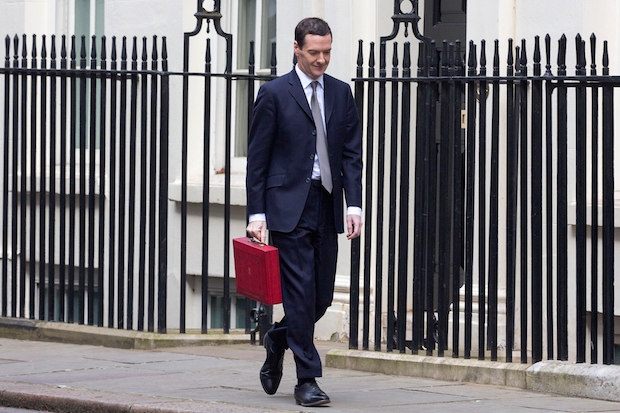
Did George Osborne hide any surprises in yesterday’s Budget? The Institute for Fiscal Studies delivered its post-budget analysis this afternoon and presented a generally positive picture — noting that, as expected, the Budget ‘did not usher in any dramatic changes’ and Osborne ‘resisted the temptation to offer lots of pre-election goodies.’ Here are five things you need to know about the IFS’ report.
- Voters are ‘probably’ better off under this government
‘Are you better off now than you were four years ago?’ was the question Ronald Reagan put to America during his first presidential campaign. Ed Balls said last year he thought the answer would be no. But the IFS’ Paul Johnson (pdf of his remarks) thinks Balls could be wrong:
‘Average household incomes have just about regained their pre-recession levels. They are finally rising and probably will be higher in 2015 than they were in 2010, and possibly higher than their 2009 peak.’
Ed Milband has said households are £1,600 worse off under this government while Osborne has said they’re £900 better off, so who’s right? The IFS says Miliband is talking about gross earnings until April 2014 while the Chancellor is looking at forecasts for net income (what people end up after taxes and benefits) up to the end of this year. So there’s truth—and artifice—in both numbers.
Johnson also noted it has still been ‘by far the slowest recovery in modern history.’
- A change in economic philosophy
Johnson said there was an ‘apparent change’ in economic philosophy from the Autumn Statement — something he described as ‘pretty remarkable’:
‘Instead of allowing public spending to fall as a proportion of national income in that year, as implied in the Autumn Statement, the default position of the government now seems to be to allow spending to grow in line with national income.’
This change has resulted in the projections for the Budget surplus dropping from £23 billion to £7 billion, or a ‘sharp change of tack’ as Johnson put it.
- Plenty of cuts still to come — but where from?
Johnson said it has been two years since the Chancellor announced he would cut welfare spending by £12 billion but there have been no cuts to pensioner benefits and no details of cutting working age benefits. Given this, there are questions as to how plausible are his future predictions are:
‘If he really wants us to believe that then he needs to more explicit about how he actually thinks he can cut welfare spending and raise substantial sums from clamping down on tax avoidance.’
Assuming £12 billion is cut from welfare bill and £5 billion is brought in from clamping down on from tax avoidance, that leaves £18 billion to be cut from departmental spending — £5 billion more than David Cameron suggested the Tories would cut earlier this year.
The IFS noted that Whitehall departments will have to prepare for ‘dramatically differing’ spending scenarios for after 7 May. They don’t know which party will be putting their spending plans into action and though health, schools and foreign aid protected, there are no further details of where the axe will fall.
- No ‘rollercoaster’ of public spending
Even with Osborne’s chopped down surplus target, ‘the actual path of spending cuts over the next parliament seems more uncertain than ever’ said Johnson. He noted that the IFS’ latest estimates suggest ‘Labour would be able to meet its fiscal targets with no cuts at all after 2015-16’. But what about if the Tories remain in power?
‘My guess is that even under a majority Conservative government, annual cuts in public service spending will not turn out much more dramatic than those we have seen over this parliament. We won’t be on the OBR’s rollercoaster.’
- A recovery for the middle classes
How has inequality worsened over the course of this government? Johnson said there has been some drop in inequality:
‘At least across the huge majority of the population inequality has fallen a little if you assume that everyone has faced the same rate of inflation.’
The IFS also noted that people on middle and upper middle incomes have been ‘remarkably insulated on average from the tax and benefit changes.’ Throughout the ‘period of consolidation’, the IFS reckons the richest have been hit hardest, but the changes implemented by the coalition have seen the poorest take ‘the biggest proportional losses.’



Comments