
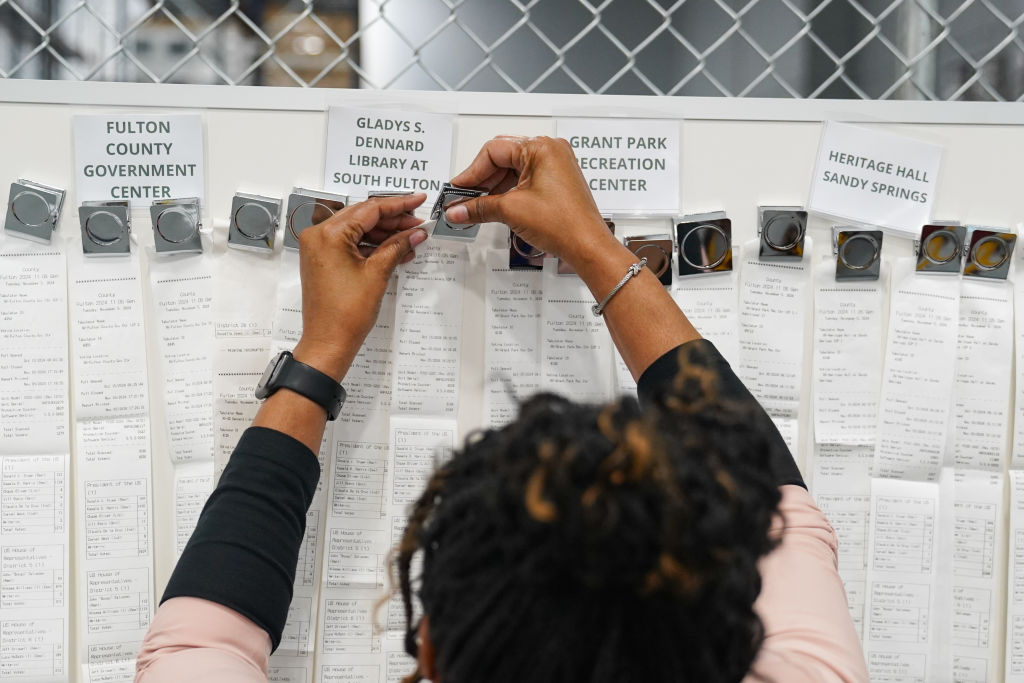
“I suspect that the FBI is going to find things missing.” As a member of the Georgia State Election Board, Salleigh Grubbs is an authority on the alleged 2020 election fraud that led to an FBI raid on an election center in Fulton County.
“It could be ballots, it could be reconciliations, it could be poll tapes, it could be any number of things,” she told The Spectator. “They have been fighting to prevent anyone looking at this evidence and preventing investigations. If you don’t have anything to hide, why do you care?”
Fulton officials finally admitted in December – after being subpoenaed by the State Election Board – they had broken state regulations by failing to sign 2020 election tabulator tapes and that they had misplaced other tabulator tapes. Tabulator tapes are receipts printed from voting machines that verify that the number of voters is the same as the number of votes cast. More than 130 tabulator tapes – covering 315,000 votes – were not signed and ten additional tapes – more than 20,000 votes – were reported missing.
Was this a simple clerical oversight or the first tangible evidence of a conspiracy?
“There’s no way you can say that it was a clean election down here in Georgia in 2020 because you cannot prove it. You have to show the reconciliation. It’s an accounting process. You want to know the number of voters that were eligible to vote, the number of ballots issued and the ballots cast, and what the total number of votes are. It’s a very simple process that they have convoluted and made unverifiable.”
In short, Salleigh, vice chair of the Georgia Republican Party, blames voting machines. “You’re never sure of interference with voting machines. I think hand-marked paper ballots are the way to go.
Georgia’s Republican Secretary of State, Brad Raffensperger, disagrees. In 2020 Trump was recorded in a now notorious call asking Raffensperger to “find 11,780 votes.” Raffensperger said of the latest tabulator tape controversy that the failure to sign them doesn’t negate the ballots. They were counted multiple times, including once by hand. He noted “all voters were verified with photo ID.
The FBi raid also revealed another dimension of the investigation into the 2020 election to the public when Tulsi Gabbard was photographed at the scene. In a letter to Congress afterwards, the Director of National Security disclosed that Trump asked her to go and she suggested that US electronic voting systems are at risk of foreign interference. Trump himself reposted claims that Italian military satellites were used to hack into voting machines to flip votes from him to Biden.
Salleigh says she is unaware of evidence of a foreign interference operation. “But I have a high degree of respect for Tulsi Gabbard and it certainly made me feel better to have her on the ground. I have met her before and she doesn’t strike me as one to be influenced by conspiracy theories.”
When the feds drove away with 700 boxes of election records on January 28 it was the culmination of a longrunning personal battle for Salleigh and for President Trump, who has long maintained the 2020 election was stolen from him and that Fulton County was ground zero.
That fight started for Salleigh on November 20, 2020, when she saw ballot material being shredded at a warehouse and videoed it. Fulton County officials said the papers were absentee ballot envelopes and mailing labels. But Salleigh cites state and federal law: “Anything that is evidence as part of an election should have been preserved. I was just completely disgusted that our elections were being treated so cavalier.”
Especially one with such an unexpectedly flattering result for Joe Biden who became the first Democrat to achieve more than 70 percent of the vote since 1944 – and the first Democrat to carry the state since Bill Clinton in 1992.
Salleigh spoke to Trump personally about the issue when he called her to congratulate her on being elected the chair of the Cobb County Republican party in 2021. “He told me I was a winner, I was a fighter, and he appreciated what I was doing. He asked me if I thought it was a fair election. I said I can only talk about what I saw in Cobb County, which is that there were numerous things that concerned me.”
While Salleigh still has significant concerns over the integrity of the impending Georgia primary elections, in her experience downballot elections are where many problems occur. Such as the case of Michelle Long Spears who in 2022 was vaulted into first place for office in DeKalb County after a series of technical errors made it appear that she had not garnered a single vote. The candidate herself asked for an investigation when she was told no votes had been cast for her even though she had voted for herself. Election officials attributed the mistake to a computer programming error.
“A lot of these local candidates spend all their money on their race, they deserve a fair shot. And that’s why the work of the State Election Board is so extremely important because we get into the granular details of those things.
“I’m concerned about the primary. We have a Secretary of State that has made no moves to secure the voting equipment as far as the software on the voting equipment. There are things in process to try and secure the general election, but it seems to be a very difficult thing to do.”
Salleigh is reluctant to attribute the apparent voting irregularities to ill intent. “I’d say never attribute to malice what can be explained by ignorance. Sometimes there are mistakes. Sometimes there are people that are ill-equipped. Sometimes it’s bad information. Sometimes it can be confusing or conflicting information in the legislation process.
“I think this a cautionary tale for every American citizen to be involved in the process. I don’t care whether you’re a Republican or a Democrat, you need to be involved in the process to ensure it’s fair.”
At the beginning of February, Donald Trump called for Republicans to “nationalize” voting and “take over” the management of elections in 15 states.“We should take over the voting, the voting in at least many – 15 places,” he said.
Salleigh disagrees. She says there has to be local accountability and oversight in compliance with federal law. “I am not for federalizing the elections. It should go back to before Covid. You would have your retired teachers that would go and be poll workers. It was always your people. Then with Covid they bring in all these temporary workers from all these other states. All of that local comradery you have of knowing who your poll workers were was gone.”
Personal safety is an issue all prominent politicians have to take seriously these days. Salleigh says for her it is a “big concern” too. She has received threats and remains vigilant at all times.
“My family are very concerned because there are people who don’t like what I’m doing. But I think God’s given me the ability to just ignore that to a large degree. I’m not trying to disenfranchise anyone’s vote. I view it in a very nonpartisan way. Who I happen to support politically should have nothing to do with my belief and our system as Americans.”


Comments