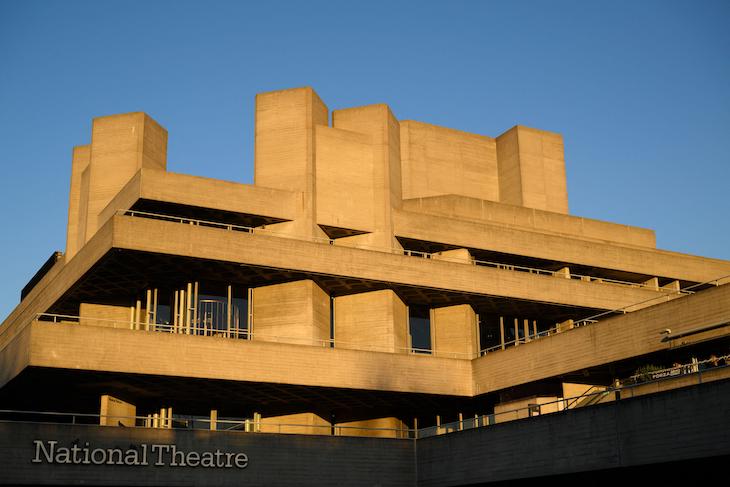
Is a concrete Brutalist complex as worthy of commemoration and preservation as a medieval cathedral or neoclassical stately home? The decision to grant London’s Southbank Centre Grade II listed status last month is an issue on which tweedy conservationists and iconoclastic modernists trade places for the day. Tories reach for the dynamite. Lefties plead that tradition must be protected. But who is right? And why is Brutalism so divisive?
The best Brutalist architects were careful craftsmen
Even those who hate Brutalist buildings must concede that it’s a form of architecture that is arresting and hard to ignore. The Southbank site has long been a cultural flashpoint. Its origins go back to the post-war Festival of Britain, whose 75th anniversary falls in May. Though often given a nostalgic tinge now, the Festival was widely loathed by many conservatives like Evelyn Waugh, who sneered at its “monstrous constructions”.
Brutalism is seen as more than just a style of building, but rather as the embodiment of an anti-human philosophy of social engineering, utilitarianism and urban planning, one dominated by socialist theories and a hatred of beauty. James Innes-Smith, writing in The Spectator, identifies Brutalism with a postmodern hatred of beauty and “the sublime”.
This impression has gained some force from the context in which Brutalism emerged in Britain. All too often, it is linked to poorly maintained social housing, and the desecration of British city centres by post-war planners, which saw motorways ploughed through traditional towns, and bombed out cities doubly damaged.
Birmingham’s post-war planner, the British-Italian civil engineer Herbet Manzoni, encapsulates this kind of philosophy at its most psychopathic: “I have never been very certain as to the value of tangible links with the past,” he said.

Yet this confusion of brutalism with brutal ideas is based on a misapprehension. Take Manzoni and Birmingham. He was a technocrat, not a socialist firebrand, and his devastation of the city’s Victorian past was signed off by a Tory council. Those looking for a culprit might also point to the automobile industry, which had good reason to want to turn Birmingham into a “Motor City”.
We remember the most unpleasant and ideological of the British Brutalists, from the self-indulgent Alison and Peter Smithson, to the famously nasty Ernő Goldfinger, who gave his name to a Bond villain. But we too often forget the ebullient Denys Lasdun, or the romanticism of Sir Basil Spence, who rebuilt Coventry Cathedral after the war, and was a student of Edward Lutyens.
The best Brutalist architects were careful craftsmen who were attentive to the needs and tastes of the individual, not cold auteurs imposing their vision on an unwilling public. Lasdun would sit down for lunch with the working class families whose new homes he was designing. When planning the National Theatre, he worked tirelessly alongside Laurence Olivier, who described the theatre, now an iconic part of the Southbank, as “the finest-looking theatre, the finest-working theatre in the world.” Conservationist and champion of Victorian architecture John Betjeman “gasped with delight” upon first seeing the National Theatre. Lasdun himself described planning a theatre as a “spiritual” endeavour.
Brutalism bears more than a slight resemblance to earlier reforming architectural projects, like the Victorian embrace of the Gothic Revival and the later Arts and Crafts movement. It sees the design of buildings as serving a moral, rather than just utilitarian or consumeristic purpose.
What makes Brutalism disturbing is what makes it sublime. It is an architecture that, in its seriousness, scale and simplicity, provokes awe – whether that means wonder, horror or both. Awe, as anyone who has ever sat in a great cathedral knows, can be the handmaid of comfort and consolation. Like the interior of a great nave, the Southbank is a radically public space. Its exterior, described as a “fourth theatre” by Lasdun, is somewhere that feels public as few other parts of London do. You can sit and wander at ease for hours around the Southbank and never feel unwelcome, hurried or pushed to move on. The interweaving bridges, stairs and platforms create a sense of simultaneous openness and interiority; it’s a space sometimes dubbed “the nation’s sitting room”.
What makes Brutalism disturbing is what makes it sublime
Its “aweful” qualities may make Brutalism divisive, but it also ensures that Brutalist buildings are meaningful, and public-spirited. It is a form that shocks and awakens, provoking discussion, debate and a sense of common ownership. Sadly, the buildings we now construct have quite the opposite message. These range from the bland “nothing” architecture of the international style, all privatised plate glass, boxes and grids, to the nihilistic arbitrariness of postmodern architecture.
Brutalism was, at least, an architecture for grown-ups; one that reflected an ambitious, inventive culture that posed serious questions of itself. Our current built environment is aimed at infantilised consumers, rather than a shared civilisational grammar. Where once we pursued justice and the divine through what we built, we now look only for comfort and convenience. Love or hate Brutalism, at least it makes us actually feel something.




Comments