
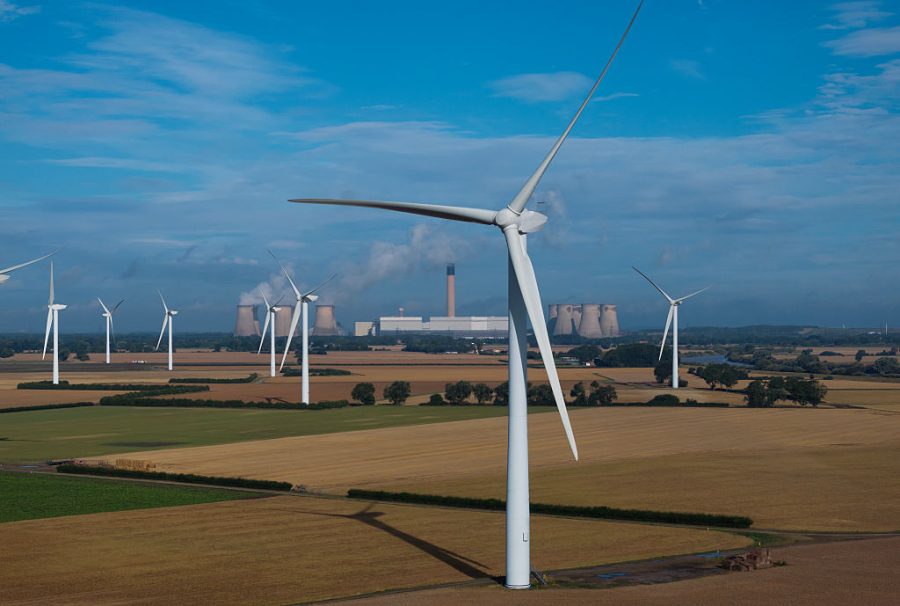
The 11,000 wind turbines in the UK are not only an eyesore, they are also a killer. Their blades can spin deceptively fast at up to 186 miles per hour. Even if most are bridled at 56 miles per hour for structural reasons, they still manage to kill creatures which fly into their paths. Birds of prey and swifts are particularly vulnerable, as are songbirds, many of which are on ornithological ‘red lists’. The scale of the slaughter of bats is monumental: 200,000 annually in Germany, 500,000 in the USA and 30,000 in the UK, according to a French study into the impact of wind turbines on bats by the Museum national d’histoire naturelle, recently reported in Le Monde. Millions of bats are killed annually by wind turbines, according to the UN Environment programme.
Labour’s aim to increase dramatically turbine numbers in the North Sea over the coming years spells danger for seabirds, not to mention the threat to bats from the growing number of onshore windfarms. Though the planned Berwick Bank mega windfarm project will be off the East Lothian coast, it is next to what the RSPB calls ‘some of the most important places on Earth for seabirds’. Its proposed 307 turbines will cover an area four times the size of Edinburgh. The RSPB believes it will be devastating for Scotland’s already dwindling seabird population causing the deaths of ‘tens of thousands of seabirds’.
The government’s doctrinaire net zero ideology and zeal for wind turbines increasingly defy logic
In the United States, Donald Trump’s executive order in January paused all wind energy projects, with the president voicing concern for wind turbine bird strikes. He even warned Keir Starmer in December last year that he should develop North Sea oil and gas instead of taxing it and ‘stop with the costly and unsightly windmills’. But in the UK, Energy Secretary Ed Miliband is fervently committed to wind power. The climate change committee calculated last year that the number of offshore wind turbines installed annually needed to be tripled and onshore turbines doubled by 2030. Little thought has been given to the impact on bird and bat populations. The best the Department for Environment, Food and Rural Affairs has come up with is to launch a four-year trial into discovering how painting the turbines black might reduce bird kills.
The government’s doctrinaire net zero ideology and zeal for wind turbines increasingly defy logic. The UK reportedly has the highest industrial electricity prices in the OECD. As a consequence, Britain is deindustrialising and losing jobs. Ever-rising taxpayer subsidies to pay for renewables have little impact in reducing energy prices.
Leaving aside the aesthetics, wind turbines are environmentally harmful for their largely imported carbon-intensive components and construction. Wind-generated power is intermittent, unreliable, wasteful and increasingly difficult to manage by grid operators, while also being prone to provoking power outages. Now there is incontrovertible evidence that wind turbines have a calamitous impact on biodiversity and the local environment, which, as a renewable energy source, they are purportedly there to protect in the first place. In his inimitable way, Donald Trump encapsulated the problem. ‘We don’t want windmills in this country,’ he told Fox News. ‘The wind blows and then it doesn’t blow, the things cost a fortune, they are made in China, they kill the birds, they’re horrible.’
The Labour government continues to reduce North Sea oil and gas production to meet net zero targets, thereby forcing up power prices, but dogmatically dismisses all economic criticism of wind power. Last week marked 25 years since the UK’s first offshore wind farm off the coast of Northumberland began to generate power. Reflecting on the milestone, without a trace of irony, the energy minister Michael Shanks celebrated: ‘Off-shore wind is at the heart of our 2030 mission – helping us to reduce our dependence on volatile fossil fuel markets, lower bills for good and support 100,000 jobs by 2030.’ The reality is that wind turbine mania is costing the British people, our economy and our wildlife a fortune.



Comments