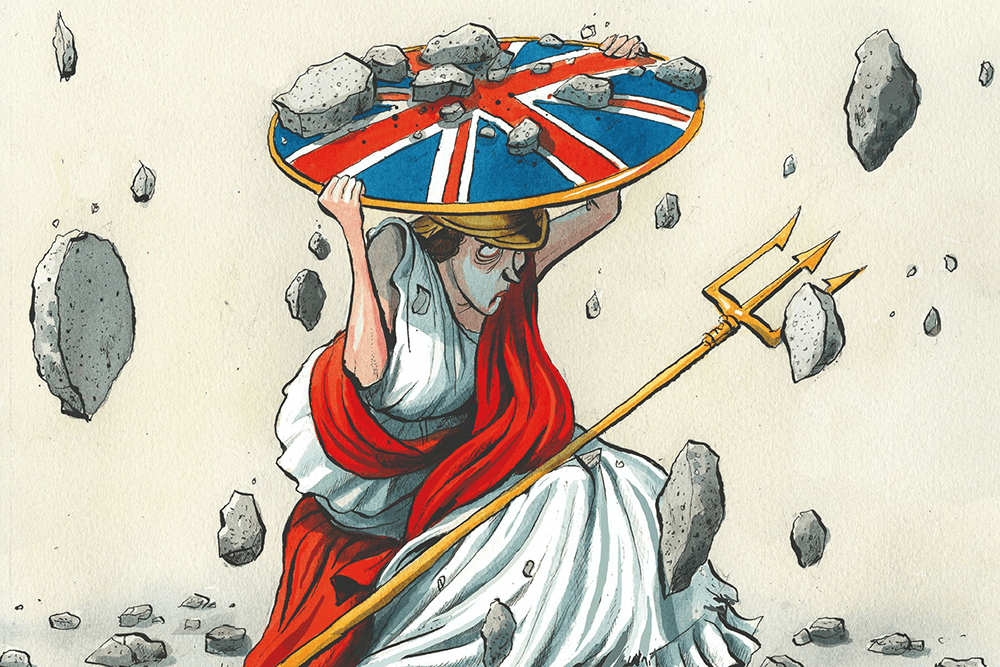


There were many reasons why John Ruskin hated Rococo. The overly decorated style was a bête noire for the great architectural critic because he thought it the supreme example of excess and by its excess it concealed its true meaning. We are in an era of British life which I can only think of as ‘late Rococo incompetence’. The excess of bad news, government ineptitude and baffling decisions made by the state is now so great that we are struck dumb, incapable of meaningful reaction.
The news cycle abounds with evidence of this tidal wave of depressing or destructive acts. The sheer number of hideous stories has desensitised us. In the past, rapes, foiled terror plots, government corruption scandals or days featuring unprecedented levels of illegal immigration would dominate news bulletins, front pages and social media. Now they’re just accepted as part of the wider tap-estry of horror.
The sheer number of hideous stories has desensitised us
These stories often come in insane twos and threes. Earlier this week, for example, in just 48 hours, we learnt that Abu Hamza’s wife was getting a £70,000 property makeover courtesy of British taxpayers, that we granted citizenship and asylum to a bona fide Hamas operative (who promptly showed his gratitude by plotting terror attacks on British soil) and that Shabana Mahmood, for all her tough talk, won’t actually do anything about migration other than increasing routes from countries whose citizens are more likely to commit harm to British people. These barely made a splash. By the time you read this, the news cycle may already have moved on. Indeed, such was my shock about Hamza’s wife, I temporarily forgot that Britain also provided council housing for the First Lady of Sierra Leone.
Last October, a man named Wayne Broadhurst was stabbed to death by an Afghan migrant in a quiet street in Uxbridge while walking his dog. It was precisely the sort of random, senseless killing of an innocent member of the public that would once have prompted weeks of discussion and national soul-searching. It emerged that the migrant had lied about his age, but had – inevitably – been given asylum and free accommodation. Yet the murder wasn’t prominently featured in many newspapers; nor was it mentioned in the Commons that week. To date, Broadhurst has only been mentioned once in parliament, by shadow home secretary Chris Philp commenting on the government’s silence.

Part of the problem is the media itself. The BBC often covers these stories only very belatedly, or as a minor local item. This matters because the BBC website is by a wide margin the country’s most-read online news source so its sluggishness has an outsize impact on awareness. However, there is also a sense of profound weariness among the public when confronted with obvious indicators of national decline. If they’ve heard of these things at all, many perceive reacting to them as either ‘low status’ or not worth the effort. Perhaps this is simply the consequence of being so ground down. It’s easy to see why. When they are so numerous, treating each act of malice or incompetence with the fury it deserves wouldn’t result in anything changing; it would just result in an aneurysm.
This applies to the wider incompetence of the Establishment too. We are desensitised to the nature of our national situation and the appalling triviality of our government. Scandals – in the civil service, the legal system, the Church, the universities, the NHS and the government – are now so abundant that they get memory-holed after a day of coverage when once their very uncovering would have consumed weeks of news.
This week’s Labour conference has been a veritable tsunami of bad ideas, from the mooted destruction of educational standards to ball-dropping on visas, migration and Heathrow. The government has just handed councils the power to seize homes deemed ‘vacant’ after just six months. ‘I’ll say it again,’ crowed multiple-property owner Emily Thornberry in the manner of a corrupt Soviet commissar. ‘If you leave a home empty long-term in the middle of a housing crisis, it should be seized.’
It bears repeating: we are led by people who believe they should be able to expropriate your property and rent it out if they feel you are not putting it to good enough use. This is full-Commie stuff, and doubly terrifying – for if they believe this, then what other gross tyrannies may be awaiting us? But once again, the ‘safety in numbers’ approach to madness seems to be paying off.
Each of these demonstrations of folly merits a dissection, but such is the deluge that barely any will receive the criticism required. This is partly due to that febrile news cycle. However, many of them will get a free pass because of the Rococo nature of this incompetence and the fatigue it inspires. Since the last general election, we’ve gone from managing decline to speed-running it and nobody can quite keep up.
The deluge is sometimes absurd. This week the Defra minister Jenny Riddell-Carpenter claimed at a fringe group meeting that the countryside was going to be weaponised by ‘the far-right’. Country pubs, black labradors and warm ale are apparently part of a fascist conspiracy – and a vision of England that never existed. Bold talk from the MP for Suffolk Coastal. What is the appropriate response to this? ‘Am I having a stroke?’ comes to mind as the most obvious one. But that’s the point: the deluge of the inane, the mad and the wicked continues, demoralising and radicalising as it does so. They are dismantling the England you grew up in and then telling you it never existed.
One might question whether this is a deliberate tactic to overwhelm us with incompetence and malfeasance. The Rococo was designed to act as such, providing so many possible places to look that getting any sense of the wider vision became impossible. Ruskin rejected this because he thought it deceitful. We ought to reject the current deluge and the diversionary tactics for exactly the same reason.






Comments