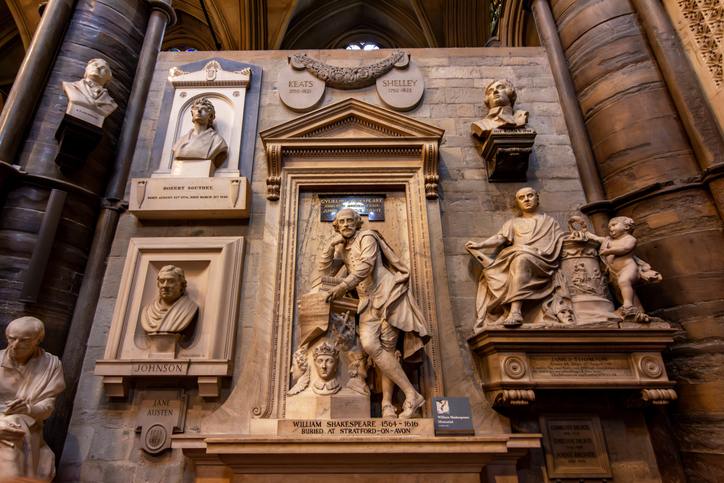
If there is such a thing as a home for Britain’s national story, it might be found in Westminster Abbey. Enter, and you are immediately inducted into the long history of these islands. Monarchs, statesmen, scientists, generals, poets: here, under one roof, are memorialised the people whose works have formed the mind and body of England and in whose language England learnt to dream.
These days, however, we dream less. The problem is not that our contemporary culture is incapable of producing figures of significance. It is that we can no longer recognise it when we do. As a result, the gates of the Abbey have been closed to the dead.
The gates of the Abbey have been closed to the dead
Last month, J. H. Prynne, described variously as ‘without doubt the most formidable and accomplished poet in England’ and the most erudite poet ‘since Milton’, died. The other – and arguably stronger – contender for that crown, Geoffrey Hill, died a decade ago. But there are no plans to memorialise Hill in Poets’ Corner, and nor does it seem likely that Prynne will be inducted either. Indeed, the last poet to be buried in Westminster Abbey was Thomas Hardy in 1928, while the last to have a memorial plaque was Larkin (a decade ago, some thirty years after his death). The age of the poets, it seems, is over.
The same phenomenon can be seen with politicians – or, as we called some of them in a less punitive age, statesmen. The last to be buried in the Abbey was Clement Attlee (1967), the last to be given a statue was Gladstone (1903) and the last to have a memorial stone laid for them was Jim Callaghan over a decade ago.

It is now almost 15 years since our first female prime minister died. Whatever one thinks of her politics, it’s hard to argue that turning the country from the sick man of Europe into the continent’s strongest economy, transforming the nation’s psyche, and winning a war halfway across the world to defend a British Overseas Territory doesn’t make you an historically significant leader. Yet Thatcher seemingly warrants no mention in our nation’s hall of memory. If Thatcher doesn’t meet the Dean’s criteria, it is hard to imagine any of her successors doing so.
What do Thatcher, Prynne and Hill have in common? In a word: ‘difficulty’. Prynne and Hill are both notoriously ‘difficult’ poets. Thatcher, we are endlessly reminded, was a ‘divisive’ figure. Both views fundamentally miss the point. Consensus is not the aim of politics or the arts. Both are subjective fields. Consensus collects – at least before time has done its work – around that which is easy. Easy work does not solve structural problems, nor does it revivify or deepen a language. Indeed, to extend an argument Hill made about his own writing, difficult work in both politics and the arts is ‘truly democratic’ since it resists treating the public as fools and avoids slipping into the tyrannical simplicity of propaganda.
Perhaps the Deans of Westminster would argue that memorialising ‘difficult’ figures is just a matter of time. And perhaps it is – though it is worth noting that it wasn’t always like this. Auden’s memorial stone was unveiled a year after his death. Churchill’s took a matter of months, while Attlee was buried, unsurprisingly, weeks after his death.
Once, we knew that significance depended not on universal popularity but on achievement, on influence, on action. Today, we fret about whether figures are ‘divisive’ or ‘elitist’. Where earlier generations were able to move quickly to memorialise, we now defer, waiting for a consensus that never comes.
Westminster Abbey’s function as our national Valhalla is not merely to suggest that time past is indeed time present – but also that the present time might one day be worthy of memorialising. It is designed to be a place of aspiration, as well as recollection. But we seem to have lost confidence in ourselves.
What happened? Well for one thing, Britain’s role in the world has diminished dramatically since the Second World War, and we have faced fewer (if any) truly existential crises. The fields of action have been smaller, and so the figures who emerged from them seem smaller too.
But our current predicament speaks to something greater: a near-total loss of faith in politics and the arts to create and represent a shared national life at all. The great writers aren’t read, and politicians are only ever pilloried. We no longer believe that our history is a living thing or that our national story can continue to be forged by us, today.
Instead, the Left and Right are bound in a cultural pessimism that competes to pinpoint the year the clock should be turned back to, before everything went wrong. Was it 2016, before Brexit and the ensuing psychodramas? Was it 1997 and Blair’s constitutional and immigration revolutions? Or 1979 and Thatcher’s rewiring of the state? Or even 1945, and the global legal order that slowly emerged from it? Meanwhile, the arts compete to envision the precise form our dystopia will take, from robotic enslavement to life in a burning world.
All we are left with is a faith in disaster and a belief in our own decline, but we articulate these creeds in ever fewer shared, human spaces. Indeed, as we slide into an increasingly sectarian, increasingly illiterate and increasingly online life, spread across dozens of platforms, where does a truly national politics or art form take place? Is such a thing even possible? It is little wonder that when we enter Westminster Abbey today, we look at the statues from bygone days and feel a sense of estrangement – not from the past, but from the future.



Comments