
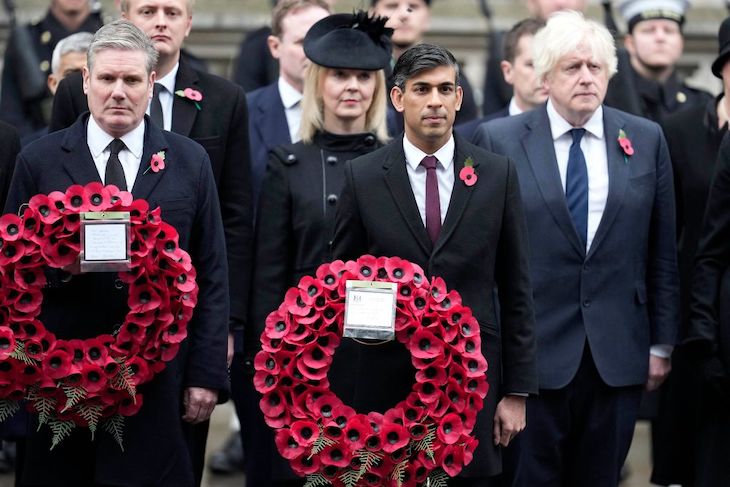
I wrote not all that long ago about this disconcerting situation we’re in where the only news story the Prime Minister seems capable of generating is a news story about the likelihood of his losing his job. Let’s just say, things haven’t exactly changed.
As ever, Starmer said all the standard things about how everyone saying he was useless doesn’t bother him
In the first week of January, his nibs thrilled the world by giving an exclusive interview to the BBC’s Laura Kuenssberg (and no doubt he’d think of this as a decisive move to draw a line under frivolous speculation in the Westminster Bubble): “‘I’ll be PM this time next year,’ Starmer tells BBC.” Yesterday he thrilled the world by giving an exclusive interview to the Sunday Times: “Keir Starmer: ‘I can win the next election.’” Another decisive line drawn. The grown-ups are back in charge, and they’re drawing lines. He’s drawn so many lines under frivolous speculation, at this point, that the area under the Westminster bubble must now look like a particularly intense area of Edward Gorey cross-hatching.
To his inward fury and grief, I expect, the rest of the world in January replied, “No you jolly well won’t!”, and the rest of the world yesterday replied, “No you jolly well can’t!” The case he pressed yesterday was that, actually, the “vast majority” of the Labour Party secretly supports him (thinks he’s showing the courage to make the difficult decisions, doing the right thing for hardworking families in this nation he’s so proud to call his own, getting on with the job, blah blah) but you “never hear from” them. Why these admirers are reluctant to speak to the newspapers on or even off the record, or pipe up in Parliament, is just one of those mysteries.
And, as ever, he said all the standard things about how everyone saying he was useless doesn’t bother him. “You can’t be in politics, you can’t be the Prime Minister, if you let these things get to you,” he said. It’s a tough old game, politics. You learn to rise above it. And you show how you’re rising above it, apparently, by giving interviews to newspapers saying how effortlessly you’re rising above it. It’s worth noticing, incidentally, that Kemi Badenoch — who is up much the same creek with much the same shortage of nautical equipment — makes exactly the same noises. “I was telling someone only the other day how much I’m enjoying the job,” she said last week; “People who can’t deal with difficult times are not fit for government.”
Why do we go through this ludicrous pantomime? Why must senior politicians spend so much of their time insisting a) that they are not about to get the sack and b) that contrary to all we know about human nature in general and the egos of politicians in particular they positively relish everyone saying that they are useless and about to get the sack. They know they’re fibbing, and we know they’re fibbing, and they know we know they’re fibbing, and we know they know we know they’re fibbing — yet on it goes, like one of those rituals where they carry a duck backwards round the quad of an Oxford college once a year just because that’s what they’ve always done.
In fairness to these hapless politicians, there probably is something in the idea that the job security of Prime Ministers is a media obsession, and a self-fulfilling one at that. We like big stories, and we like human stories, and speculating on whether the PM’s about to lose his job is easy and fun compared to, for instance, trying to make sense – still less front-page box-office – of boring material about infrastructure and gilt yields. And, pleasingly from our point of view and disastrously from the point of view of our victims, enough talk about senior politicians being about to lose their job has a funny way of bringing just that eventuality about.
Never mind that the boring material about infrastructure and gilt yields is, in the end, the important stuff — and that the personality-led drama is an impediment to delivering it. Never mind that as Sam Freedman has argued forcefully in his recent book Failed State: Why Nothing Works and How We Fix It, the problems we have are institutional: “People matter, but systems matter more.” My former colleague Fraser Nelson has made what seems to me a gloomily persuasive argument that it doesn’t follow from even a nailed-on case for ditching Starmer (on grounds of incompetence, weakness, dishonesty, annoyingness, ideological vacuity — take your pick) that what follows will be an improvement. We’ve been churning through Prime Ministers over the last few years, with the same apparent arbitrariness as the apocryphal newspaper proprietor (usually Lord Northcliffe) who complained that he’d had no luck with two fat editors on the jog so was going to try appointing a thin one. We’ve tried having a rogue as Prime Minister — now how about a maniac? Now let’s try a wetty. Hm. A dullard next? And so on.
Look, I do not come here to try to defend the PM. Even – perhaps especially – those of us inclined to give him a chance in the first place stand agog at quite what a disappointment he has been, quite how little he seems to stand for even the dismal competence he offered as a selling point at the last election. History’s dustbin yawns hungrily. But if we keep feeding that dustbin with quite such frequency, it won’t just be a succession of Prime Ministers it ends up swallowing.





Comments