
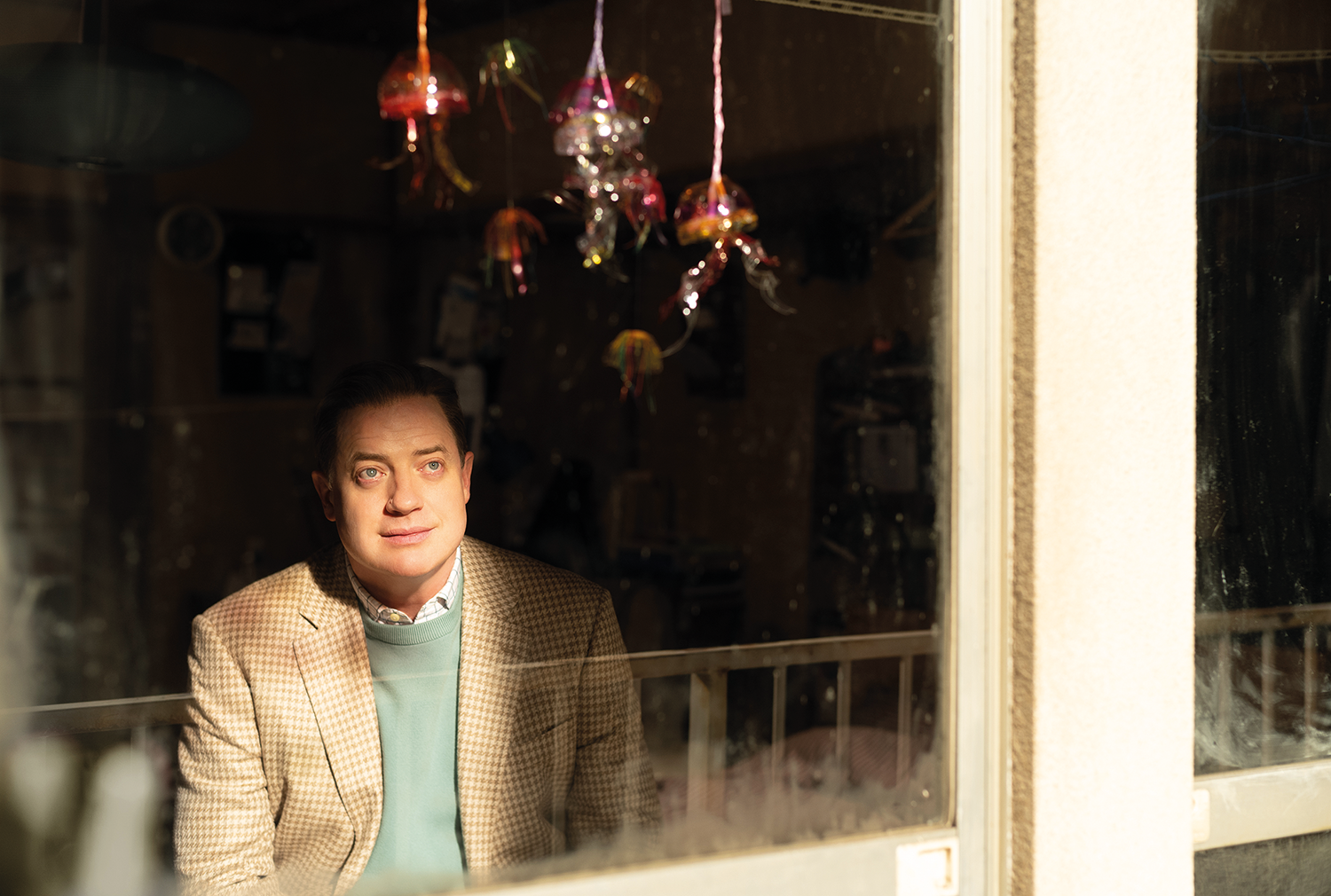
Rental Family stars Brendan Fraser as an out-of-work American actor living in Tokyo. He accepts employment with an agency that gets performers to play roles in real people’s lives. You may need a friend, for example, or a mourner should you fear your funeral will be sparse. (Tell me about it.) Fraser won an Oscar for a dark performance in The Whale but in this he’s back as a lovable, good-hearted everyman. (Is there anyone who does that better, aside from Tom Hanks?)
Fraser plays Phillip, who arrived in Tokyo seven years before to star in a toothpaste commercial and has never left. Presumably, there is nothing, and no one, calling him home. He lives alone in a tiny, dimly lit apartment. His displacement and isolation are firmly established visually. He is a big fella – too big for his apartment, too big for everything in Japan. He stands out in every group shot. He longs to belong and spends his evenings gazing enviously at the happy families in the building opposite who don’t seem to have heard of curtains. Or blinds. (And we think that the Japanese are way ahead of us in everything.)
He’s out of options when he accepts the job with the agency and is first deployed to play the ‘sad American’ at a fake funeral so the client can ascertain how he will be mourned. (Such a good idea.) He doesn’t know the funeral is fake initially, and neither do we, so when the ‘corpse’ suddenly sits up it is brilliantly funny. Minor assignments lead to two major ones. In one scenario Phillip pretends to be a journalist keen to interview a once-famous actor who fears irrelevance and is losing his memory. In another a mother asks him to play her little girl’s long absent father. This is so she might get her daughter (Shannon Mahina Gorman, cute as a button) into a top school that discriminates against single parents. She wants her daughter to believe that Phillip is her real father, too, which is heinous. We know it. He knows it. But his boss is convincing. We’re helping, not hurting, he keeps saying. These are the most meaningful parts that you will ever play, he says. Of course, Phillip ends up not being able to stop himself from becoming emotionally attached.
The film wants to hug you, rather than unsettle
This is rich terrain psychologically, yet there are questions the film is unwilling to go near. Where is that absent father? Why is the mother OK with deceiving her daughter? How are schools allowed to discriminate in such a way? It is rich terrain morally, too. Is living a lie better than the alternative? But it doesn’t go much near that either. Just when you think it’s about to, everything dissolves into sentimentality. The film wants to hug you, rather than unsettle.
But there are pluses. It is wonderfully filmed by director Hikari, infusing Tokyo with the most astonishing beauty, and there is a clever twist towards the end involving the boss that I absolutely didn’t see coming. As for Fraser’s performance, it is immensely touching. He seems to have learned some Japanese for the role, God bless him, and his sad, puppy-dog eyes establish his lonely, vulnerable character right from the off.
That said, can we now please draw a line under all these films with a ‘human connection is everything’ message? Might we not hear it for the nodding acquaintance one day? I love a nodding acquaintance who asks for nothing. This, I now realise, is why my funeral might be sparse.






Comments